







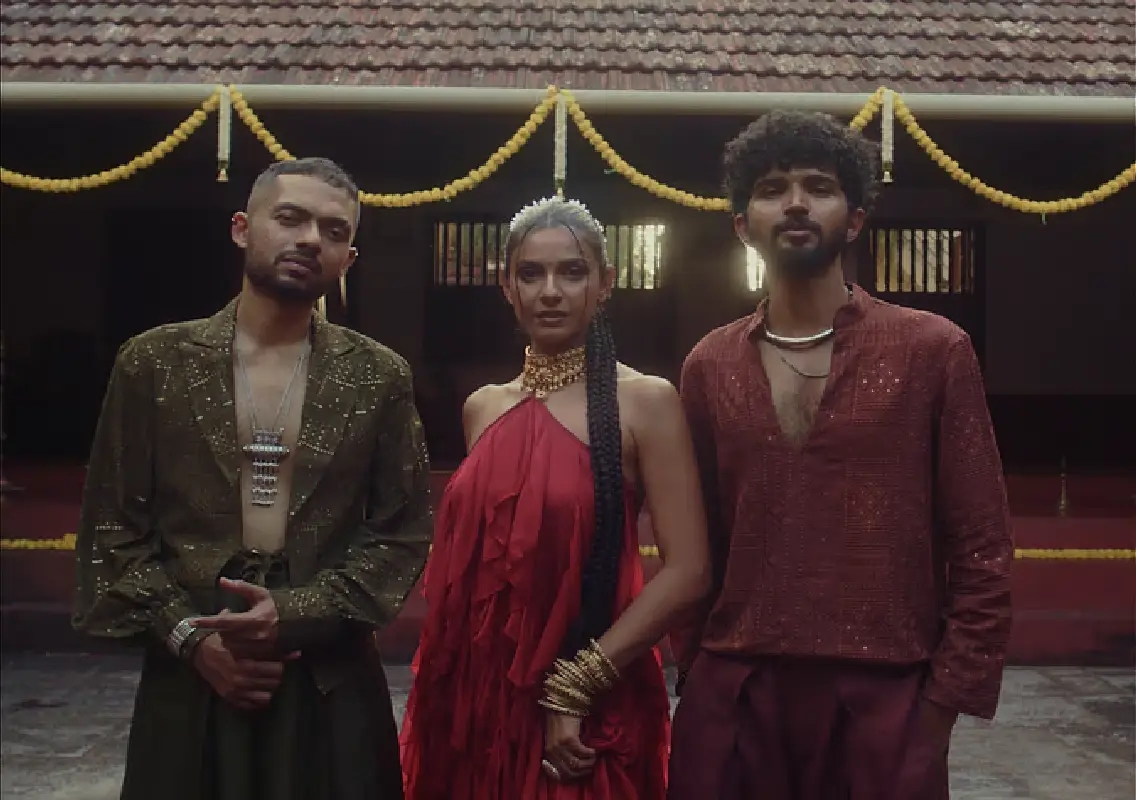


Mangaluru: Electric guitars, basuri and an open floor illuminated in pink, blue and other techno hues set the stage for Curry, a Mumbai-based multilingual pop trio with roots in Mangaluru, as they performed a vibrant mashup of AR Rahman’s ‘Rukmini Rukmini’ and ‘Chinnamma Chilakamma’.
A reel from the live performance soon gained traction on social media, with more than 70,000 people liking the video within just over two weeks. The performance is the latest in a series of viral moments for the trio, which has steadily built a name by combining regional musical influences with contemporary pop and energetic live performances.
Curry comprises Mangaluru friends Ashish Palanna, who performs under the name Sheesh, Ria D’Souza, known as Ryo, and Sumanth Shetty, aka Kanasue. The three have known one another since their school days in Mangaluru, although their musical journeys took different paths before eventually converging in Mumbai.
From school friends to a Mumbai music trio
D’Souza and Palanna were involved in singing and music competitions from their school years and also grew up performing at church. Shetty, meanwhile, initially had little connection with music.
“I had nothing to do with any music. No musical foundation at all,” Shetty recalled.
His relationship with music changed when he picked up the guitar in Class 11. What began as an interest in playing the instrument gradually developed into composition and music production. His musical tastes also expanded beyond the heavy metal he had previously been listening to.
Shetty moved to Mumbai in 2016 to pursue opportunities in music production. Over the following decade, he worked on several television projects, including The Voice of India. D’Souza and Palanna moved to Mumbai around a year later and began performing at weddings, parties and small concerts.
At that stage, however, there was no concrete plan to form a band.
The trio’s musical identity eventually developed from their different backgrounds. None of them had formal classical music training, but Carnatic music had always been part of their surroundings. Those traditional sounds from Karnataka eventually became an important element of Curry’s music.
How Curry found its sound
Around 2020, D’Souza and Palanna visited Shetty in Mumbai, curious to see what the three old friends could create together.
What began as informal jamming developed into professional work, including music for advertisements and other projects. Their chemistry quickly became apparent.
“We realised we have good chemistry, the three of us,” D’Souza said.
The name Curry also emerged from their interest in Indian classical music. While looking online for Indian names and Carnatic ragas, Shetty came across the raga Kari. The word sounded sufficiently close to Curry, while also offering an immediately recognisable Indian association.
Although Curry was gradually taking shape, the members were still trying to make a living from music.
For D’Souza and Palanna, wedding performances, hotel brunches, dinners and private events provided much of their income. These gigs helped them meet everyday expenses while allowing them to remain in the music industry.
Shetty’s experience was different. Despite having an engineering degree, he was earning comparatively little from music production during the early years.
“You’re literally seeing your friends earn lakhs and you’re earning fifteen thousand rupees a month. And I have an engineering degree. None of this makes any sense. Why am I doing this?” he said.
Yet the trio continued. Their objective was not simply to survive through live performances but eventually to create and release original music.
“We always wanted to make original music,” Shetty said.
Weddings helped fund original music
Wedding performances became an unexpected but crucial part of Curry’s journey.
Producing original songs and music videos required money for musicians, crews, equipment and production. The income from weddings helped finance those creative ambitions.
The trio also found that weddings offered something beyond financial support. They provided an intimate setting in which Curry could connect directly with audiences.
“It’s extremely heartwarming. To see people come together and actually dance to your music. It feels really good,” Shetty said.
The band members often spent several days with families during wedding events, interacting with hosts and getting to know the people attending. This gradually helped Curry develop a reputation within the wedding and private-event circuit.
D’Souza said the band’s popularity among couples has changed the way it is booked. Earlier, event planners would typically offer families a selection of bands, with Curry not necessarily making the list.
“Now people call up an event planner and tell them, ‘We want Curry,’” she said.
Vijay Deverakonda, Rashmika Mandanna performance
One of Curry’s biggest wedding assignments came earlier this year when the trio performed at the sangeet of actors Vijay Deverakonda and Rashmika Mandanna in Udaipur.
Deverakonda had discovered the band through Instagram and wanted Curry to be part of the wedding celebrations.
According to Shetty, the actor told the band that he had been listening to their music on Instagram and wanted to accommodate them at one of the wedding events.
A photograph taken with the couple after the performance was subsequently shared by Curry on its official social media account. The post travelled widely, bringing the Mangaluru-origin band to the attention of an even larger audience.
The experience highlighted the growing importance of social media in Curry’s journey. The trio produces much of its own visual content and has learned through repeated experimentation how framing, styling, clothing and presentation can influence audience engagement.
‘Suprabhata’ celebrates Mangaluru roots
Curry’s ambitions extend beyond performing covers and playing private events. The trio released its debut EP, Suprabhata, in September.
The four-track EP draws heavily from Mangaluru, nostalgia and regional identity while presenting those influences through a contemporary pop sound.
The approach reflects what Curry has been attempting since its formation — taking elements of traditional and regional music and presenting them through modern arrangements and high-energy performances.
Its first single, ‘Marigold’, was released in 2024. By then, the members had spent years experimenting with their musical identity, bringing together influences ranging from church music and Carnatic traditions to heavy metal, pop and other contemporary genres.
The result is a sound that allows the trio to remain connected to its Karnataka roots while operating within Mumbai’s diverse music ecosystem.
Looking beyond weddings and viral reels
Curry’s growing social media presence has helped the trio reach audiences well beyond the wedding circuit. Its performances have become a discovery point for listeners interested in multilingual and regional pop.
The members also have ambitious goals for their original music.
D’Souza hopes Curry’s songs will eventually find their way into major films because filmmakers genuinely connect with the music rather than approaching the band with a predetermined brief.
Palanna has an even bigger dream — a stadium concert attended by 50,000 to one lakh people solely to watch Curry perform.
“A concert, just us. People know Curry, and they’re coming for Curry. It’s not part of a festival. Everyone knows our songs. That’d be amazing,” he said.
For a trio that began as three school friends from Mangaluru, Curry has already travelled a considerable distance. From church performances and heavy-metal guitar sessions to Mumbai weddings, celebrity celebrations, viral reels and an original EP, the band’s journey reflects a growing appetite for music that combines regional identity with modern pop.
As Curry continues to release original music while performing across India, its biggest challenge — and opportunity — will be to turn viral moments and wedding popularity into a lasting audience for its own sound.