







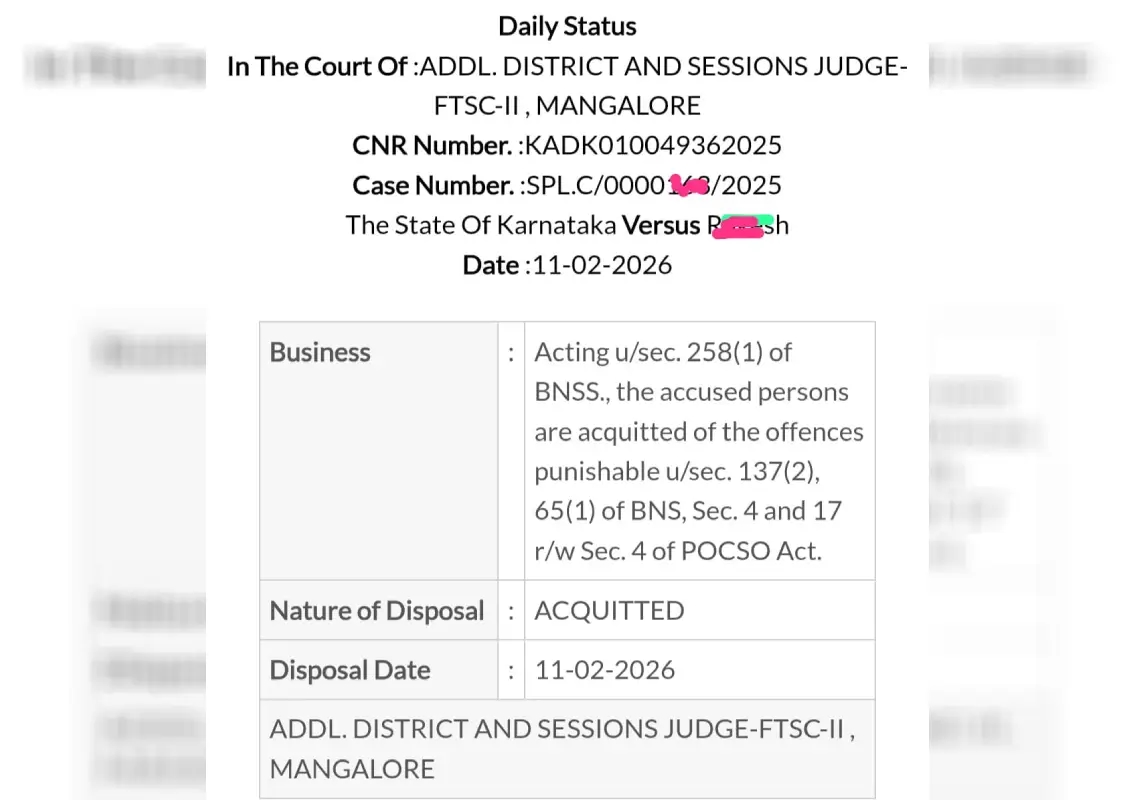


Mangaluru: The Second Additional District and Special Court under the Protection of Children from Sexual Offences (POCSO) Act in Mangaluru has acquitted two accused persons in a case involving alleged sexual assault of a minor girl, holding that the prosecution failed to establish the charges with sufficient supporting evidence.
The verdict was delivered by POCSO Special Court Judge K.S. Manu after completion of trial and examination of witnesses and documentary records placed before the court.
The case had been registered by Mulki police in 2025 following a complaint by the minor girl and her parents.
Allegations and police case
Mangaluru police records show that the complaint related to an incident that allegedly took place in April 2025 near the Bappanadu temple area in Mulki.
According to the prosecution version placed before the court, the first accused allegedly took the minor girl on a motorcycle to a private hostel in Mulki, where a sexual offence was said to have occurred. It was further alleged that a hostel staff member had cooperated by providing access to the premises.
Based on the complaint filed by the girl’s parents, Mulki police registered a case on July 23, 2025, under relevant provisions of the POCSO Act and other applicable sections of criminal law. Both accused were later arrested during the course of investigation.
During the investigation stage, the survivor was subjected to a medical examination. The findings were recorded and included in the charge sheet submitted to the special court.
After completing the probe, investigating officers filed a final report (charge sheet) before the Second Additional District and POCSO Special Court in Mangaluru.
Trial and witness examination
Mangaluru POCSO court took up the case for trial and conducted proceedings on a priority basis, as mandated under special law dealing with offences against children.
During the trial:
- Nine witnesses were examined on behalf of the prosecution
- 28 documents were marked as exhibits
- Statements of the minor girl and her parents were recorded before the court
The prosecution argued that the oral testimonies and documentary material supported the charges framed against the two accused.
The defence, however, contested the prosecution’s claims and questioned the consistency and corroboration of the evidence presented.
Court finds evidence insufficient
Mangaluru Special Court, after evaluating the oral and documentary evidence, held that the prosecution did not meet the required standard of proof necessary for conviction in a criminal case.
In the judgment, the court observed that there was lack of adequate corroborative evidence to firmly establish the charges against the accused beyond reasonable doubt.
Based on this assessment, Judge K.S. Manu ordered the acquittal of both accused persons.
Legal experts note that in criminal trials, particularly under special statutes such as POCSO, courts require reliable and consistent supporting evidence in addition to testimony, and the benefit of doubt goes to the accused if proof falls short of the legal threshold.
Defence represented by advocates
The accused were represented by defence counsel Sharath Shetty of Moodbidri and Advocate Rehana of Mangaluru, who argued the matter before the special court.
They contended that the prosecution evidence contained gaps and inconsistencies and that the charges were not legally sustainable without strong corroboration.
The prosecution side relied on witness accounts and investigation records submitted through the police.
Sensitivity of POCSO cases
Cases registered under the POCSO Act are handled through designated special courts and follow child-sensitive procedures, including in-camera hearings and identity protection of the minor involved.
Courts generally avoid disclosure of identifying details of survivors and restrict publication of personal information, in line with statutory safeguards.
Legal observers point out that acquittal in a trial reflects the court’s assessment of available evidence and does not prevent further legal remedies, including appeals, if filed by the prosecution as permitted under law.
Conclusion
The Mangaluru POCSO special court’s acquittal of the two accused in the minor assault case underscores the central role of corroborated evidence in criminal trials. While the case involved serious allegations, the court concluded that the prosecution did not sufficiently prove the charges, leading to the acquittal order after full trial.