







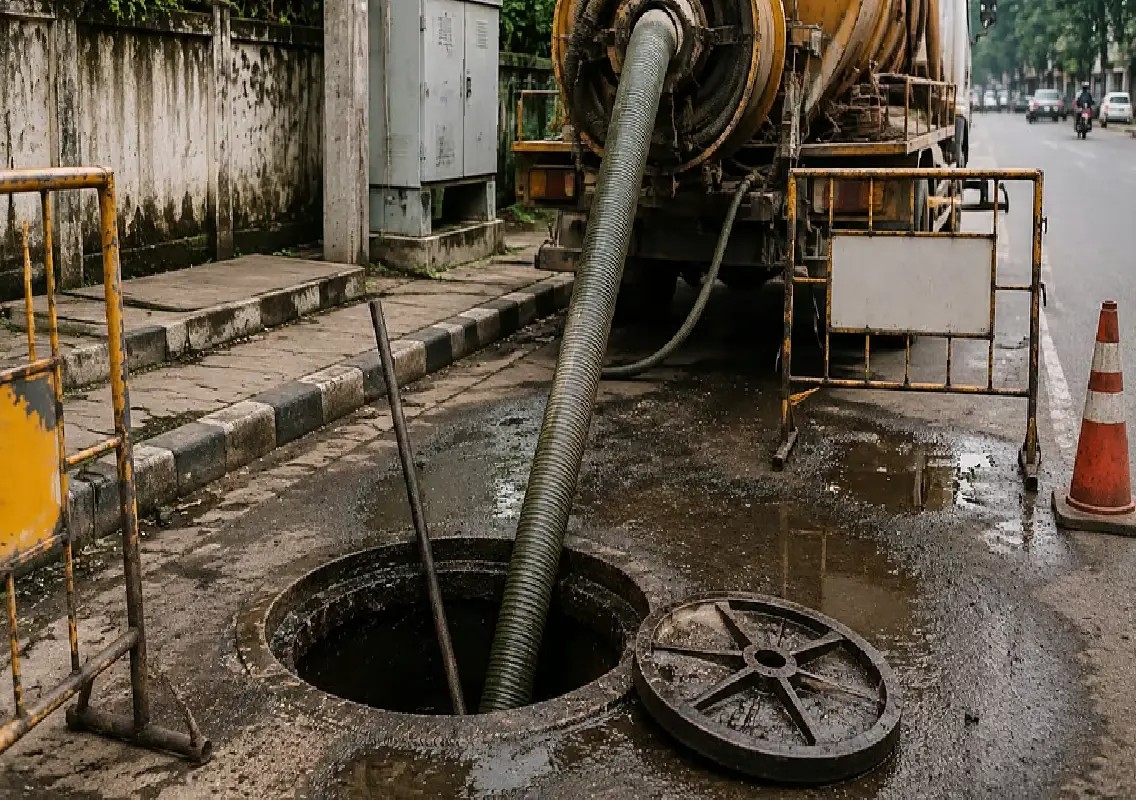


Mangaluru: Mangaluru’s underground drainage (UGD) system, much of which was constructed decades ago, is in urgent need of comprehensive rehabilitation and expansion, with around 216 km of the sewer network estimated to be more than 50 years old.
The city currently has an underground drainage network spanning about 650 km and comprising nearly 25,000 manholes. Of this network, around 250 km is more than five decades old. While rehabilitation works have begun on 25 km under the AMRUT scheme through the Karnataka Urban Infrastructure Development and Finance Corporation (KUIDFC), another 9 km is being restored through works funded in connection with the National Green Tribunal (NGT).
The remaining 216 km, however, is still awaiting comprehensive rehabilitation.
35% of MCC area remains without UGD
Despite the expansion of the sewer network over the years, around 35% of the Mangaluru City Corporation (MCC) area continues to remain outside the UGD network.
Several households in these areas therefore do not have access to proper underground sewer connections and continue to depend on alternative arrangements for managing domestic sewage.
Boloor is among the areas where residents have been demanding UGD connectivity for decades. Despite repeated memorandums submitted to the authorities and assurances from elected representatives, the project remains incomplete.
Residents said a pipeline was laid along a small stretch of the area several years ago, but the work was not completed. They have continued to seek the extension of the network to cover the entire locality.
Some apartment complexes in Boloor have sewage treatment plants (STPs), residents said. However, several individual houses and smaller apartment buildings reportedly continue to discharge wastewater into drains due to the absence of proper UGD connectivity.
The Mangaluru City South MLA recently held a meeting with senior officials, local organisations and residents in Boloor to discuss the issue.
According to the MLA, funds had been earmarked under the Karnataka Urban Water Supply and Drainage Board-linked KUDCEMP initiative, but the project could not be implemented because of geographical challenges, including underground rock formations.
Other localities, including Bengre, also continue to remain outside the UGD network.
Ageing pipelines and manholes pose problems
The ageing sewer infrastructure has increasingly become vulnerable to failures. Several laterite manholes and stoneware pipelines across Mangaluru are reportedly in a dilapidated condition.
Malfunctioning pumping stations add to the problem, as they can disrupt the movement of sewage to treatment facilities.
The situation becomes particularly difficult during the monsoon. Rainwater can enter damaged manholes and overloaded sections of the sewer network, increasing the volume of water flowing through the system.
This can result in sewage overflowing onto roads and into residential areas, creating sanitation and public health concerns.
In areas without UGD connectivity, households largely depend on septic tanks, leach pits and soak pits for managing domestic sewage and wastewater. Residents have also raised concerns over groundwater contamination in locations where sewage seeps into the soil.
UGD network expanded in several phases
Mangaluru’s sewerage infrastructure has developed in several phases as the city expanded.
The original underground drainage system was designed in 1961 for a population of around 1.41 lakh. The system was planned with projections only up to 1991, when the city’s population was expected to reach approximately two lakh.
The original network consisted of about 170 km of pipelines and around 4,000 manholes, along with sewage treatment plants at Kavoor and Ekkur.
As Mangaluru grew and its municipal limits expanded, another 245 km of pipelines and around 8,000 manholes were added.
A major expansion subsequently took place under the Asian Development Bank-assisted Karnataka Urban Development and Coastal Environmental Management Project (KUDCEMP), which was launched in 2003.
Under the project, approximately 355 km of additional pipelines, more than 14,815 machineholes, 20 wet wells and four sewage treatment plants were developed in newly merged areas.
However, the expansion of the network has not been matched by comprehensive rehabilitation of older infrastructure.
Legislature committee flags infrastructure failures
The deteriorating condition of Mangaluru’s UGD system has also been highlighted in a report of a Karnataka Legislature Committee on Public Undertakings.
The committee report paints a concerning picture of the city’s ageing sewerage infrastructure, noting that despite substantial investments and multiple phases of expansion, several projects were implemented only partially.
According to the findings, incomplete works and inadequate rehabilitation have contributed to failures in the sewerage system.
The committee also flagged instances of untreated sewage entering stormwater drains and nearby water bodies. Such incidents have led the Karnataka State Pollution Control Board (KSPCB) to issue repeated notices to the civic body.
Cases concerning sewage discharge are also pending before the NGT.
MLC Ivan D’Souza, who was part of the committee, said the report had been submitted to the Ministry of Urban Development and would be tabled before the Legislative Assembly during the upcoming session.
He said he would raise the issue during the session and seek the government’s attention towards a comprehensive overhaul of Mangaluru’s UGD infrastructure.
Given the scale of the rehabilitation required, he also stressed the need for financial assistance from the Centre.
D’Souza pointed out that seepage from damaged sewer infrastructure and the absence of UGD connections in some areas had contributed to the pollution of several wells in the city.
STPs also require immediate upgrades
The committee also examined the condition of Mangaluru’s sewage treatment plants.
The city has four major STPs located at Bajal, Surathkal, Pacchanady and Kavoor. Together, these facilities have a treatment capacity of 88.75 million litres per day (MLD).
However, only around 49 MLD of sewage currently reaches the treatment facilities.
This gap between installed treatment capacity and the actual volume of sewage reaching the plants indicates that significant quantities of sewage are either not being collected through the UGD network or are being lost due to deficiencies in the existing system.
The treatment plants themselves also require attention. Officials have pointed out that the facilities use outdated technology and need upgrades to meet revised environmental standards.
Improving treatment capacity alone, however, will not resolve the city’s sewage problems unless the collection network, pumping infrastructure and connectivity to uncovered areas are addressed simultaneously.
MCC submits ₹1,250-crore proposal
MCC Commissioner Rahul Ratnam Pandey said a comprehensive proposal worth ₹1,250 crore has been submitted to the state government for an overhaul of Mangaluru’s underground drainage system.
He said the civic body would not be able to undertake the proposed works using its internal financial resources and would require assistance from both the state and Central governments.
The issue is also expected to be brought to the attention of the local Member of Parliament.
The proposed overhaul covers both rehabilitation of the existing network and expansion into areas that currently lack UGD connectivity.
Of the estimated ₹1,250 crore, around ₹840 crore has been earmarked for rehabilitating the existing sewer network. Another ₹410 crore has been proposed for extending UGD coverage to areas that remain unserved.
Proposal focuses on modernising entire system
Officials said the comprehensive proposal includes replacing ageing laterite manholes and stoneware pipelines with modern reinforced cement concrete (RCC) and other durable pipes.
The plan also includes rehabilitation of existing sewer lines, extension of UGD facilities to uncovered localities, construction of new wet wells and upgrading of sewage treatment plants.
Infrastructure for the reuse of treated wastewater has also been included in the proposal.
Such reuse systems could help reduce dependence on freshwater for suitable non-potable applications while improving the overall efficiency of the city’s water and wastewater management system.
For Mangaluru, the proposed ₹1,250-crore project represents a major opportunity to address problems that have accumulated over several decades.
However, the implementation will depend heavily on securing financial assistance from the state and Central governments and ensuring that the proposed works are carried out in a coordinated manner.
With a significant portion of the existing network ageing rapidly and more than one-third of the municipal area still without UGD connectivity, the proposed overhaul is not merely an expansion project. It is an effort to modernise the city’s entire sewage collection, treatment and reuse system.
A timely decision on funding and phased implementation could help reduce sewage overflows, protect groundwater and water bodies, improve sanitation and extend reliable sewerage services to the remaining unserved areas of Mangaluru.