







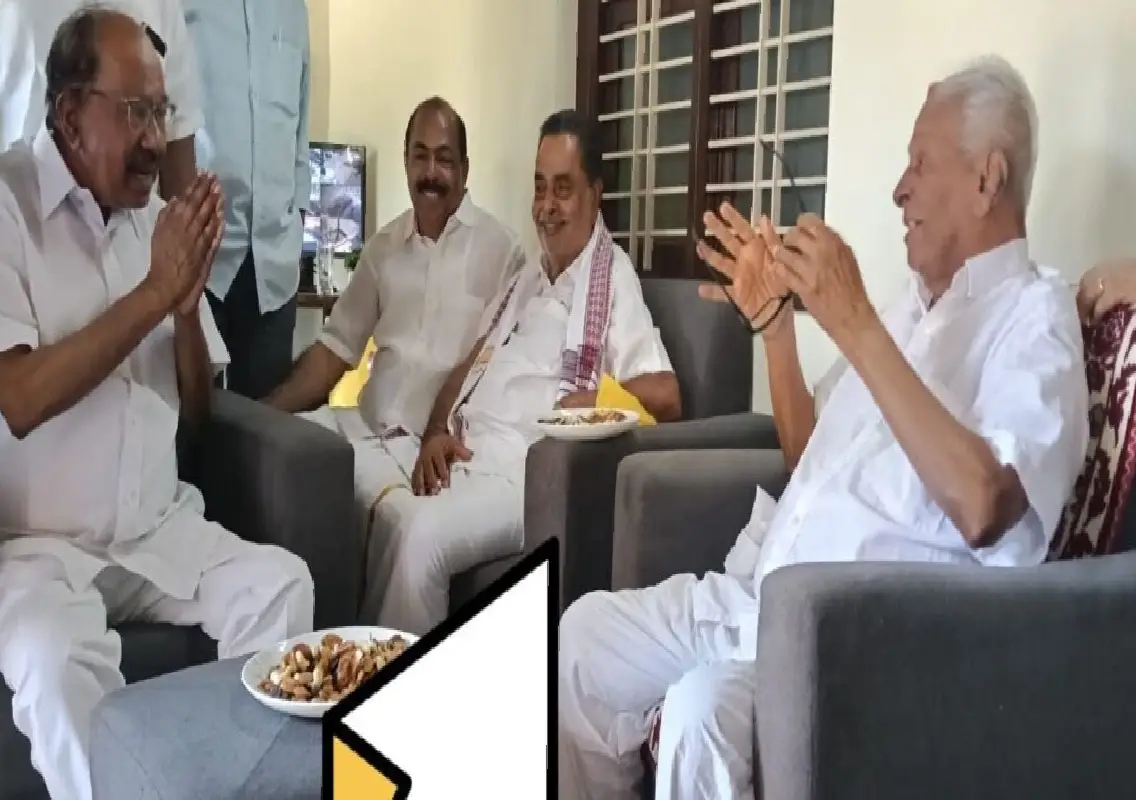


Mangaluru: Coastal Karnataka’s political landscape, often compared to a slushy kambala field that demands both speed and awareness of rivals, once saw a formidable pairing in Veerappa Moily and Janardhana Poojary. Their relationship — marked by mentorship, collaboration, rivalry and reconciliation — shaped a defining phase of Congress politics in the region. Their recent meeting after years of distance has stirred strong emotions among party workers and long-time observers, reviving memories of an era when coastal leaders held significant influence in state and national politics.
The reunion, which took place at Janardhana Poojary’s residence at his request, was seen by many as a symbolic closing of a long political circle defined by both partnership and friction.
A partnership that opened doors in Delhi
Veerappa Moily is widely credited with playing a key role in introducing Janardhana Poojary to the national leadership during the early phase of his rise. It was Moily who facilitated Poojary’s entry into the corridors of power in Delhi and introduced him to then Prime Minister Indira Gandhi, effectively giving an early push to his national political journey.
From there, both leaders went on to build strong but distinct identities within the Congress party. For a period, they functioned like a synchronised kambala pair — aligned in direction and momentum — helping expand the party’s base across the coastal belt.
Their influence also created space for the rise of other strong regional leaders such as Ramanath Rai and Abhayachandra Jain, who later emerged as dependable organisational pillars and mass leaders in their own right.
Contrasting leadership styles
Janardhana Poojary earned a reputation as a grassroots mass leader closely connected with the poor and marginalised. He became synonymous with the “Saala Mela” movement, which pushed for easier banking access and loan settlements for small borrowers. The campaign evolved into a socio-economic mobilisation that strengthened his bond with weaker sections.
Moily, in contrast, was widely regarded as a policy-driven technocrat. Known for administrative discipline and intellectual depth, he functioned within structured governance frameworks. Over the years, he earned recognition not only as a politician but also as a writer and thinker, receiving the Saraswati Samman for his literary contribution.
One was viewed as a pulse-reader of the masses, the other as a system-builder — a contrast that both complemented and complicated their partnership.
Rivalry and ego clashes over the years
Political observers often recall that clashes between the two leaders could be as intense as competing kambala pairs colliding mid-race. Differences in approach, influence and ambition periodically created visible rifts.
When Janardhana Poojary served as Karnataka Pradesh Congress Committee (KPCC) president, Veerappa Moily held office as Chief Minister. During that phase, both leaders commanded enough stature that the party high command in Delhi paid close attention to their positions.
However, internal disagreements and personal egos sometimes divided what was otherwise a powerful coastal bloc within the party. Veteran leaders say such divisions diluted regional bargaining power at critical moments.
Ramanath Rai and others often attempted to play bridge-builders between factions, sometimes at personal political cost. In the fast-moving terrain of party politics, friendships frequently turned strained under competitive pressure.
An emotional meeting after years of silence
After a long period without direct engagement, the recent face-to-face meeting between Moily and Poojary carried deep emotional weight for those present. Witnesses say the interaction was marked by warmth, reflection and visible affection.
Moily holding Poojary’s hand and speaking at length reportedly moved onlookers, with some unable to hold back tears. The conversation is said to have revisited shared struggles, turning points and decisions that shaped their journeys.
Those familiar with both leaders described the moment as one of mature reconciliation — less about politics and more about personal regard forged over decades.
Reflection in the twilight years
Senior Congress workers say both leaders now appear more reflective about the past, placing greater value on relationships built on the soil of the coast than on the prestige of ministerial office in Delhi. The sentiment expressed by those close to them is that power is temporary, but human bonds endure.
Their reunion has also prompted introspection among other regional leaders who rose during that era. Seeing the two stalwarts together again has reminded many of their own political beginnings and shared organisational struggles.
Legacy of friendship and conflict
Today, both Moily and Poojary stand as towering figures of a defining chapter in coastal Congress politics — a chapter marked equally by cooperation and confrontation. Like kambala bullocks resting under a tree after a demanding race, they are now seen as veterans looking back calmly on long and eventful careers.
In the historical narrative of the region’s politics, their names are likely to remain linked — not merely as rivals or colleagues, but as a powerful, complicated pair whose friendship and friction together shaped an era.