







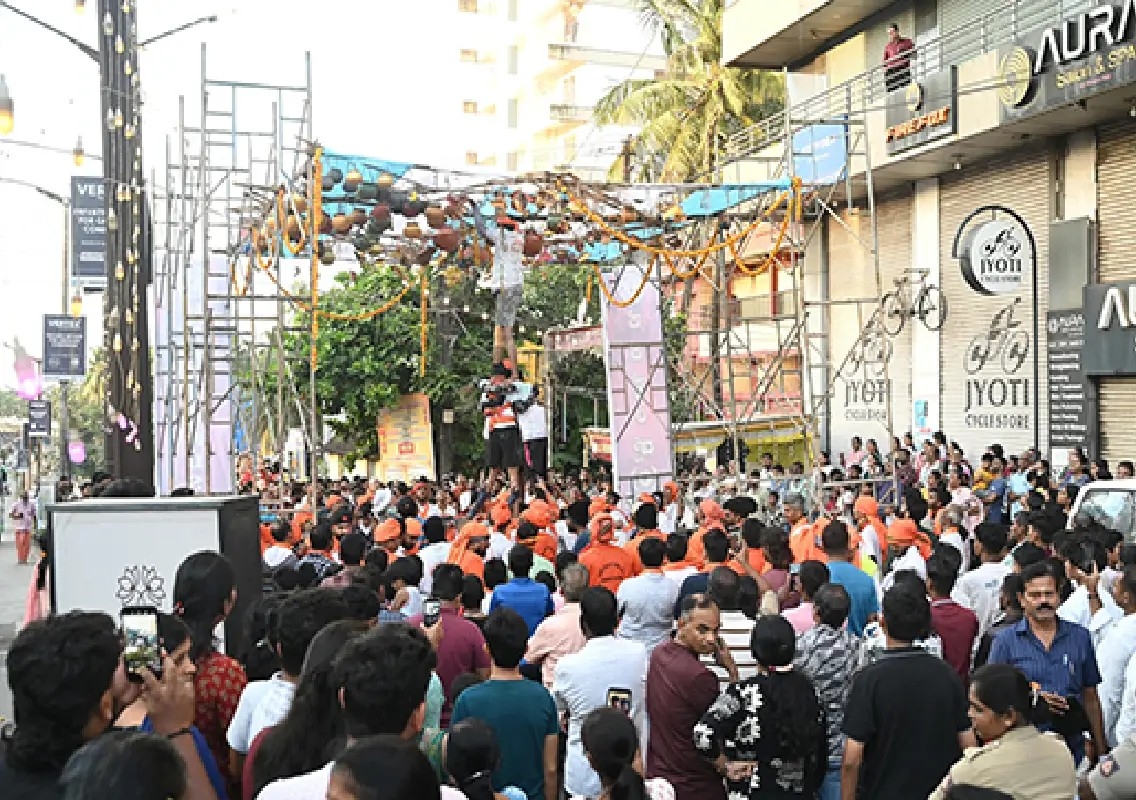


Mangaluru: The traditional Mosaru Kudike Ustav was celebrated with enthusiasm at Kadri, Kottara and Attavar on Saturday as part of the Sri Krishna Janmastami celebrations.
The festivities brought together devotees and residents for colourful processions, cultural performances, music and the traditional breaking of pots. Large crowds gathered at various locations to witness the celebrations, which reflected the region’s vibrant cultural traditions associated with Janmastami.
Special rituals held at Kadri Kambla
At Kadri Kambla, the Kadri Sri Krishna Janma Mahotsava Committee organised special puja and mangalarati to the idol of Lord Krishna brought from the Kadri Manjunatha Temple.
Following the rituals, the idol was taken out in a colourful procession. The procession travelled through Mallikatta before reaching the temple, with devotees and members of the public participating in the celebrations.
The procession featured a variety of traditional performances, adding colour and energy to the festivities.
Pili Nalike and traditional performances
One of the major attractions of the procession was Pili Nalike, the traditional tiger dance associated with festive celebrations in Coastal Karnataka.
Performers painted and dressed as tigers danced to the rhythm of traditional percussion instruments, drawing the attention of spectators along the procession route.
The procession also featured chende and thase performances, along with Singari Melam, creating a lively musical atmosphere.
Tableaux and performances by Yakshagana artistes were among the other attractions. The combination of traditional dance, percussion, theatre and devotional elements showcased the cultural character of the region’s Janmastami celebrations.
Large numbers of people gathered along the route to watch the procession and participate in the festivities.
Human pyramids remain major attraction
The traditional Mosaru Kudike ceremony remained the highlight of the celebrations.
As part of the ritual, participants formed human pyramids to reach and break pots suspended at a height. The spectacle attracted enthusiastic crowds, with people gathered below splashing water on the participants as they attempted to reach the pots.
The activity added an element of excitement to the celebrations while retaining the traditional character of Mosaru Kudike.
Participants worked together to form the human pyramids, demonstrating coordination and teamwork as they attempted to reach the suspended pots.
Dance bhajans also formed part of the celebrations, adding a devotional dimension to the festive programme.
Kadri Star Nights organised
The celebrations at Kadri were accompanied by Kadri Star Nights, organised by Kadri Cricketers at the Kadri ground.
The programme added to the entertainment offered during the festival and brought residents together as part of the wider Janmastami celebrations.
The combination of religious rituals, cultural performances and entertainment programmes ensured that the festivities continued with enthusiasm among people of different age groups.
Celebrations continue at Attavar and Kottara
At Attavar, the Mosaru Kudike celebrations continued with a grand procession that went on until late into the night.
Residents and devotees participated in the procession, contributing to the festive atmosphere in the area. Traditional performances and the procession formed an important part of the celebrations.
Kottara also witnessed Mosaru Kudike festivities as part of the Janmastami celebrations, with residents joining in the traditional observances.
Across the different locations, the celebrations reflected the strong connection between religious festivals and local cultural traditions in Coastal Karnataka.
Cultural traditions remain central to Janmastami
Mosaru Kudike is closely associated with celebrations of Lord Krishna and is marked by the breaking of a suspended pot, often through the formation of human pyramids.
In Mangaluru and other parts of Coastal Karnataka, the festival is celebrated with a distinctive local character, incorporating traditional music, dance and cultural performances.
The presence of Pili Nalike, chende and thase, Singari Melam and Yakshagana artistes added a distinctly regional flavour to this year’s festivities.
The celebrations at Kadri, Kottara and Attavar also provided an opportunity for communities to come together and participate in a shared cultural tradition.
With processions continuing into the night at some locations, the Janmastami celebrations brought colour, devotion and cultural vibrancy to different parts of the city.