







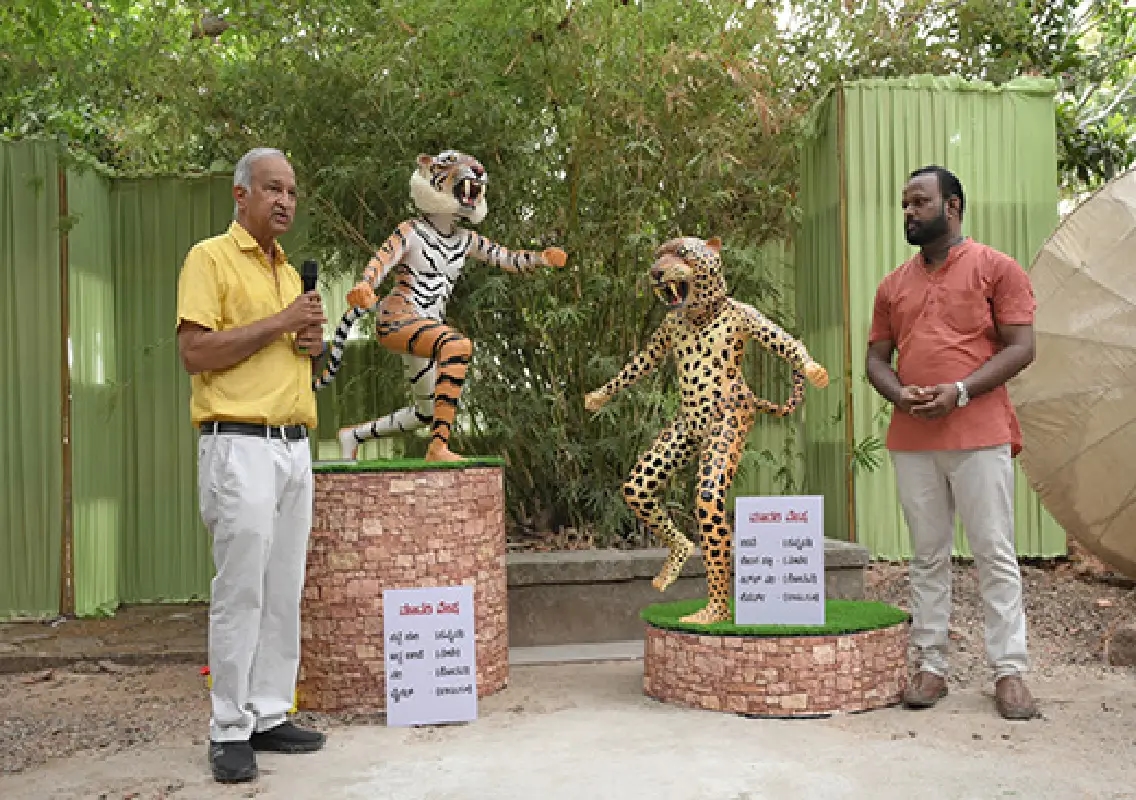


Mangaluru: Renowned wildlife zoologist and tiger conservationist K. Ullas Karanth unveiled ‘Naturalistic Tiger Dance Models’ at the Kodialguthu Centre for Art and Culture in Ballalbagh on April 20, in an effort to bring greater realism and authenticity to Pilivesha, the traditional tiger dance of Dakshina Kannada.
The initiative introduces two intricately designed sculptures representing a tiger and a leopard. These models feature authentic body colours, natural patterns such as stripes and rosettes, and detailed elements including headgear and tail, closely mirroring real animal characteristics.
Art meets science in cultural revival
The sculptures were created by artist Harish Kodialbail, with assistance from Siddakatte Bhushan Shetty and Nagaraj Bajal. The work was based on extensive research and guided by inputs from Dr Karanth, drawing from his decades of field experience studying big cats in the wild.
The project reflects a unique blend of art and science, aiming to reintroduce biological accuracy into a folk tradition that has evolved over time. By presenting realistic models, the initiative seeks to inspire performers and organisers to rethink current practices in Pilivesha.
Formal inauguration and interactions
The models were formally inaugurated by Pradip Shetty in the presence of Pilivesha scholars Chandrashekar Shetty and K. K. Pejavar. The event featured an introductory address by Dr Karanth, followed by an interactive session with participants.
The gathering brought together artists, scholars, and cultural enthusiasts, creating a platform for dialogue on preserving and enhancing traditional art forms through informed approaches.
From childhood fascination to conservation
Sharing his personal journey, Dr Karanth recalled that his fascination with tigers began in childhood after witnessing a tiger dance performance and later seeing a real tiger in a circus. He highlighted that by the 1960s, rampant hunting had pushed tiger populations to the brink of extinction.
He referred to conservation efforts initiated under former Prime Minister Indira Gandhi, which played a crucial role in protecting the species. “I was so drawn to tigers that I chose to dedicate my life to their scientific study and conservation,” he said, noting that he encountered his first tiger in the wild only after 15 years of fieldwork.
Concerns over changing Pilivesha trends
Dr Karanth expressed concern that contemporary Pilivesha performances often lack a connection with real tiger characteristics. He observed that earlier, the art form carried social prestige and reflected elements of actual tiger behaviour.
“Today, unrelated colours and patterns are used, and the form has drifted from its roots. By becoming a showcase for glamour and vanity, it has transitioned from attracting children to appeasing adults,” he remarked.
He emphasised the need for research-driven approaches and urged performers to adopt more realistic representations that honour both tradition and the natural world.
Scholars and artists share insights
Artist Harish Kodialbail described the project as a unique experience, particularly in translating animal features into forms suitable for human performance. He noted that achieving anatomical balance while maintaining artistic expression was a key challenge.
Dr Chandrashekar Shetty highlighted the lack of documented material on the evolution of tiger dance, pointing to the need for academic research in this area. K. K. Pejavar added that Pilivesha is deeply connected to local traditions of faith, physical culture, and community institutions such as gymnasiums.
Event highlights and participation
Kodialguthu Pratibha Karanth welcomed the gathering, while complimentary copies of a book on tiger dance authored by Dr Chandrashekar Shetty were distributed by Kodialguthu family elder Jyothi Alva. Nemiraj Shetty delivered the vote of thanks.
The event was supported by the INTACH Mangaluru Chapter and Art Kanara Trust. Prominent attendees included former District Chief Commissioner of Bharath Scouts and Guides N. G. Mohan and former MUDA Chairman K. Tejomaya.
Conclusion
The unveiling of the Naturalistic Tiger Dance Models marks a significant step towards reviving authenticity in Pilivesha. By bridging scientific understanding with cultural expression, the initiative encourages a more informed and meaningful representation of tradition. As discussions around preservation and innovation continue, such efforts could play a key role in shaping the future of this iconic folk art.