







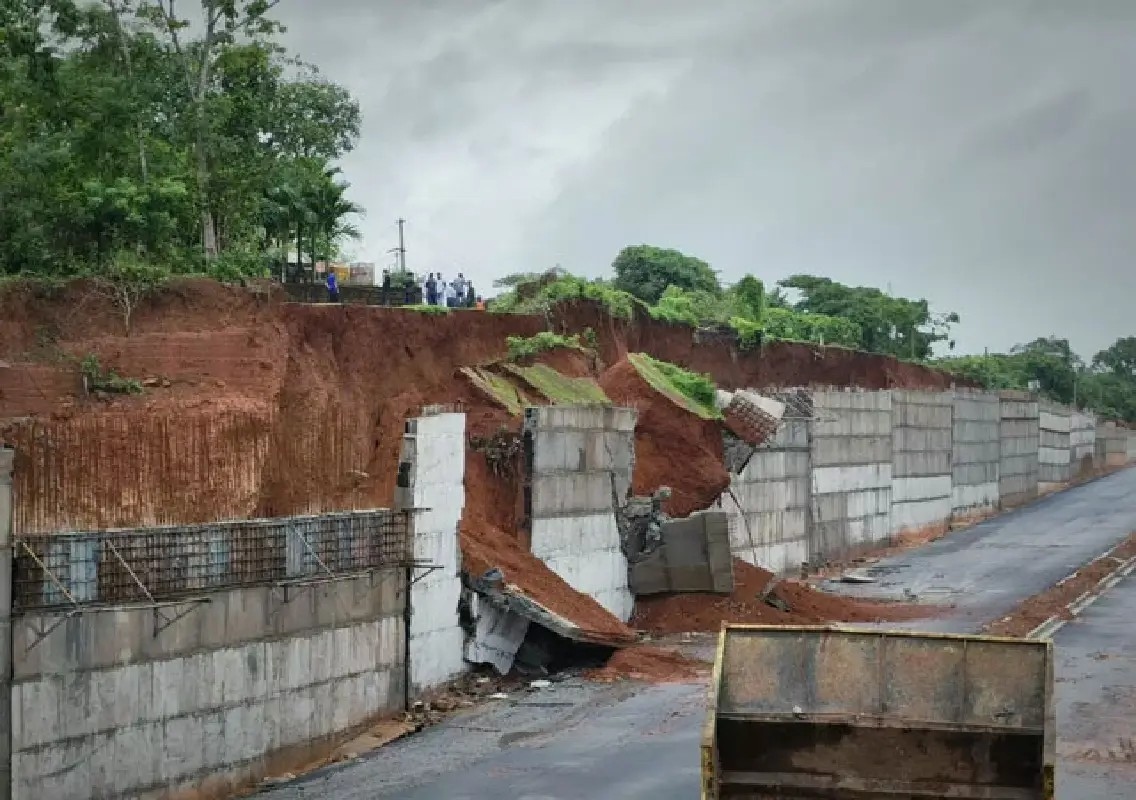


Moodbidri: A retaining wall and a portion of a hillside collapsed near Nelligudde in the Puthige Gram Panchayat limits on Wednesday following continuous rainfall, raising fresh concerns over the safety of ongoing National Highway construction works in the region. Fortunately, no casualties or injuries were reported in the incident.
Heavy rain triggers landslip
The incident occurred at an active National Highway construction site near Nelligudde, where prolonged and intense rainfall is believed to have weakened the hillside. According to preliminary information, saturated soil from the hill began sliding downhill, exerting significant pressure on the retaining wall constructed alongside the road.
Unable to withstand the increasing load, the retaining wall eventually collapsed, leading to a major landslip at the construction site. The collapse scattered soil and debris across the area, highlighting the vulnerability of infrastructure projects during the monsoon season.
The incident comes as several parts of coastal Karnataka continue to receive heavy rainfall, resulting in waterlogging, landslides and disruptions to road connectivity in vulnerable locations.
Construction team initiates safety measures
Soon after the retaining wall gave way, personnel associated with the National Highway construction project rushed to the site to assess the extent of the damage. Workers immediately initiated precautionary safety measures to prevent any further risk to labourers, motorists and nearby residents.
Authorities ensured that the affected portion of the construction area was secured while technical teams carried out an initial inspection. Efforts are expected to continue to stabilise the hillside and prevent additional soil movement if heavy rainfall persists over the coming days.
Construction activities in the affected stretch may be reviewed depending on the findings of the inspection and prevailing weather conditions.
Officials inspect the affected site
Officials from the concerned departments also visited the location following the incident to inspect the damage. They examined the collapsed retaining wall, assessed the extent of the landslip and began evaluating the possible reasons behind the structural failure.
Preliminary observations suggest that continuous rainfall significantly weakened the soil, increasing pressure against the retaining structure. A detailed technical assessment is expected to determine whether additional factors, including soil stability, drainage arrangements or engineering considerations, contributed to the collapse.
Authorities are likely to recommend remedial measures to strengthen the affected stretch before construction resumes at full pace.
No injuries reported
Despite the scale of the landslip, no workers or members of the public were injured. The absence of casualties is being attributed to the timely response of construction personnel and the fact that the collapse occurred without impacting passing traffic or nearby habitations.
Officials have urged workers and the public to remain cautious around ongoing construction zones, particularly during periods of heavy rainfall when slopes become more susceptible to landslides and soil erosion.
Monsoon highlights infrastructure challenges
The incident once again underscores the challenges of executing large-scale infrastructure projects during the southwest monsoon, especially in hilly areas of Dakshina Kannada district. Continuous rainfall often weakens soil stability, increasing the risk of retaining wall failures, embankment erosion and landslides.
Experts note that effective drainage systems, regular slope monitoring and timely geotechnical assessments are essential to minimise such risks during construction. Authorities are expected to closely monitor the affected site and nearby stretches to ensure public safety as the rainy season continues.
While no lives were lost in Wednesday’s incident, the collapse serves as a reminder of the importance of robust engineering practices and continuous monitoring in monsoon-prone regions. Further inspections and corrective measures are expected before normal construction activities resume.