







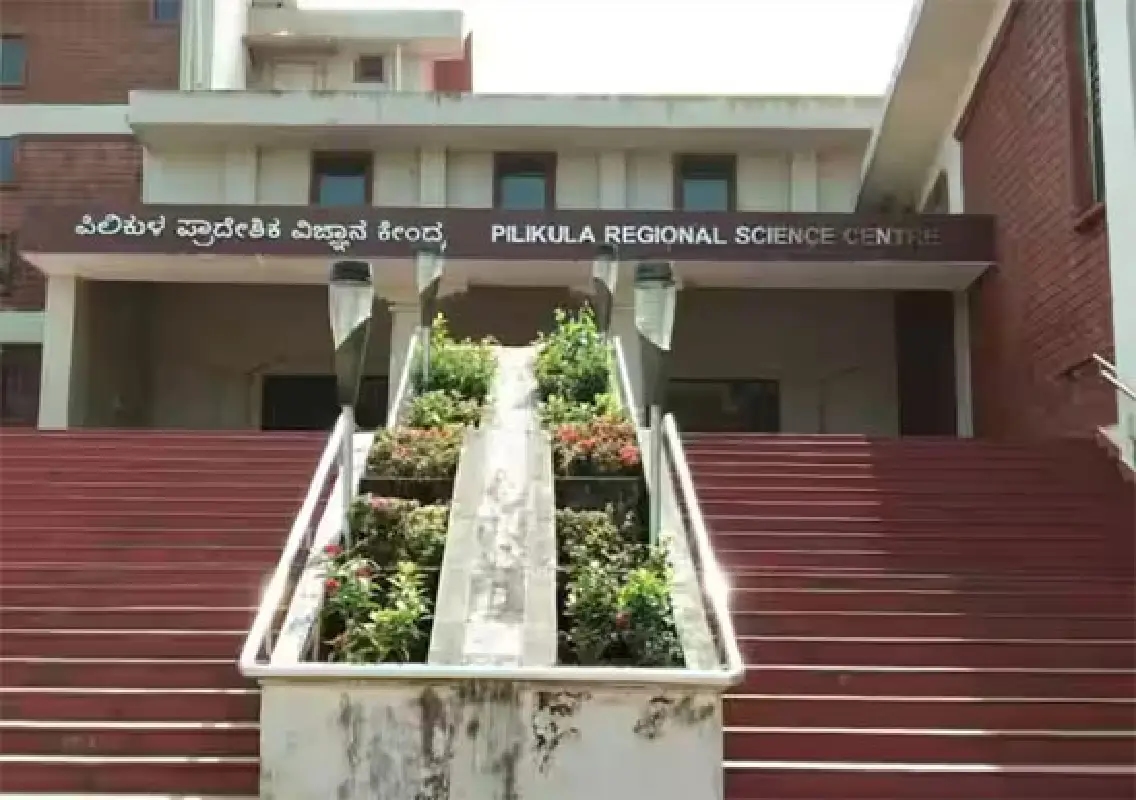


Mangaluru: Visitors to Pilikula will soon get a rare chance to view models of satellites and rockets developed by the Indian Space Research Organisation (ISRO), as the Regional Science Centre is preparing to launch an exclusive space gallery dedicated to India’s achievements in space science. The initiative aims to bring the wonders of astronomy, rocket science, and satellite technology closer to the public, especially students.
The project is taking shape near the Dr Shivaram Karanth Biological Park in Pilikula, where a new centre is being established adjacent to the 3D planetarium. Significant preparations are currently underway, marking an important step in enhancing the region’s scientific and educational landscape.
A gateway to space exploration
Once completed, the gallery will offer visitors insight into space science through interactive displays and satellite-based explorations. Exhibits will explain how rockets are planned and launched, how satellites operate, and how India’s space missions are designed and executed. The centre will also highlight major scientific discoveries by ISRO and global space organisations.
The new gallery has been named the Prof U R Rao Space Gallery, honouring the former ISRO Chairman, Prof Udupi Ramachandra Rao, who hailed from the coastal belt and played a defining role in India’s space advancement. Officials said the gallery not only recognises his immense contributions but also ensures that his legacy remains alive among future generations.
ISRO is expected to extend technical support to the project, including providing authentic models, mission data, and other educational resources that will enrich the visitor experience.
Funding and institutional collaboration
The total project cost of ₹5.43 crore has been sanctioned by Mangalore Refinery and Petrochemicals Ltd (MRPL) as part of its CSR initiatives. The Visvesvaraya Industrial and Technological Museum (VITM), Bengaluru, is designing the gallery, which will be equipped with high-quality models, animations, videos, and scientific displays.
Authorities confirmed that agreements between MRPL, VITM, and the Regional Science Centre have been finalised. A portion of the funds has already been released, enabling the commencement of preliminary work at the gallery site.
ISRO has provided 25 satellite and launch vehicle models to the centre, which will form the core of its display collection. These models include representations of major Indian satellites, launch vehicles from the PSLV and GSLV families, and other significant scientific payloads.
Bringing space science to the public
The gallery is being set up at the building near the Swami Vivekananda Planetarium in Pilikula, a location that already attracts thousands of students and science enthusiasts every year. With the addition of the Prof U R Rao Space Gallery, Pilikula is expected to further strengthen its position as a regional hub for science education.
The exhibits will be accompanied by animations, software-based demonstrations, graphical presentations, and audio-visual modules that will make complex scientific concepts easier for visitors to understand. These tools aim to engage learners of all ages — from school students seeing satellites for the first time to adults with a keen interest in India’s space missions.
Officials said the gallery will highlight ISRO’s major accomplishments, including the Chandrayaan lunar missions, Mangalyaan (Mars Orbiter Mission), and India’s impressive progress in developing indigenous launch vehicles. Visuals, mission timelines, and models will help visitors trace India’s journey from early satellite launches to its emergence as a global space leader.
Expected completion and impact
Initial work on the gallery has begun, with teams from VITM and the Regional Science Centre collaborating to set up displays, prepare the layout, and design interactive elements. The project is expected to be completed in the coming months.
Once operational, the gallery will serve as a platform to cultivate scientific curiosity among students across the region. It will also provide the public with valuable insight into India’s space technology, a field that often remains out of reach for many due to its technical complexity and restricted access.
Officials said the walk-through experience would give visitors a near-authentic understanding of satellite mechanics, rocket stages, and mission execution — something that only a handful of organisations in the country currently offer.
The initiative is expected to significantly boost science education efforts in coastal Karnataka, helping young learners develop a deeper interest in astronomy, physics, engineering, and space research.