







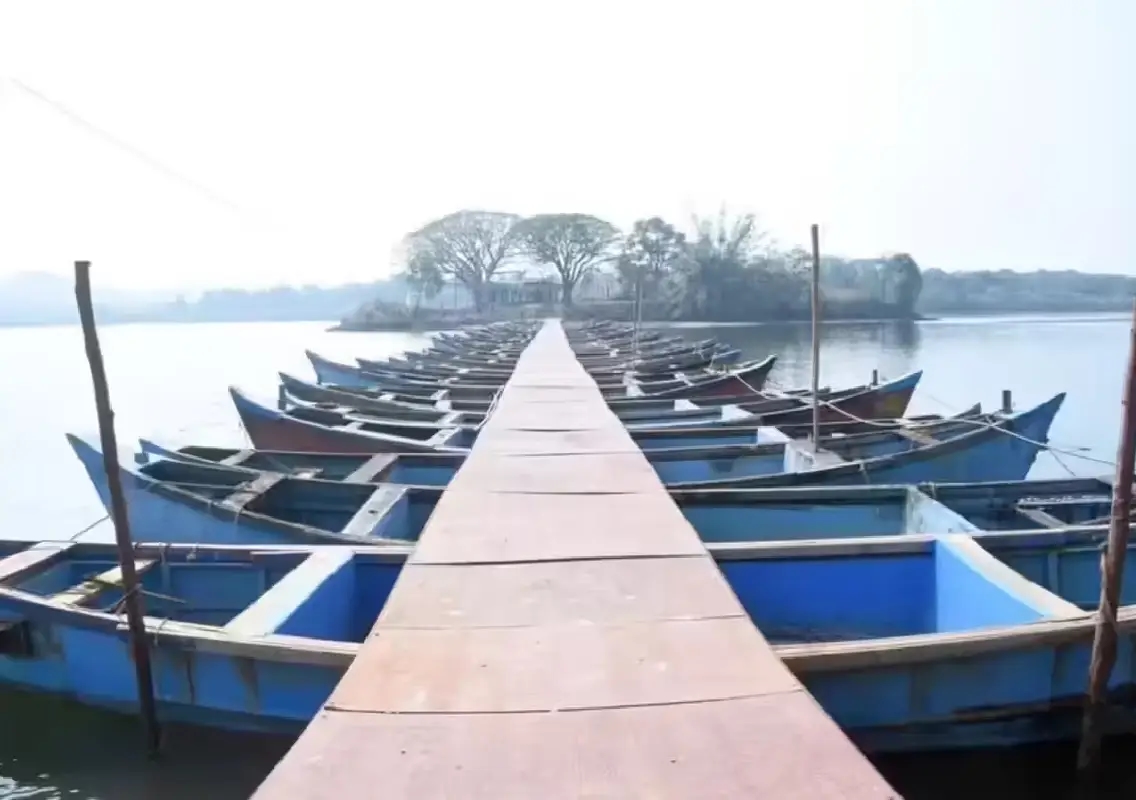


Mangaluru: With the long-pending demand for a permanent bridge remaining unresolved, thousands of devotees and visitors to Dargah Sharif at Rahmaniya Masjid, popularly known as Nadupalli Maqam, continue to depend on boat services and a temporary pontoon bridge to reach the shrine located on an island formed by the Nethravati river at Adyar Kannur. As in previous years, the masjid committee has once again begun setting up a makeshift pontoon bridge ahead of the annual uroos scheduled on January 31 and February 1.
For more than five years, residents and devotees have been petitioning various government authorities seeking construction of a permanent bridge across the river, which is about 100 metres wide at this stretch. Despite repeated representations, the demand has remained unfulfilled, compelling the local community to rely on temporary arrangements year after year.
Fifth year of makeshift arrangement
This year marks the fifth consecutive time that the Rahmaniya Masjid committee is installing a pontoon bridge using nearly 60 traditional boats tied together to form a floating passage. The temporary bridge is being set up primarily to manage the large influx of devotees during the two-day Nadupalli Uroos, one of the most significant religious events in the region.
The annual uroos attracts no fewer than 50,000 devotees from across Dakshina Kannada, Kodagu and Hassan districts of Karnataka, as well as neighbouring Kasargod district in Kerala. With such a massive turnout expected, the pontoon bridge is considered essential to ensure smooth and safe movement of devotees between the mainland and the shrine.
Shrine with centuries-old history
The Rahmaniya Masjid at Nadupalli Maqam is a prominent pilgrimage centre with a history spanning over 400 years. Residents say the shrine houses three tombs believed to have been built in memory of revered religious preachers. According to local belief, villagers began offering prayers at the site after witnessing what they describe as miracles, leading to the dargah gaining spiritual significance over generations.
The shrine draws devotees cutting across religious and social backgrounds throughout the year, but footfall increases manifold during the uroos, when special prayers and rituals are held.
Boat service still a daily necessity
On regular days, devotees reach the dargah by boat, as the island is located roughly 100 metres away from the mainland. A boat service currently operates daily from Adyar Kannur to ferry devotees to and from the shrine.
Abdul Hameed, president of the Usman Bin Affan Masjid at Borugudde, which functions under the Rahmaniya Masjid committee, said people from different faiths visit the dargah with offerings such as rice, coconut, jaggery and sugar.
“During the uroos, the shrine distributes bella ganji, a sweet dish made of rice and jaggery, to all devotees without discrimination,” he said, highlighting the inclusive nature of the event.
Changing river landscape
Residents point out that reaching the shrine was not always this challenging. Decades ago, there was only a narrow stream separating the mainland from the island, and devotees could walk across to the masjid on foot.
Over the years, the watercourse gradually widened due to changes in the river’s flow and erosion, eventually making pedestrian access impossible. As a result, devotees were forced to rely on boats to cross the river.
Initially, around 20 boats fitted with outboard engines were deployed to ferry devotees, especially during peak occasions. However, as the shrine’s popularity grew and the number of visitors increased significantly, managing large crowds using boats alone became difficult.
Need for permanent solution
It was under these circumstances that the masjid committee decided to introduce the pontoon bridge during uroos to ease congestion and reduce waiting time for devotees. While the temporary bridge has proved effective during the festival, residents stress that it is no substitute for a permanent structure.
Villagers say the absence of a permanent bridge not only affects pilgrims but also poses safety risks, particularly for elderly devotees, children and those with health issues. They argue that a permanent bridge would provide year-round, reliable access to the shrine and improve connectivity for the surrounding areas as well.
Repeated appeals to authorities
Local residents and members of the masjid committee say they have approached multiple government departments and elected representatives over the years, seeking approval and funding for the bridge. Despite assurances and site visits in the past, no concrete progress has been made.
As a result, the community has been compelled to bear the cost and responsibility of setting up the pontoon bridge every year during the uroos, relying largely on donations and voluntary support.
Faith and perseverance
Despite the challenges, the devotees’ faith and commitment remain undeterred. Preparations for the uroos are underway, with volunteers working to ensure that the pontoon bridge is safely installed and that crowd movement is well managed during the two-day event.
Residents hope that the continued attention drawn to the issue during large gatherings like the uroos will eventually prompt authorities to take up the long-pending bridge project, providing a permanent solution to a problem that has persisted for years.
Until then, Nadupalli Maqam will continue to be reached by boats and temporary bridges, upheld by the devotion and collective effort of the community.