







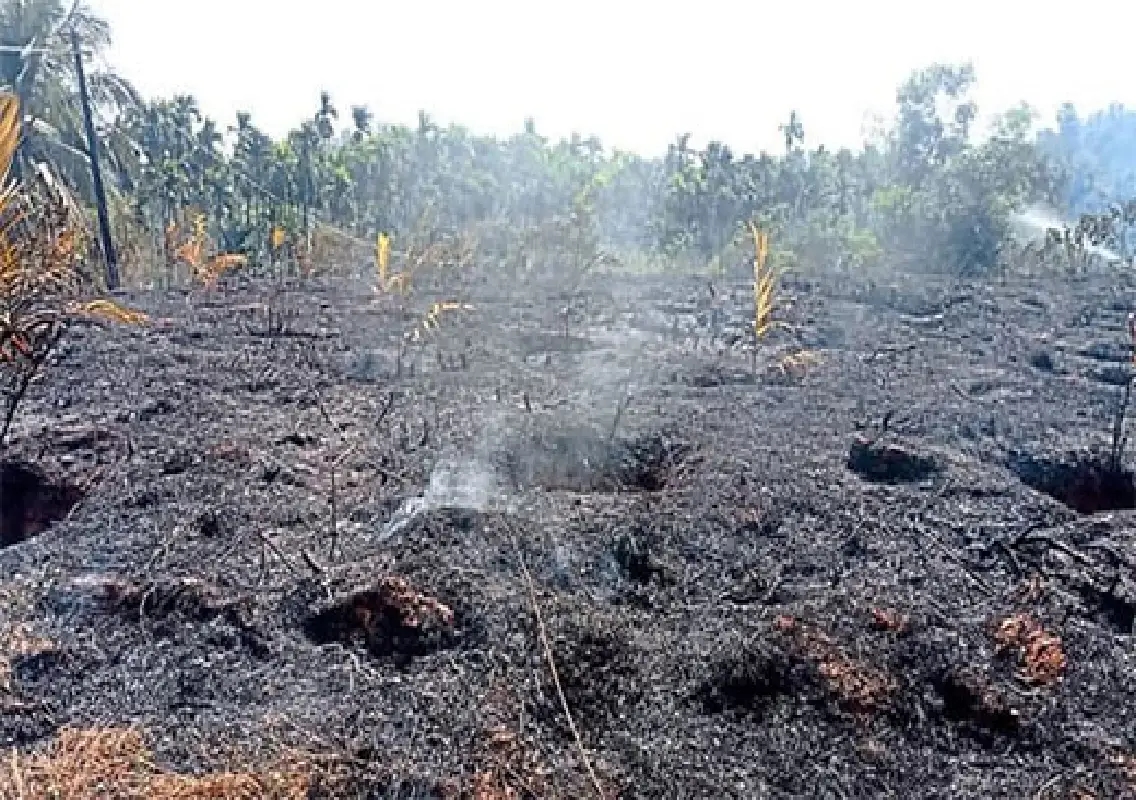


Puttur: More than 900 arecanut saplings were completely destroyed after a high-tension electricity line snapped and fell onto a plantation at Boodiyaru in Kuriya village near Puttur on Tuesday afternoon. The incident has caused significant losses to the farmer and raised serious concerns about the safety and maintenance of overhead power lines in agricultural areas.
The affected plantation belongs to Ganesh Rai, a resident and farmer of Boodiyaru. The saplings, planted around a year ago, were reportedly healthy and growing well until the sudden accident wiped out the entire crop within a short span of time.
Fire breaks out after power line snaps
According to local sources and eyewitnesses, the electricity line snapped unexpectedly on Tuesday afternoon, possibly due to wear and tear or strong winds in the area. As the live wire fell onto the dry plantation land, it sparked instantly, triggering a fire that spread rapidly across the field.
Farm workers and nearby residents attempted to control the blaze, but the fire intensified due to the presence of dry leaves, organic matter, and plastic irrigation pipes. Within minutes, the flames engulfed the entire plantation, leaving no chance to save the young saplings.
Year-old arecanut crop wiped out
Ganesh Rai had planted the arecanut saplings approximately a year ago after investing considerable time and money into land preparation, planting material, fertilisers, and irrigation infrastructure. Arecanut is a long-term plantation crop, and farmers usually begin to see returns only after several years of careful maintenance.
“The plants were growing well and had shown good potential. Losing them at this stage is heartbreaking,” Rai said, expressing distress over the incident. He added that the plantation was a crucial source of future income for his family.
Irrigation infrastructure also damaged
In addition to the saplings, the fire completely damaged the irrigation system installed in the field. Plastic pipes laid across the plantation melted in the intense heat, further increasing the financial burden on the farmer.
Agriculture experts point out that replacing irrigation infrastructure along with replanting saplings will require significant additional investment. Farmers in the region depend heavily on such systems, especially during dry months, to ensure proper growth of plantation crops.
Loss estimated to exceed ₹5 lakh
The total loss caused by the fire is estimated to exceed ₹5 lakh, according to preliminary assessments by local sources. This includes the cost of saplings, land preparation, irrigation equipment, and labour expenses incurred over the past year.
Local farmer associations have stated that such incidents can severely impact small and medium farmers, who often rely on loans or savings to establish plantations. Without timely compensation, recovery becomes extremely difficult.
Demand for compensation and safety measures
Residents of Boodiyaru and surrounding areas have urged the electricity department to take responsibility for the incident and provide adequate compensation to the affected farmer. They have also demanded a thorough inspection of power lines passing through agricultural lands to prevent similar accidents in the future.
“This is not an isolated incident. Poor maintenance of electricity lines poses a constant threat to farmers,” said a local farmer leader. He stressed the need for regular checks, replacement of old wires, and better safety protocols, especially in plantation-heavy regions like Puttur taluk.
Officials yet to issue formal statement
As of Tuesday evening, officials from the electricity supply company had reportedly visited the site to assess the damage. However, a formal statement regarding the cause of the line snapping and compensation details was awaited.
Local administration sources said that a detailed report would be prepared after further inspection, following which necessary action would be taken.
A reminder of farmers’ vulnerability
The incident once again highlights the vulnerability of farmers to infrastructure failures beyond their control. With agriculture already facing challenges such as unpredictable weather, rising input costs, and market fluctuations, accidents like these add to the burden faced by rural communities.
For Ganesh Rai, the immediate concern is rebuilding what was lost and securing support to restart cultivation. Farmers and residents hope that authorities will act swiftly to ensure compensation and prevent such incidents from recurring in the future.