







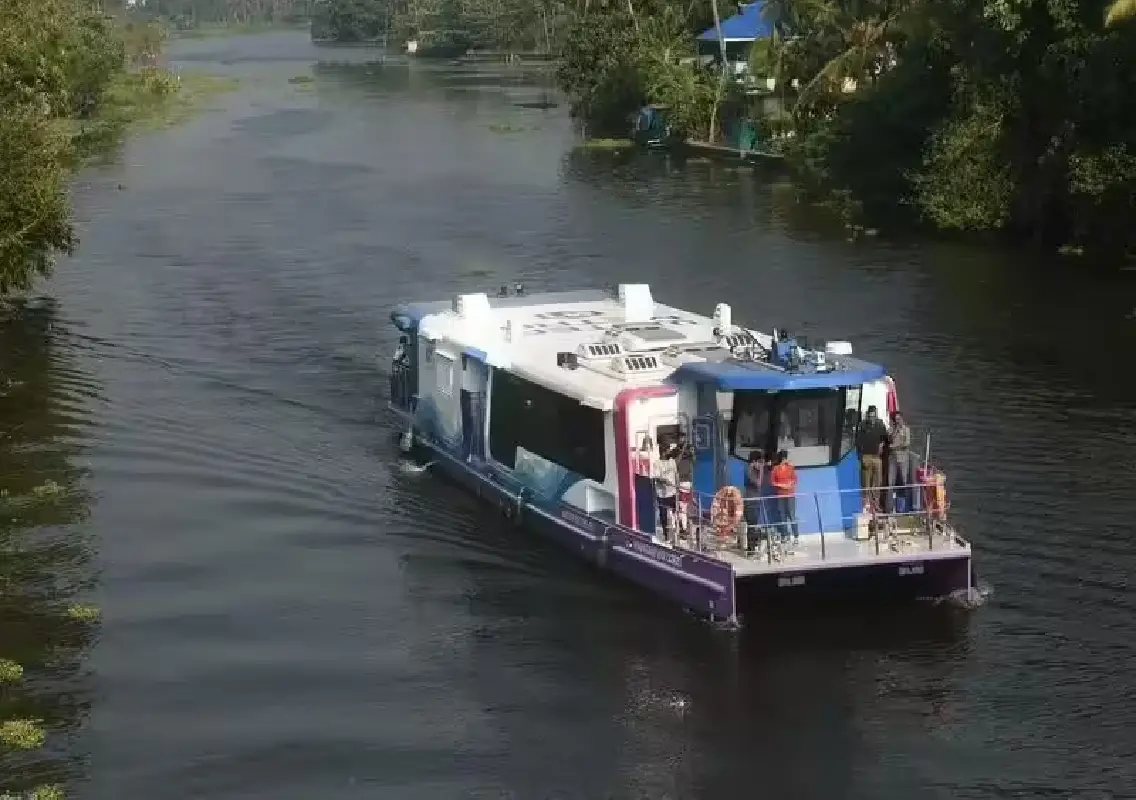


Mangaluru: Preparations are underway for the development of Karnataka’s first roll-on roll-off (Ro-Ro) waterways service along the Mangaluru coast, marking a major milestone in the state’s inland water transport infrastructure. The Karnataka Inland Waterways Authority (KIWA) conducted an environmental public hearing on Thursday to discuss the proposed 8-km-long waterway on the Gurupura River between Hoige Bazaar and Kulur Bridge, which aims to connect directly to the national highway.
The project, estimated at a cost of ₹29.6 crore, will be implemented jointly by the state and central governments with equal contributions. It is designed to enhance cargo movement, lower transportation costs, and promote sustainable, eco-friendly water-based logistics across coastal Karnataka.
Boost to cargo and passenger transport
Speaking at the hearing chaired by Dakshina Kannada Deputy Commissioner Darshan HV, officials said that once operational, the Ro-Ro waterway will be capable of handling up to 400 metric tonnes of cargo and 200 passengers daily. Two Ro-Ro vessels will ply the route, offering 12 trips per day to ensure smooth connectivity.
Prasanna Kumar, Executive Engineer, Department of Ports and Fisheries, detailed that jetties measuring 25×13 metres and terminal buildings would be constructed at both Hoige Bazaar and Kulur. To facilitate the safe movement of vessels, dredging up to a depth of three metres will be undertaken. The project will also include the installation of two floating jetties and a floating pontoon.
He added that the project has already received Coastal Regulation Zone (CRZ) clearance and is awaiting environmental clearance under the Environmental Impact Assessment (EIA) Notification, 2006. Once approvals are secured, construction is expected to be completed within 18 months.
Expected benefits for coastal Karnataka
Officials emphasised that the Ro-Ro service would significantly reduce road congestion within Mangaluru city, cutting down transportation time and costs for both goods and commuters. It is also projected to encourage water tourism, create new employment opportunities, and contribute to the region’s economic growth.
“The project will not interfere with local fishing activities and will adhere to all safety and environmental norms,” Kumar assured. “Every precaution is being taken to ensure minimal ecological impact and full compliance with safety protocols.”
Environmental concerns and objections raised
However, not everyone shared the optimism. During the public hearing, members of the National Environment Care Federation (NECF) voiced serious objections to the project’s execution and transparency.
Shashidar Shetty, honorary secretary of NECF, claimed that the project lacked a proper land survey and warned that dredging and construction could lead to the destruction of mangroves and local vegetation. He further alleged that the project tender may have been floated before obtaining environmental clearance, which would constitute a procedural and legal violation.
Shetty also questioned why the project proposal did not appear on the Parivesh portal of the Ministry of Environment, Forest and Climate Change (MoEF&CC), which is the standard online system for environmental clearance applications. “The absence of the project on the portal raises serious doubts about the transparency and legality of the clearance process,” he said.
He also criticised the authorities for inadequate publicity surrounding the public hearing, noting that local fisherfolk and residents — the primary stakeholders — were largely unaware of the event. “The low attendance today is proof that the affected communities were not properly informed,” Shetty added.
Way forward
Despite these objections, officials from KIWA maintained that all necessary environmental safeguards would be implemented before and during construction. They reiterated that the Ro-Ro project is designed to be a model for sustainable inland water transport in Karnataka, balancing economic development with ecological preservation.
If implemented successfully, the Hoige Bazaar–Kulur Ro-Ro route could serve as a template for similar projects across the state, helping to decongest urban roads, reduce carbon emissions, and encourage a shift towards cleaner modes of transport. The initiative also aligns with the government’s broader push under the “Sagarmala” and “Jal Marg Vikas” programmes to enhance India’s coastal and inland waterways infrastructure.
With environmental clearance pending, all eyes are now on the authorities to ensure that the next steps uphold transparency, public participation, and ecological balance — key factors that will determine the success and acceptance of Karnataka’s first Ro-Ro waterway.