







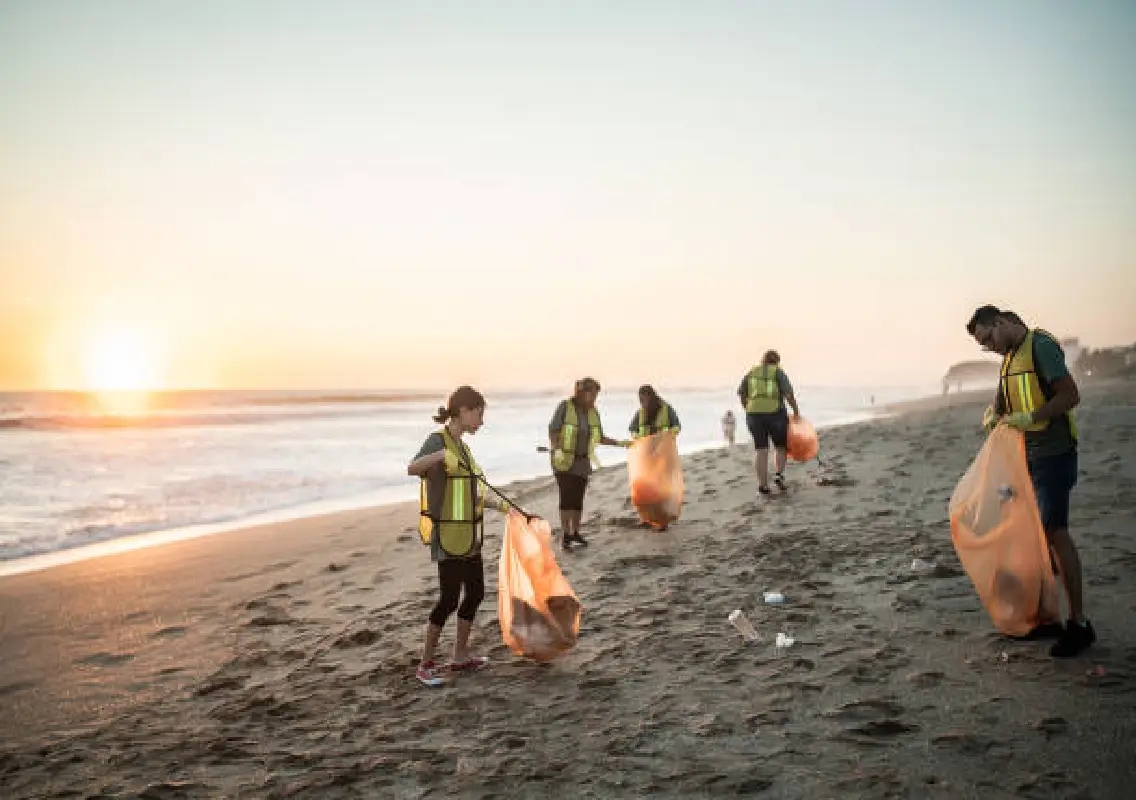


Mangaluru: This month’s cleanliness shramadan under the Ramakrishna Mission Swacch Mangaluru Abhiyan was held at Someshwara Beach on Sunday, with volunteers dedicating the drive exclusively to cleaning the shoreline. The initiative aimed at creating awareness about coastal conservation and addressing the growing concern of plastic pollution along the beach.
The cleanliness drive was inaugurated by Fr Avinash D’Souza of St Aloysius Kotekar Beeri Campus and senior volunteer Anirudh Nayak, who jointly waved the green flag to mark the formal commencement of the programme. Organisers said the decision to focus entirely on beach cleaning was taken in view of the large quantities of waste that regularly wash ashore, posing a threat to marine life and the coastal ecosystem.
Emphasis on environmental awareness
Speaking on the occasion, Fr Avinash D’Souza underlined the moral and social responsibility of protecting nature. “Cleanliness is a path that takes us closer to God. Youth must actively participate in such noble initiatives. This service towards protecting nature is extremely important,” he said, urging students and citizens alike to take ownership of their surroundings.
Organisers said the shramadan was designed not just as a cleaning activity but also as an awareness exercise to sensitise participants about the long-term impact of plastic waste on beaches and oceans. Volunteers were briefed on waste segregation and the importance of reducing single-use plastics in daily life.
Student volunteers take the lead
A large group of student volunteers from St Aloysius PG Centre participated enthusiastically in the drive. Under the leadership of faculty members Gowthami, Rachana, Mahalakshmi and Shreesha, students worked along the shoreline to collect plastic waste, bottles and non-recyclable debris that had accumulated on the sand.
The students were divided into teams to cover different stretches of the beach, ensuring systematic collection and segregation of waste. Faculty members said such hands-on activities help students understand environmental issues beyond textbooks and encourage them to become responsible citizens.
Senior volunteers clear heavy waste
Another team comprising senior volunteers Uday KP, Taranath Alva, Sridhar, Rajeevi Chandrashekar, Prakash and Babitha Shetty, along with an additional batch of student volunteers, focused on clearing heavier and bulk waste. This included thermocol pieces, wooden waste, plastics, discarded footwear, glass and plastic bottles, and other debris washed ashore by tides.
Volunteers noted that thermocol and plastic fragments were among the most commonly found items, highlighting the need for stricter waste management practices and greater public awareness about responsible disposal.
Support from multiple organisations
The shramadan was conducted in association with Swacch Mangaluru Prathishtana and received support from MRPL–ONGC under its environmental social responsibility programme. Organisers said such institutional backing plays a crucial role in sustaining large-scale cleanliness initiatives.
Staff members from the Bantwal Materials Recovery Facility (MRF) actively participated in the beach cleaning work, lending technical support for waste handling. Their presence ensured that the collected waste was properly segregated and sent for recycling or safe disposal, rather than ending up in landfills indiscriminately.
Efficient coordination and waste management
Event coordination and logistics were handled by Sachin Shetty, Navaneeth, Varun, Raghavendra and Harsha. The team ensured that the waste collected from different sections of the beach was sorted according to recyclable and non-recyclable categories and transported efficiently.
Representatives from Repurpose Global and Sattva Knowledge Reality Trust also took part in the initiative, interacting with volunteers and sharing insights on sustainable waste management and circular economy practices.
Growing importance of beach clean-ups
Organisers pointed out that beach clean-ups have become increasingly important in coastal regions due to rising plastic consumption and improper waste disposal. Waste carried by rivers and stormwater drains often ends up in the sea and is later deposited on beaches, affecting tourism, marine biodiversity and the livelihoods of fishing communities.
Regular shramadans, they said, help mitigate the immediate problem while also fostering a culture of environmental responsibility among citizens, especially the youth.
Conclusion
The Someshwara Beach shramadan once again demonstrated the impact of collective action in addressing environmental challenges. Volunteers and organisers reiterated that while periodic clean-up drives are essential, long-term solutions lie in reducing plastic use, improving waste segregation at source and strengthening public awareness. The Ramakrishna Mission Swacch Mangaluru Abhiyan, they added, will continue to focus on such initiatives to promote a cleaner and more sustainable coastal environment.