







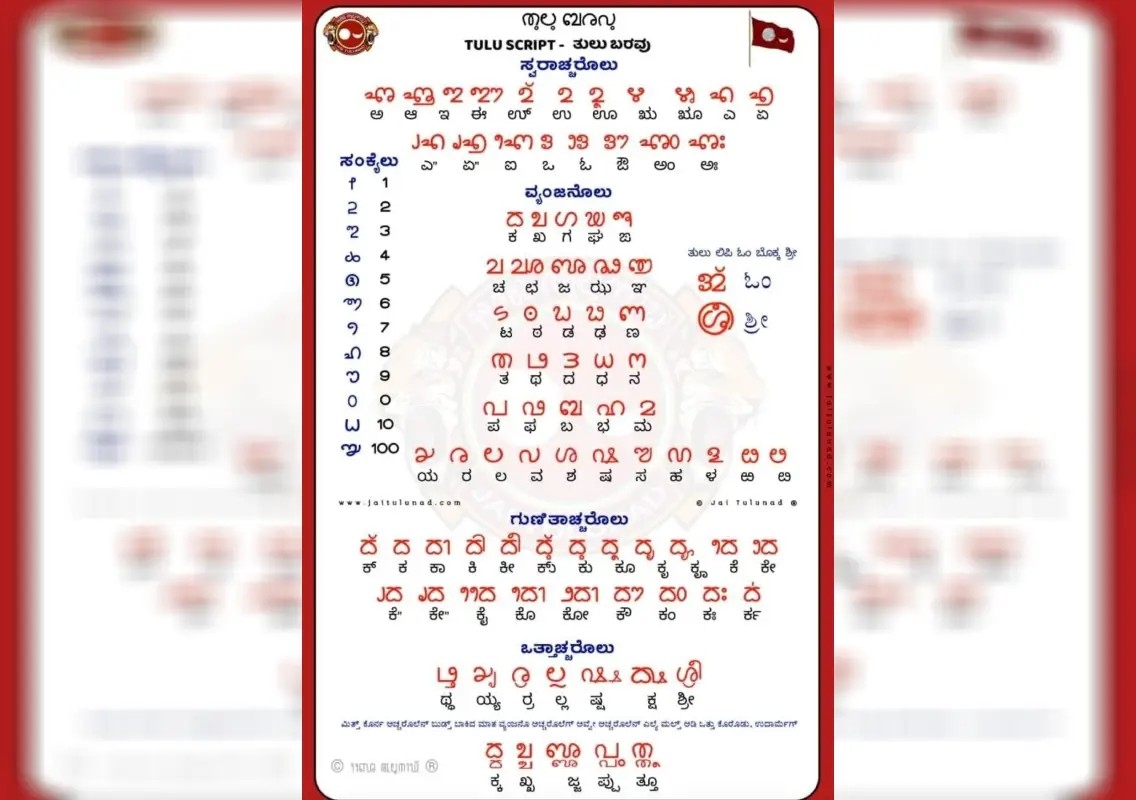


Mangaluru: Tulu organisations across the coastal region are preparing to observe Tulu Script Day with a series of programmes on October 9 and 10, following the Karnataka Cabinet’s recent decision to recognise Tulu as the second additional official language for administrative and government purposes in Dakshina Kannada and Udupi districts.
Observed annually on October 10, Tulu Script Day marks the birth anniversary of Venkataraja Puninchathaya, a noted scholar, researcher and author who made significant contributions to the preservation, study and promotion of Tulu language and literature.
The celebrations this year are expected to assume added significance following the state government’s announcement on Tulu recognition at the Cabinet meeting held in Mangaluru.
Organisations including the Tulu World Foundation, Tuluva Mahasabha and several local bodies are planning programmes aimed at creating awareness about the traditional Tulu script and encouraging its use among younger generations.
Programmes planned across coastal region
Rajesh Alva, founder of the Tulu World Foundation, said the Karnataka Tulu Sahitya Academy had declared October 10 as Tulu Script Day in honour of Puninchathaya.
According to Alva, programmes will be held at several locations across Dakshina Kannada, Udupi, Kasaragod and other parts of the coastal region on October 9 and 10.
Events are planned at places including Mulki, Karkala and Kasaragod, with organisers planning activities centred on Tulu script awareness and the legacy of Puninchathaya.
“Puninchathaya made monumental contributions to preserving, teaching and promoting the Tulu script. Our aim is to popularise the ancient Tulu script, also known as Tigalari, among the younger generation,” Alva said.
The programmes will seek to introduce participants, particularly students and young people, to the history and characteristics of the traditional script.
Focus on Tigalari script
The traditional script associated with Tulu is also widely referred to as Tigalari. While Tulu is currently written by many people using Kannada, Malayalam and Roman scripts, Tulu organisations have been seeking to revive greater awareness and use of the traditional script.
Alva said the objective of the celebrations was not only to commemorate Puninchathaya but also to encourage younger generations to learn and use the traditional script.
He pointed to the existence of numerous historical documents that provide evidence of the long literary and cultural legacy associated with the Tulu script.
Continued research into such documents, he said, could provide further insights into the history, development and evolution of the language and its script.
The organisers hope that awareness programmes and practical writing sessions will make the script more accessible to students and younger Tulu speakers.
Tuluva Mahasabha directs local units
The Tuluva Mahasabha has directed its state, district, zonal and local units to organise at least one programme in their respective jurisdictions as part of Tulu Script Day.
The organisation has planned a range of activities designed to introduce the script and its cultural significance to the public.
These include introductory sessions on Tulu Lipi, training workshops, memorial meetings dedicated to Puninchathaya and lectures focusing on the history of the script.
Tulu script writing competitions for students are also planned, providing young participants with an opportunity to learn and practise the traditional script.
Book exhibitions and awareness campaigns will form another component of the celebrations.
Remembering Venkataraja Puninchathaya
The celebrations will also focus on the contributions of Venkataraja Puninchathaya to Tulu literature and scholarship.
Puninchathaya devoted much of his work to documenting, studying and promoting Tulu language and literature. His contribution to the preservation and teaching of the Tulu script has made his birth anniversary an important occasion for organisations working for the language.
The observance of Tulu Script Day is intended to keep that legacy relevant among younger generations while creating wider public interest in the traditional writing system.
Memorial meetings and lectures planned during the celebrations will provide an opportunity for scholars, language activists and members of the public to discuss Puninchathaya’s work and the historical importance of Tulu script.
Cabinet decision adds significance
The Script Day programmes come soon after the Karnataka Cabinet meeting in Mangaluru, where the government announced recognition of Tulu as the second additional official language for administrative and government purposes in Dakshina Kannada and Udupi districts.
The decision has given fresh momentum to organisations seeking greater recognition and institutional support for the language.
For Tulu organisations, the recognition and the annual Script Day observance together provide an opportunity to focus attention not only on the spoken language but also on its traditional literary heritage.
The organisations are now seeking to use the celebrations to encourage wider awareness of Tulu Lipi and its historical significance.
Students at centre of awareness drive
A major focus of this year’s programmes will be encouraging students to learn the script.
Writing competitions, introductory classes and training workshops are expected to help participants gain basic familiarity with Tulu Lipi.
Organisers believe that introducing the script at a young age could help preserve knowledge of the traditional writing system and create a new generation of readers and researchers.
The planned book exhibitions will also showcase literature and historical material connected with Tulu language and script, giving visitors an opportunity to learn more about the region’s linguistic heritage.
With programmes planned across Dakshina Kannada, Udupi, Kasaragod and other areas, Tulu organisations are seeking to turn Tulu Script Day into a wider public awareness campaign.
The celebrations on October 9 and 10 are therefore expected to combine remembrance of Venkataraja Puninchathaya with efforts to promote the traditional script and encourage its continued study and use among younger generations.