







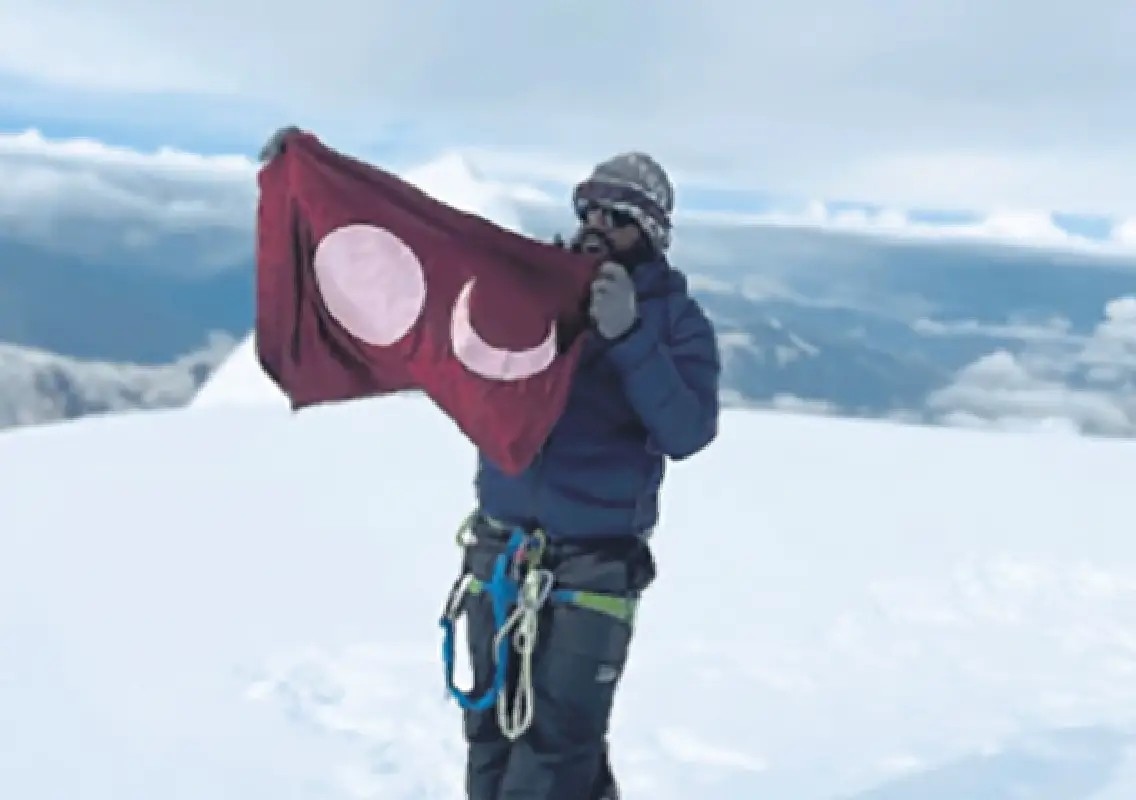


Belthangady: Pradeep Babu Shetty of Ujire has successfully scaled Mount Kun, a 7,077-metre peak in Ladakh, and hoisted the Tulu Nadu flag at the summit, bringing pride to Dakshina Kannada and the coastal Karnataka region.
Pradeep, the youngest of three children of Babu Shetty and Girija Shetty, developed an interest in trekking at an early age. His passion for adventure gradually led him towards mountaineering, prompting him to undergo rigorous physical conditioning and specialised training.
Over the years, he completed several mountaineering courses and built experience by taking on increasingly challenging high-altitude expeditions.
From Ujire to the high Himalayas
Currently employed with NMC, Pradeep continues to pursue mountaineering alongside his professional career. His latest achievement on Mount Kun adds another major milestone to an already impressive list of high-altitude climbs.
Before attempting Mount Kun, Pradeep had successfully climbed several prominent peaks in the Himalayas.
His previous expeditions include Mount Lobuche (6,119 metres), Island Peak (6,189 metres), Mera Peak (6,476 metres), Mount Ama Dablam (6,812 metres) and Mount Yunam (6,111 metres).
He has also climbed Kang Yatse-I and Kang Yatse-II, further strengthening his experience in high-altitude mountaineering.
His successful ascent of Mount Kun demonstrates the experience and preparation he has gained through these expeditions.
Mount Kun presents extreme challenges
Mount Kun is located in the Zanskar range of the Greater Himalayas in Ladakh, close to the India-China border. At an elevation of 7,077 metres, the peak presents demanding conditions even for experienced mountaineers.
Extreme cold, reduced oxygen levels, difficult and technically challenging terrain and unpredictable weather can make an expedition to the summit particularly hazardous.
For Pradeep, who hails from coastal Karnataka, adapting to the high-altitude environment was an additional challenge. The climate and atmospheric conditions in the coastal region are vastly different from those encountered at more than 7,000 metres in the Himalayas.
Recognising the importance of acclimatisation, Pradeep travelled to Ladakh ahead of the expedition. He spent time preparing his body for the demanding high-altitude conditions before beginning the gradual ascent towards Mount Kun.
The acclimatisation process helped him adapt to the lower oxygen levels and harsh environment before taking on the final stages of the climb.
Tulu Nadu flag reaches the summit
One of the notable aspects of Pradeep’s achievement was his decision to carry and hoist the Tulu Nadu flag at the summit of Mount Kun.
The gesture has brought recognition to the region and highlighted the growing presence of adventure enthusiasts and mountaineers from coastal Karnataka on major Himalayan expeditions.
For people in Ujire and the wider Belthangady region, Pradeep’s achievement is particularly significant as he has combined his professional responsibilities with his passion for mountaineering.
His journey also demonstrates the importance of disciplined preparation and specialised training in pursuing high-altitude adventures.
Training and safety crucial for snow mountaineering
Pradeep has stressed the importance of adequate preparation and safety equipment for anyone taking up snow mountaineering.
“Proper training and high-quality safety equipment are extremely essential for snow mountaineering. Conditions can become very dangerous, but determination and preparation are equally important,” he said.
High-altitude mountaineering requires physical endurance, technical skills, mental strength and the ability to respond to rapidly changing weather and terrain conditions.
For climbers attempting peaks above 6,000 metres, acclimatisation is particularly important because oxygen availability decreases significantly with altitude. Careful planning, appropriate equipment and experienced expedition support are therefore essential.
A growing mountaineering journey
Pradeep’s ascent of Mount Kun is the latest achievement in a journey that began with an early interest in trekking. His progression from trekking to specialised mountaineering training and eventually to peaks exceeding 7,000 metres reflects years of preparation and perseverance.
His successful climbs of Lobuche, Island Peak, Mera Peak, Ama Dablam, Yunam and the Kang Yatse peaks provided valuable high-altitude experience before the Mount Kun expedition.
The latest achievement has added another significant chapter to his mountaineering journey while bringing the Tulu Nadu identity to one of the challenging summits of the Himalayas.
For coastal Karnataka, where mountaineering is not traditionally associated with the region’s landscape, Pradeep’s achievement serves as an inspiring example of how determination, training and sustained preparation can help adventure enthusiasts take on some of the world’s most demanding environments.