







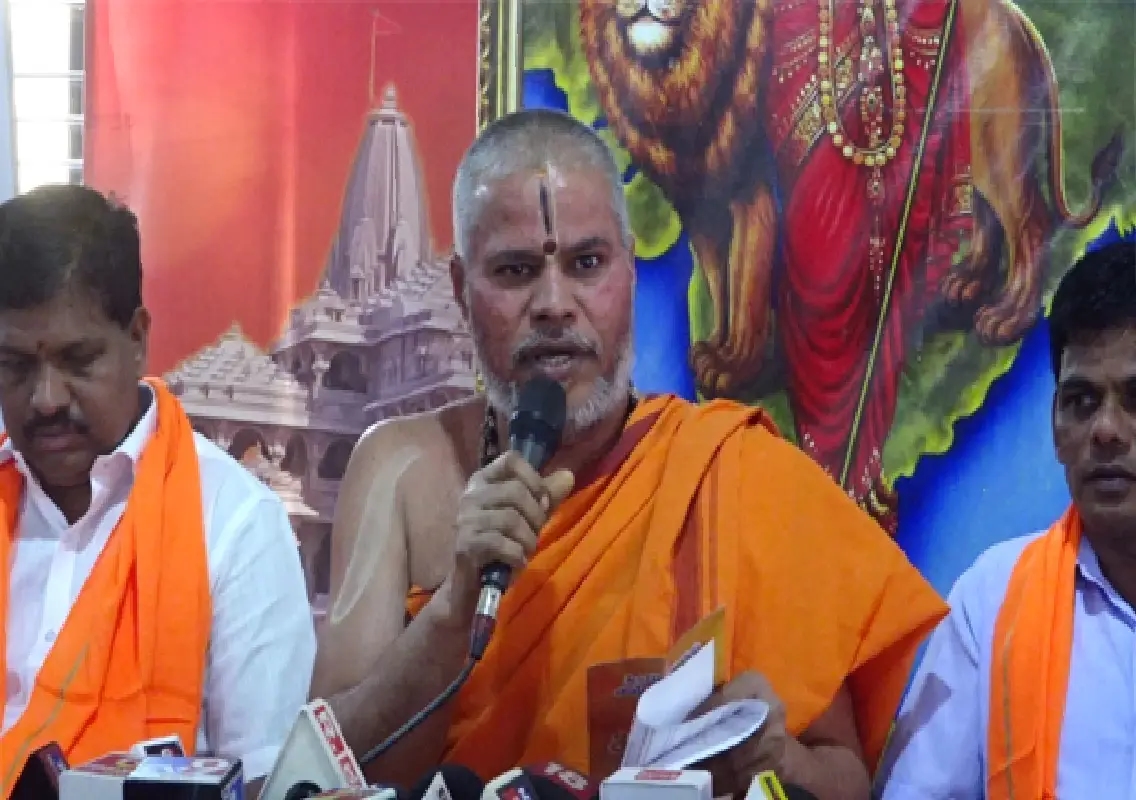


Mangaluru: Reacting to the controversy surrounding the hoisting of the saffron flag by the Udupi Deputy Commissioner and the opposition raised by Congress leaders, Gurupura Vajradehi Matha seer Rajashekharananda Swamiji said that several local leaders lack a proper understanding of religion and its traditions. He remarked that it was unclear whether those opposing the act even follow such religious customs in their own homes.
Addressing the issue, the seer said that the Bhagwa Dhwaja, or saffron flag, holds deep spiritual and cultural significance in Hindu tradition. He emphasised that while the Deputy Commissioner is a representative of the government, he is also an individual with personal beliefs and religious practices. “Participating in such traditions is a personal matter, and the government should not impose restrictions on individual religious expression,” he said.
Saffron flag holds sacred significance
Rajashekharananda Swamiji explained that the saffron flag symbolises sacrifice, renunciation and spiritual awakening, values that are central to Hindu philosophy. He said questioning or objecting to its hoisting reflects a lack of understanding of Sanatana traditions.
According to him, the act of hoisting the flag should not be viewed through a political lens. “This is not about politics or governance. It is about faith and tradition. Reducing it to a controversy only shows ignorance about its deeper meaning,” he remarked.
The seer stressed that religious practices should be respected as long as they do not violate the law or harm social harmony.
Questions over selective objections
Raising concerns over what he described as selective objections, Rajashekharananda Swamiji questioned why similar issues are not raised when officials belonging to other faiths participate in religious activities. He cited earlier instances and asked whether the government had ever stopped a Deputy Commissioner of another religion from visiting or participating in rituals at their own place of worship.
He argued that singling out one individual for practising his faith amounts to unfair treatment. “Why is there justification when officials from other religions are associated with their religious systems, but objections arise only in this case?” he asked.
The seer alleged that efforts were being made to malign the Deputy Commissioner and tarnish his reputation unnecessarily. He said such actions only create divisions and misunderstandings in society.
No place for caste or religion, says seer
Rajashekharananda Swamiji strongly refuted allegations that religious institutions promote caste or religious discrimination. He said that in the traditions followed by the matha, there has never been exclusion based on caste or community.
“There should be no scope for caste or religion in such matters. People from all communities bring offerings, and no one has ever been excluded. Everyone eats together, and there has never been any sense of caste discrimination,” he said.
He added that temples and religious institutions have historically served as spaces that bring people together, rather than divide them, and that this inclusive spirit continues to be upheld.
Hindu Sangama programmes focus on unity
Speaking further, the seer said that Hindu Sangama programmes are being organised with the aim of uniting the Hindu community by highlighting the inner essence of ancient Sanatana culture. He explained that these initiatives seek to strengthen cultural values, religious faith and social harmony.
According to him, the programmes are not meant to target or exclude anyone but to create awareness about shared cultural roots and ethical living. “The focus is on unity, not division. The idea is to bring people together by reminding them of common values,” he said.
Five core principles for social transformation
Rajashekharananda Swamiji explained that the Hindu Sangama initiatives also aim to bring about positive transformation from the individual level to society at large. He said this is achieved by encouraging people to practise five core principles.
These principles include social harmony, strengthening family values, environmental conservation, adopting an indigenous way of life and fostering civic responsibility. According to the seer, these values are deeply rooted in Sanatana traditions and remain relevant in contemporary society.
He added that by practising these principles, individuals can contribute to a more balanced and responsible society, where cultural identity and social duty go hand in hand.
Programmes held across mandals
As part of this initiative, Hindu Sangama programmes have been organised in various mandals of Gurupura taluk. The seer said the response has been encouraging, with people from different backgrounds participating in discussions and activities centred on cultural awareness and ethical living.
He noted that such programmes provide a platform for dialogue and reflection, helping people understand the philosophical foundations of tradition beyond rituals alone.
Conclusion
Rajashekharananda Swamiji said that controversies over religious symbols should be addressed with sensitivity and understanding rather than politicisation. He reiterated that personal faith and official responsibility need not be viewed as conflicting, as long as constitutional values and social harmony are maintained.
Calling for restraint and mutual respect, he urged leaders and the public alike to focus on unity and constructive engagement. According to him, preserving cultural traditions while fostering inclusivity is essential for maintaining social balance in a diverse society.