







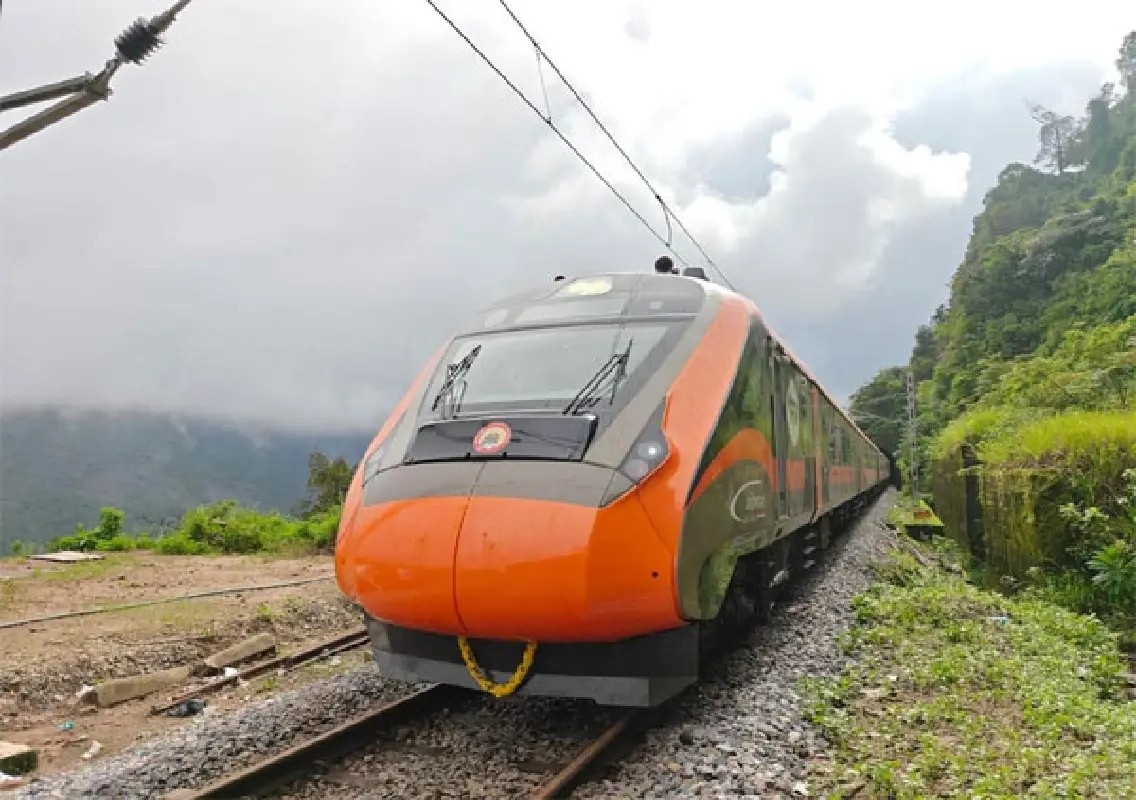


Mangaluru: The proposed Vande Bharat Express service between Bengaluru and Mangaluru moved a step closer to becoming a reality after the orange-coloured train successfully completed a trial run through the challenging Sakleshpur Ghat section on Wednesday. The trial was conducted by the Mysuru Division of South Western Railway between Sakleshpur and Subrahmanya Road railway stations to assess the train’s performance on the steep gradients and demanding terrain.
The trial is significant for railway passengers in the coastal region, who have been seeking a faster and more convenient Vande Bharat connection between Mangaluru and Bengaluru. A 20-coach Vande Bharat train equipped with automatic emergency braking technology has been brought from the Integral Coach Factory (ICF) in Chennai specifically for the trials.
Trial conducted on challenging ghat section
The Sakleshpur–Subrahmanya Road railway stretch is considered one of the more technically demanding sections of the proposed route because of its steep gradients, curves and challenging geographical conditions.
During the trial, railway officials assessed the train’s performance under conditions designed to replicate actual passenger operations. Instead of passengers, sandbags were loaded into the coaches to simulate passenger weight.
The train was then operated at prescribed speeds while railway officials monitored its performance on the ghat section. The exercise was intended to assess the train’s ability to negotiate the gradients safely while carrying a simulated passenger load.
Multiple speed trials planned
According to information available, multiple rounds of trials are being conducted at different speeds. The speed of the train is being increased gradually as officials assess its technical capabilities on the route.
The trials are expected to help determine the maximum operating speed at which the Vande Bharat can travel safely and efficiently through the challenging section.
Such testing is important before introducing a regular passenger service, as railway authorities need to establish the operational and safety parameters applicable to the route.
The trials will also provide technical information about the train’s braking, acceleration and overall performance while negotiating the gradients under loaded conditions.
20-coach train brought from Chennai
The Vande Bharat train being used for the trials consists of 20 coaches. The train has been brought from ICF, Chennai, for the testing process.
The train is equipped with automatic emergency braking technology, which is among the safety features being considered while assessing its suitability for the route.
The presence of a longer 20-coach formation also makes the trial relevant from an operational perspective, as officials need to examine how the train performs with a substantial load while negotiating the ghat section.
The trials will help authorities assess whether the train can operate safely and reliably on the route before any final decision regarding passenger services is taken.
MLA marks trial with prayers and sweets
At Sakleshpur railway station, MLA Cement Manju offered prayers and distributed sweets among members of the public to mark the occasion.
The trial generated interest among local residents and railway enthusiasts, particularly because the proposed service has been the subject of a long-standing demand from passengers travelling between Bengaluru and the coastal region.
A direct Vande Bharat service could provide a faster travel option between the two important cities if the route is approved for regular operations.
Coastal passengers await service
The proposed Bengaluru–Mangaluru Vande Bharat service has attracted considerable attention in coastal Karnataka because of the strong travel demand between the two regions.
Mangaluru serves as an important commercial, educational, healthcare and transport hub for Dakshina Kannada and neighbouring districts. Bengaluru, meanwhile, is a major destination for employment, business and education.
A faster train service between the two cities could therefore benefit a wide range of passengers, including students, professionals, business travellers and people travelling for personal and medical purposes.
However, the introduction of a regular service depends on the outcome of the technical trials and subsequent decisions by the railway authorities.
Safety remains the priority
The Sakleshpur Ghat section presents a particularly important test because of its steep gradients and difficult terrain. Railway authorities need to ensure that any high-speed train introduced on the route can operate within safe technical and operational limits.
The current trials are therefore not merely aimed at checking travel time. They are also intended to establish the safety standards, speed restrictions and operating conditions that would be necessary for regular passenger services.
By conducting trials at different speeds and with simulated passenger loads, officials can gather data about the train’s behaviour under various operating conditions.
The information gathered during these tests will be important in determining the suitability of the Vande Bharat for the Bengaluru–Mangaluru route.
Service decision expected after trials
The successful completion of the initial trial through the Sakleshpur Ghat section represents an important stage in the process of evaluating the proposed service. Further trials and technical assessments are expected before the railway authorities arrive at a final decision.
For passengers in Mangaluru and other parts of coastal Karnataka, the trials have renewed expectations of a direct Vande Bharat connection with Bengaluru.
The focus now remains on the outcome of the remaining technical trials and the safety assessment of the route. If the train is found suitable for regular operations, the proposed service could significantly improve rail connectivity between Bengaluru and the coastal region.