







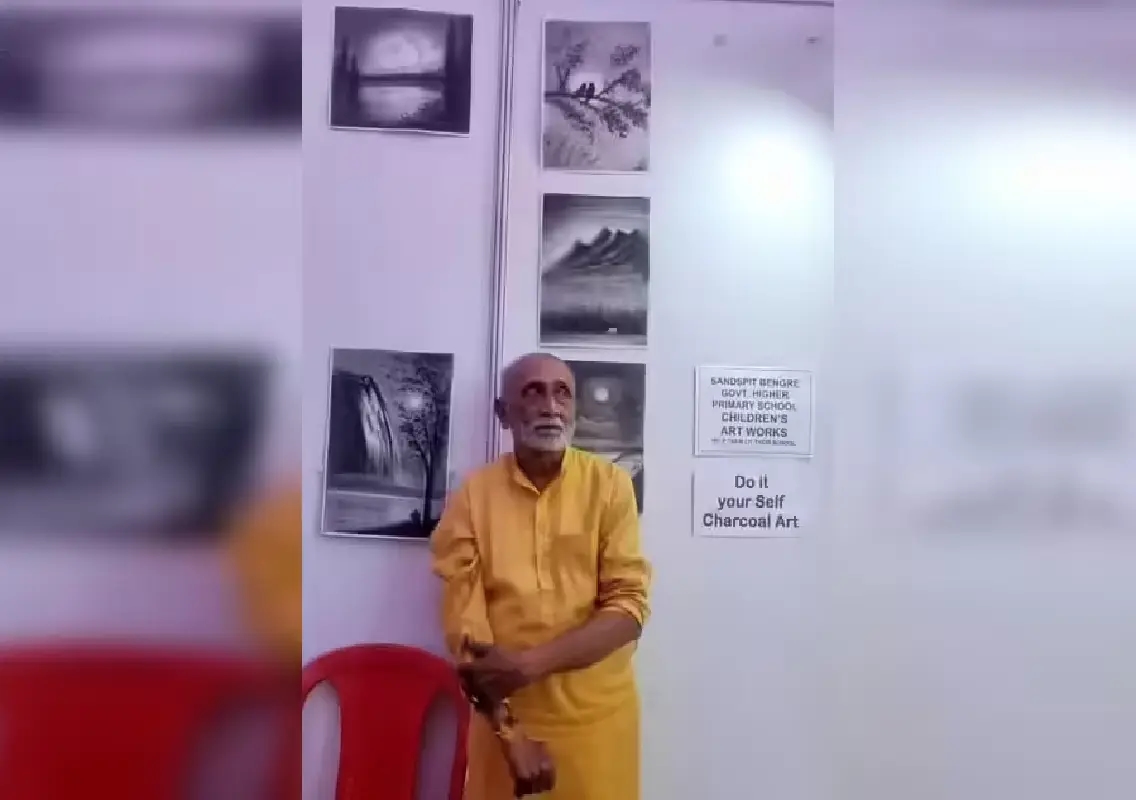


Mangaluru: At an age when many choose to slow down, 76-year-old veteran artist B Dayananda continues to channel his creativity and experience towards a larger social cause. The founder of the Daya School of Arts, Dayananda has taken upon himself the mission of supporting a government school in meeting its basic infrastructure needs—by empowering its students through art.
For nearly four years now, Dayananda has been teaching charcoal painting free of cost to students of the Sandpit Bengre Government Higher Primary School on the outskirts of Mangaluru. What began as voluntary art classes has now evolved into a meaningful initiative aimed at improving the school’s facilities, after the artist noticed the lack of basic amenities on the campus.
Art classes that grew into a larger cause
Dayananda has been visiting the school regularly, usually on Saturdays, to conduct charcoal painting sessions for interested students. Over time, he observed that while the children showed remarkable interest and talent in drawing, the school itself struggled with infrastructural constraints due to limited resources.
“The immediate requirement of the school is an inverter,” Dayananda said. “During the rainy season, classrooms become very dark, and with many academic activities shifting online, uninterrupted power has become essential. We hope to raise funds for an inverter by selling the students’ charcoal paintings.”
To achieve this, Dayananda decided to showcase and sell the artwork created by his students at the Kala Parbha art exhibition, a prominent platform for artists in the region. Works by 10 to 12 students from the school were displayed at a dedicated stall, with each artwork priced at Rs 500.
Students’ talent on public display
The decision to put students’ artwork up for sale not only aimed at fundraising but also provided young artists with exposure and confidence. Visitors to the exhibition had the opportunity to view and purchase charcoal paintings created by government school students—an experience rarely accessible to children from such backgrounds.
Dayananda emphasised that the initiative was as much about recognising talent as it was about addressing material needs. “The talent government school children possess is amazing. They show so much love and enthusiasm and look forward to coming and sitting with me. Their eagerness to learn is truly inspiring,” he said.
A lifetime dedicated to art and teaching
Dayananda’s journey in the field of art spans several decades. He graduated from the School of Visual Arts in 1974 and trained under noted artist Ramdas Shevgoor, whom he describes as his favourite teacher. He also received training at the BGM School of Art, further shaping his artistic foundation.
Over the years, Dayananda has taught charcoal painting to students in about five government schools, including those in Kapikad and Gandhinagar. He continued this outreach work for nearly a decade, firmly believing that art education should not be limited by economic background.
Apart from teaching, Dayananda is also known for his extensive collection of paintings and portraits of Sri Sri Ravi Shankar Guru, a subject he deeply enjoys working on.
School authorities acknowledge his contribution
Umalakshmi K, the headmistress of Sandpit Bengre Government Higher Primary School, spoke highly of Dayananda’s consistent support and dedication. She said the school, which has a student strength of just 75 children, does not have a dedicated drawing teacher, despite students having a keen interest in art.
“The children are very interested in drawing, but they lack opportunities to learn due to the absence of an art teacher. Dayananda has been taking free classes for the past four years. It was entirely his idea to do something more for the school,” she said.
She added that this was not the first time Dayananda had supported the school financially. “Earlier, he contributed funds by selling his own artwork. When he realised how dark classrooms become during the rainy season, and how important electricity has become for teaching, he suggested raising money for an inverter,” she explained.
Plans beyond the inverter
According to the headmistress, if the sale of student artwork generates funds beyond the immediate requirement, the money will be used for other pressing needs. These include constructing a compound wall for the school and installing a steel basin in the handwash area to improve hygiene facilities.
The school currently functions with three government-appointed teachers, one guest teacher, and three teachers sponsored by local residents. Much of its operational support comes from donors and members of the School Development and Monitoring Committee (SDMC).
“When we see what Dayananda is doing at this age, our own contribution feels very small,” Umalakshmi said, highlighting the impact of his selfless efforts on both staff and students.
Conclusion
Dayananda’s initiative stands as a powerful example of how art can transcend aesthetics and become a tool for social change. By nurturing creativity among young students and using their talent to address real-world challenges, he has not only enriched their learning experience but also strengthened a community institution in need. His work underscores the role individuals can play in bridging gaps in public education, one painting at a time.