







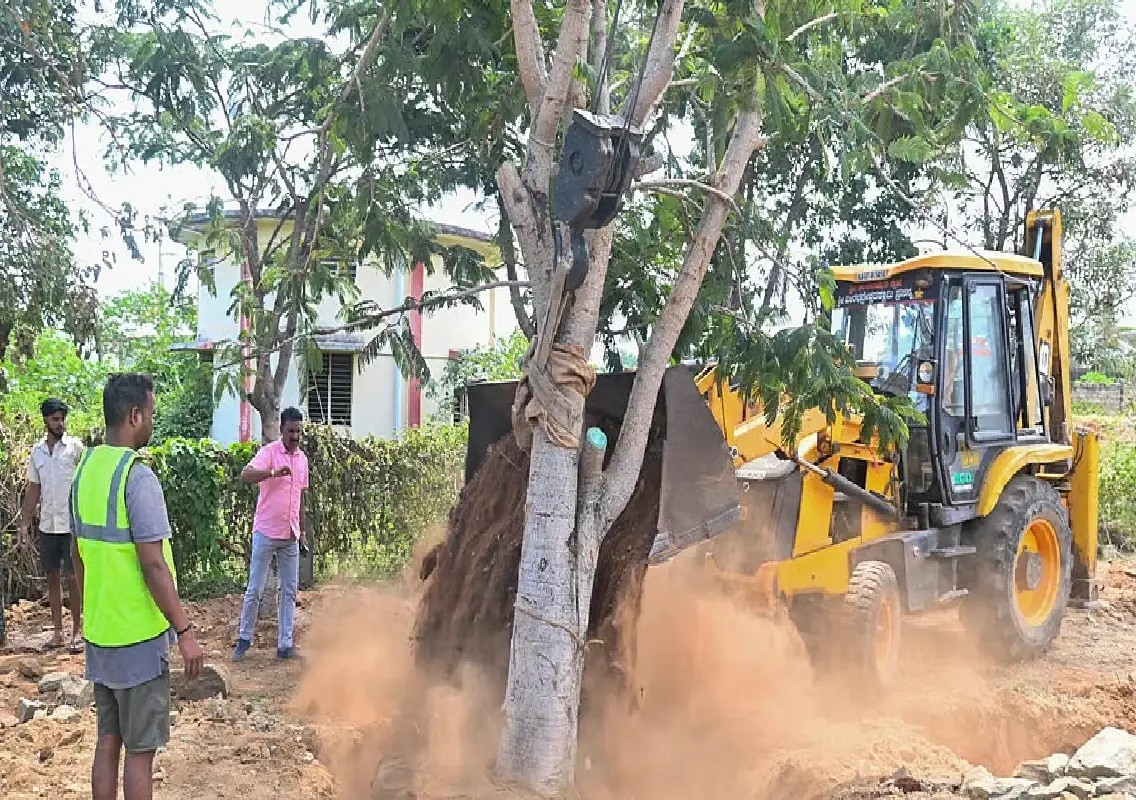


Mysuru: The translocation of trees at Kempegowda Circle, also known as Manipal Hospital junction, is underway to facilitate the construction of a flyover and underpass on the Mysuru-Bengaluru highway.
Of the 278 trees identified for translocation, around 100 have been shifted and replanted so far. However, environmentalists have expressed concern over the manner in which the trees are being relocated and stressed that the transplanted trees require careful maintenance, particularly during the first two months.
278 trees to be translocated
The National Highways Authority of India (NHAI) has taken up the construction of a flyover and an underpass at the junction of NH 275 and the Outer Ring Road to ease traffic congestion.
The junction witnesses heavy traffic, particularly during weekends and holidays, prompting the authorities to take up the infrastructure project.
Initially, around 350 trees had been identified for felling to make way for the project. Following suggestions from the public and consultations with the Forest Department, the plan was subsequently revised.
Under the revised plan, 65 trees will be felled, 278 trees will be translocated and 10 trees will be retained at their existing locations.
Environmentalists question translocation process
The NHAI has entrusted the tree translocation work to a Pune-based company. According to sources, the company is also responsible for maintaining the transplanted trees for two years, with the process having the approval of the Forest Department.
The trees are being excavated along with their roots and surrounding soil using machinery. They are then transported to the new locations and planted with the assistance of cranes.
The Mysuru City Corporation has identified locations near a park and at Shivarathreeshwara Nagar for replanting the trees.
The pits prepared for the trees are reportedly treated with fungicides and insecticides as part of bio-stimulation measures before the trees are replanted.
Environmentalists, however, have raised questions over whether adequate scientific procedures are being followed during the operation.
Activists raise concerns over survival
Environmental activist Mansoor alleged that the relocation work was being carried out in an unscientific manner and claimed that certain norms were not being followed.
He alleged that trees had been planted beneath high-tension electricity lines, which he said violated CESC rules. He also claimed that 49 trees had been planted in a park, while some others had been placed along roadsides.
According to him, the trees were watered on the first day but there were concerns about whether regular watering and maintenance would continue.
“The norms that have to be followed in translocation of trees are being neglected. There is also not much space between the two trees at some places. Everything is being done in a hurry and there are no authorities to supervise this,” he alleged.
Activist Banu Mohan also raised concerns over the maintenance of the trees after transplantation.
She pointed out that younger trees, particularly those below three years of age, generally have better chances of survival, while many of the trees being translocated are older.
She suggested that authorities should also consider planting new saplings alongside the translocation effort.
Banu Mohan also alleged that the transplanted trees were not being watered adequately. She questioned the plan to water the trees once every three days, stressing that regular care is crucial for their survival.
Forest Department says process is being monitored
A Forest Department officer said officials had visited the locations and that the translocation process was being carried out smoothly.
The Mysuru City Corporation has also used water tankers to water the transplanted trees.
However, the availability of water remains a concern. With parts of Mysuru facing water shortages, residents have questioned whether sufficient water can be supplied regularly to the newly planted trees.
A resident of the area pointed out that there are no adequate water sources nearby and that borewells in the locality have also dried up.
Survival rate remains key concern
The survival of the 278 translocated trees will ultimately determine the success of the exercise.
As per the conditions associated with the project, if 70% of the translocated trees fail to survive, three saplings are required to be planted for every tree that does not survive.
Environmentalists have therefore called for close monitoring of the trees, particularly during the initial months after transplantation.
While the tree relocation is intended to reduce the number of trees that need to be felled for the infrastructure project, activists have stressed that simply shifting the trees is not enough.
They have urged the authorities and the agency responsible for the work to ensure proper spacing, watering, supervision and scientific maintenance until the trees establish themselves at their new locations.
With around 100 trees already translocated and the remaining trees scheduled to be shifted, the coming months will be crucial in determining whether the exercise succeeds in preserving the mature trees while allowing the NH 275 infrastructure project to progress.