







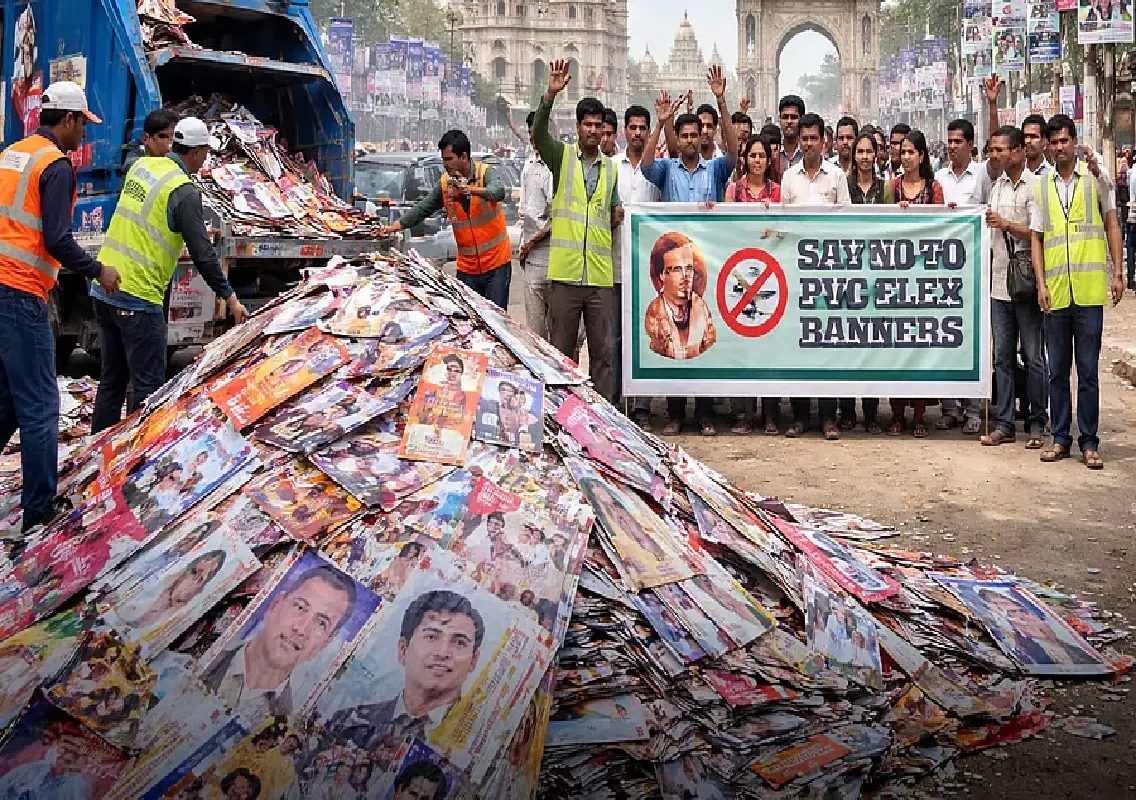


Mysuru: Amid growing environmental and health concerns, activists and authorities in Mysuru are gearing up for a large-scale campaign to curb the widespread use of PVC flexes, banners, and hoardings across urban and rural areas.
Despite existing regulations, the unchecked proliferation of flex materials has become a major issue, affecting not only the city’s aesthetics but also posing serious risks to the environment and public health.
Daily waste highlights scale of problem
According to officials from the Mysore City Corporation (MCC), nearly 300 kg of flex waste is being collected and disposed of ежедневно at waste management facilities in Mysuru city alone.
Flexes dominate public spaces, roads, and traffic circles, often used for advertisements, celebrations, political messaging, and personal events such as birthdays and festivals.
Environmental hazards raise alarm
Experts have raised concerns about the long-term environmental damage caused by PVC flex materials. M S Vijaya Kumar, Associate Professor at the Department of Polymer Science and Technology and Chemistry, explained that flexes are made of complex materials including PVC, plasticisers, additives, and polyester fabrics.
“These materials contain carcinogenic dyes. When exposed to weather, toxins leach into soil and water. When burnt, they release toxic gases and dioxins,” he said.
He added that PVC can take over 100 years to degrade, breaking down into microplastics that contaminate ecosystems and enter the food chain.
Health risks linked to toxic exposure
Medical experts have also warned about the health implications. Dr Sanjeev Rao Girimaji noted that prolonged exposure to toxins such as dioxins can lead to serious conditions including Chronic Obstructive Pulmonary Disease (COPD) and cancer.
He further explained that microplastics and chemical residues can enter the human body indirectly through contaminated food, water, and livestock, increasing risks of hormonal imbalances and long-term illnesses.
Mega awareness campaign planned
Environmental groups are now planning a coordinated campaign to tackle the issue. Activist and engineer Ravi Bale, associated with Parisara Balaga and Mysore Grahakara Parishat (MGP), is leading the initiative along with other local leaders.
The campaign aims to partner with the Zilla Panchayat, MCC, and community organisations to spread awareness at the grassroots level.
“We plan to use jingles, reels, short films, and handouts to educate people. The goal is to change mindsets and encourage alternatives like social media for celebrations,” Ravi Bale said.
He also suggested promoting eco-friendly options such as cotton, khadi materials, and natural dyes for essential signage.
Government steps and enforcement
Authorities have already initiated measures to control the menace. Mysuru Deputy Commissioner G Lakshmikanth Reddy issued an order on February 21 mandating prior permission for putting up flexes and their removal immediately after the permitted period.
The directive is in line with provisions under the Karnataka Open Places (Prevention of Disfigurement) Act, 1981, and the Karnataka Municipalities Act, 1964.
Violations can attract penalties including imprisonment of up to six months, a fine of up to ₹1,000, or both. MCC officials reported that ₹79,000 in fines has already been collected in five cases since the order came into effect.
Panchayat-level action intensifies
S Ukesh Kumar, Chief Executive Officer of the Zilla Panchayat, said strict action is being taken across all taluks and villages.
“We are removing 20 to 25 illegal flexes ежедневно in each taluk. Public participation is crucial, and we welcome support from citizens,” he said.
Public appeal gains traction
Meanwhile, Yaduveer Krishnadatta Chamaraja Wadiyar has drawn public attention by appealing to his supporters not to use flex banners for his birthday celebrations. His move has been widely appreciated and is being seen as a positive example for others to follow.
Conclusion
With increasing awareness and coordinated efforts between authorities and citizens, Mysuru is taking significant steps to address the growing flex menace. While enforcement remains key, long-term success will depend on public cooperation and a shift towards sustainable alternatives.