







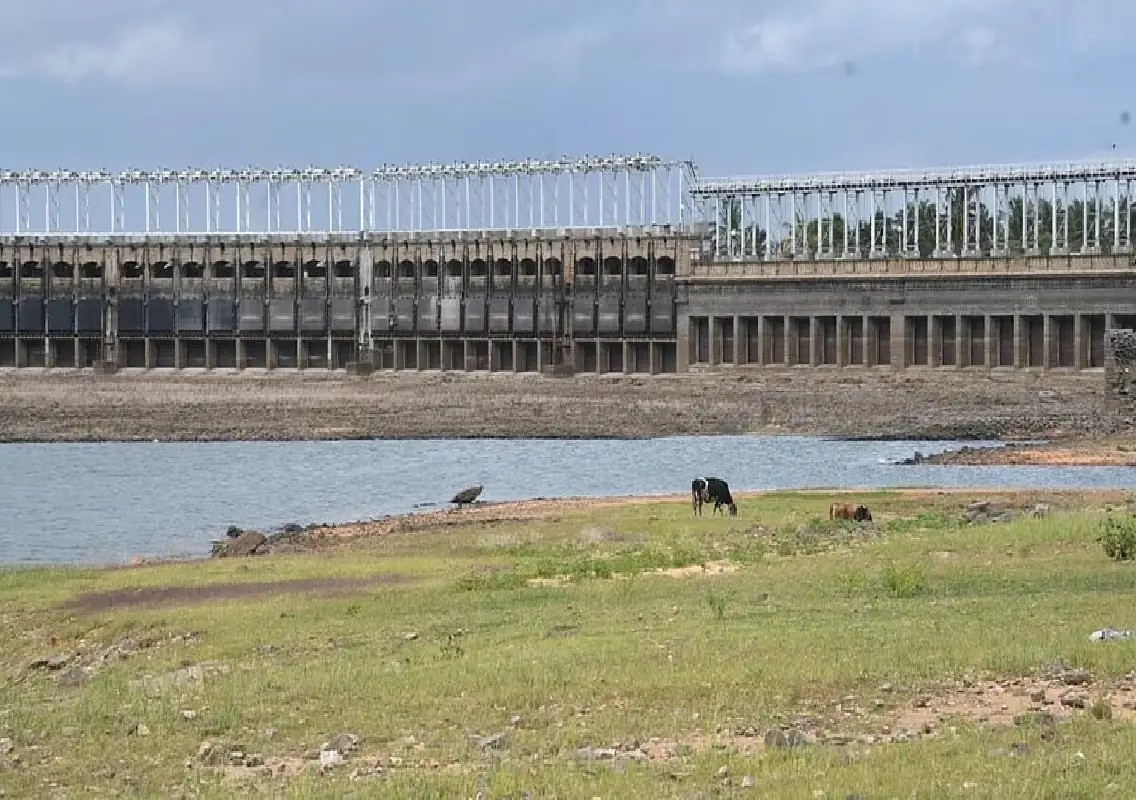


Mysuru: Despite the onset of the southwest monsoon in parts of Karnataka, insufficient rainfall in the Cauvery river catchment areas has led to a rapid decline in water levels across major reservoirs in the Mysuru region, raising concerns over water availability for irrigation in the coming months.
Officials said the delayed arrival of the monsoon and weak rainfall activity in key catchment areas have significantly reduced inflows into the Krishnaraja Sagar (KRS), Kabini and Hemavathi reservoirs, all of which are crucial for drinking water supply and agriculture in southern Karnataka.
KRS water level drops significantly
The water level in the Krishnaraja Sagar (KRS) dam in Srirangapatna taluk of Mandya district stood at 81.35 feet on June 9, substantially lower than its full reservoir level of 124.80 feet.
According to official data, the dam recorded an inflow of only 528 cusec and an outflow of 436 cusec. The current water level is approximately 43.45 feet below its maximum capacity.
On the corresponding date last year, the reservoir level stood at 108.18 feet, supported by an inflow of nearly 17,000 cusec following an early and vigorous monsoon.
The KRS reservoir, which supplies drinking water to Mysuru, Bengaluru and several other regions, had remained in a comfortable position during the past two years due to abundant rainfall in the Cauvery basin.
Catchment rainfall remains crucial
Officials said the reservoirs in the Cauvery basin depend heavily on rainfall in Kodagu district and the Wayanad region of Kerala.
While the India Meteorological Department (IMD) has forecast favourable rainfall in the Mysuru region over the next week, significant improvement in reservoir inflows will occur only if heavy rainfall is received in these critical catchment areas.
Last year, the southwest monsoon arrived nearly 10 days ahead of schedule and covered around 60 per cent of the country by the end of May, resulting in substantial inflows into Karnataka’s reservoirs.
In contrast, this year the monsoon entered Karnataka nearly a week later than usual, affecting water accumulation in major dams.
Reservoir storage below expectations
The total storage capacity of the KRS dam is 49.50 thousand million cubic feet (tmcft), while the current storage stands at 11.399 tmcft.
According to officials of the Cauvery Neeravari Nigam (CNN), nearly 3.35 tmcft of water is required every month from the KRS and Kabini reservoirs to meet the drinking water needs of Bengaluru, Mysuru, Mandya, Chamarajanagar and Bengaluru South districts.
Although current storage levels are considered sufficient to meet drinking water requirements for the next three months, authorities remain cautious about future inflows.
Agriculture sector faces uncertainty
Officials noted that while drinking water supplies are presently secure, the available water may not be adequate for agricultural activities if rainfall remains below normal.
They explained that decisions regarding the release of irrigation water into canals are generally considered only when reservoir levels exceed 100 feet and inflows remain around 2,000 cusec or more.
The Irrigation Consultative Committee is expected to assess the situation once monsoon conditions improve.
Farmers across the Cauvery basin are closely monitoring rainfall patterns as reservoir levels directly influence irrigation schedules for seasonal crops.
Kabini and Hemavathi also report low inflows
The Kabini dam in H D Kote taluk of Mysuru district recorded a water level of 2,251.61 feet against its maximum level of 2,284 feet.
The reservoir received an inflow of 890 cusec while releasing 600 cusec downstream.
Meanwhile, the Hemavathi reservoir in Hassan district recorded a water level of 2,890.88 feet against its full reservoir level of 2,922 feet. The inflow stood at 239 cusec while the outflow was 300 cusec.
Officials said sustained rainfall in the coming weeks will be essential to improve storage levels across all three reservoirs.
Conclusion
The delayed southwest monsoon and weak rainfall in the Cauvery catchment areas have resulted in declining water levels in Karnataka’s key reservoirs. While current storage remains adequate for drinking water needs, concerns are mounting over irrigation requirements and future water availability. Authorities are now closely watching rainfall in Kodagu and Wayanad, which will determine the replenishment of the KRS, Kabini and Hemavathi reservoirs in the weeks ahead.