







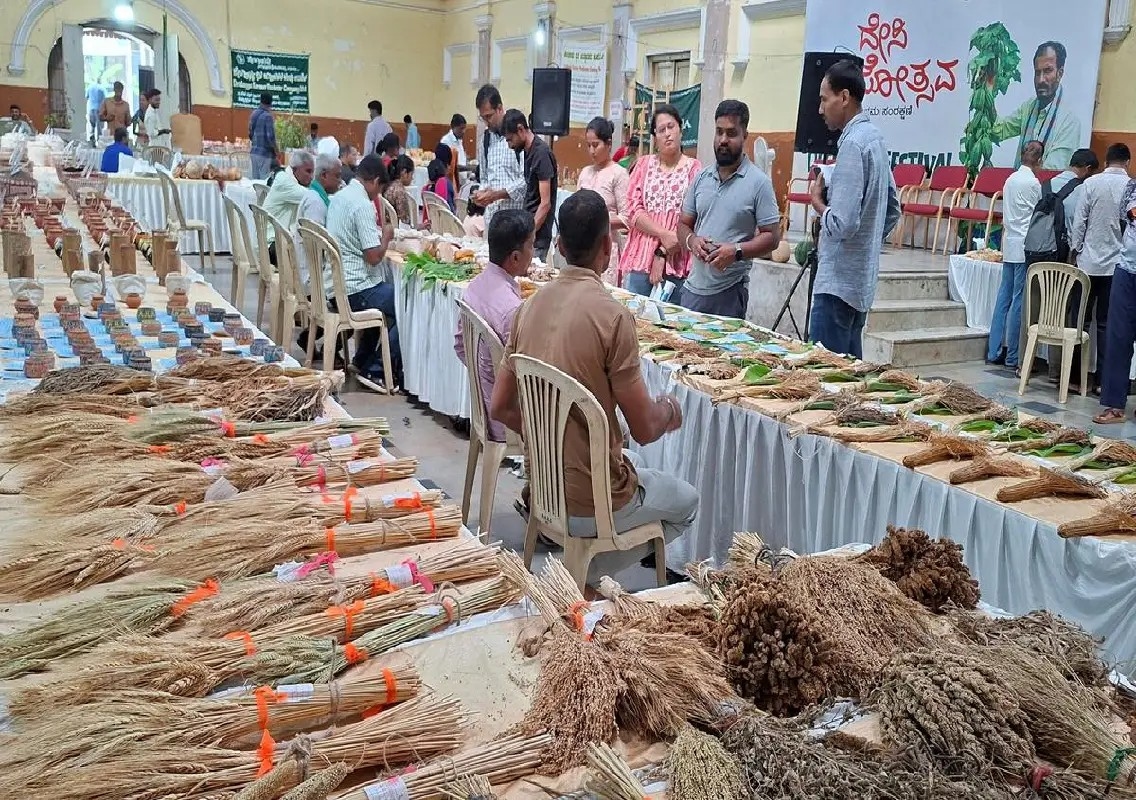


Mysuru: The two-day Desi Beejotsava, a festival celebrating indigenous seeds and the farmers dedicated to conserving them, concluded on Sunday at Nanjaraj Bahadur Choultry in Mysuru. The event brought together seed conservators, farmers, biodiversity experts and agriculture enthusiasts from across Karnataka, highlighting the importance of preserving traditional crop varieties and promoting sustainable farming practices.
Organised under the aegis of Sahaja Samrudha, the Karnataka Biodiversity Board and Sahaja Seeds, the festival served as a platform for sharing indigenous seeds, exchanging knowledge and creating awareness about the need to protect agricultural biodiversity.
Hundreds of visitors attended the event, interacting directly with seed conservators and purchasing a wide variety of native seeds, plants and naturally grown farm produce.
Seed conservators showcase traditional varieties
One of the major attractions of the festival was the stall of Padmamma from Kanagal in Periyapatna, popularly known among farming communities as a seed mother. She displayed nearly 150 varieties of paddy seeds and distributed samples to interested visitors in small paper packets, encouraging more people to cultivate indigenous rice varieties.
Farmers and conservationists from different districts also exhibited rare crops and traditional seeds that are increasingly difficult to find in conventional markets. Nagaraju from Manakatti village in Haveri district brought medicinal plants and yam tubers, while the Hulikadu Farmer Producer Company from H.D. Kote showcased uncultivated plants and vegetable seeds.
Renowned seed conservator Kalappa from Hitne Hebbagilu in Periyapatna displayed a range of leafy vegetables and vegetable seeds. Meanwhile, Devdanya Farmer Producer Company from Kundgol presented more than 100 varieties of millet and pulse crops, demonstrating the richness of Karnataka’s agricultural heritage.
Visitors show keen interest in rare crops
The festival witnessed enthusiastic participation from seed collectors, gardeners, farmers and consumers interested in sustainable agriculture. Many visitors purchased indigenous seeds and plants for cultivation in home gardens and farms.
A significant attraction was the “Shankara Jackfruit”, popularly referred to as the King of Red Jackfruits. Visitors also showed considerable interest in “Juice Bilwa”, a fruit tree widely known in northern India but still relatively uncommon in Karnataka.
The popularity of such unique varieties reflected growing public interest in preserving traditional food crops and exploring alternatives to commercially dominant varieties.
Naturally grown produce receives strong response
Naturally grown fruits and farm products attracted buyers throughout the event. Several traditional mango varieties, including Mallika, Imam Pasand, Dasheri, Amrapali, Langra and Malgoba, were sold at prices ranging between ₹70 and ₹150 per kilogram.
Farmers participating in the festival said the direct interaction with consumers helped them receive better value for their produce. Hoysala Appaji from Holenarasipura noted that customers appreciated the taste of naturally grown Dasheri and Amrapali mangoes after sampling them.
He explained that local traders often offer low prices because naturally grown fruits sometimes develop black spots due to rain and wind. However, visitors at the festival recognised the quality and flavour of the produce, resulting in strong sales.
Similarly, Nagamma from Nooralakuppe in H.D. Kote expressed satisfaction over the demand for jackfruit. She said direct sales at the festival allowed farmers to reach customers who appreciated traditional produce that often receives little attention in local markets.
Drawing competition promotes awareness among children
As part of the festival, organisers conducted a drawing competition for children aimed at encouraging awareness about seed diversity and agricultural traditions.
In the five-to-nine years category, Rishika Nandi S.K. secured the first prize, followed by Kushal R. in second place and Drushya S. in third. Ritanya and Apoorva received consolation prizes.
In the 10-to-12 years category, Vismaya won the first prize, while Dheeraj K. secured second place and Gokul Aryan finished third. Samruddh S.K. received a consolation prize.
Prizes were distributed by S. N. Vasudevan, Dean of Alva’s College of Agriculture, Moodbidri, who commended the efforts of participants and organisers in promoting awareness about biodiversity and conservation.
Seed conservators directory released
A key highlight of the closing ceremony was the release of the “Karnataka Seed Conservators Directory” by Vijayalakshmi, Executive Officer of the Karnataka Biodiversity Board. The publication is expected to serve as a valuable resource for farmers, researchers and conservationists working to preserve traditional crop varieties across the state.
Organisers said the initiative would help strengthen networks among seed conservators and support the continued exchange of indigenous seeds and farming knowledge.
For those unable to attend the festival, arrangements have been made for the sale of native seeds and organic products at Kisan Mall located within the Horticulture Nursery premises near Kukkarahalli Lake in Mysuru.
The successful conclusion of Desi Beejotsava once again highlighted the growing importance of seed conservation, sustainable agriculture and community-led efforts to protect Karnataka’s rich agricultural biodiversity for future generations.