







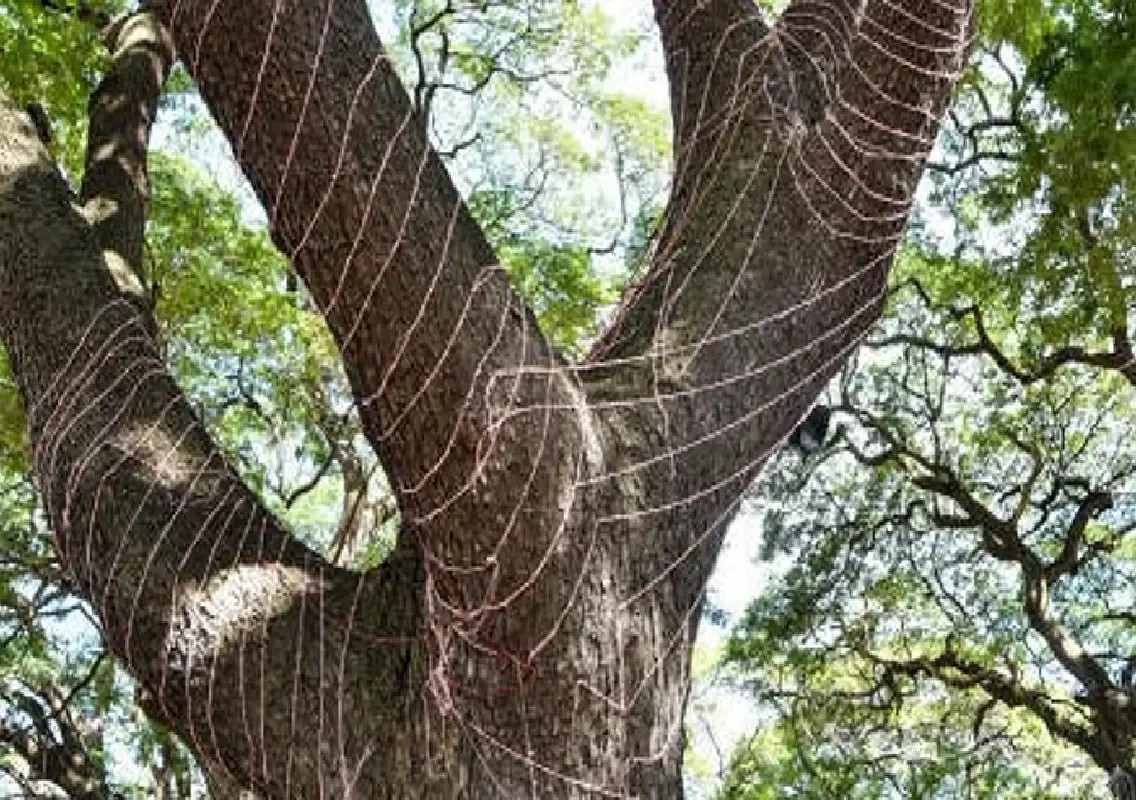


Mysuru: With the countdown to Mysuru Dasara underway, the Chamundeshwari Electricity Supply Corporation (CESC) is preparing to illuminate the city with colourful designer lighting fixtures. However, environmentalists and activists have urged authorities to ensure that trees are not used to support electrical decorations, warning that such practices could damage trees and affect the biodiversity they sustain.
The appeal comes as Mysuru prepares for its annual festival while continuing to promote its identity as a green and clean city. Activists have sought directions from the State Government, Mysuru Deputy Commissioner, Mysuru City Corporation and the Deputy Conservator of Forests, Mysuru Territorial Division, to prevent CESC and its contractors from using trees for Dasara illumination or other public functions.
Activists raise concerns over electricity consumption
According to the activists, CESC spent around Rs 7 crore last year to illuminate 136 km of roads for 21 days. The decorations reportedly consumed approximately 2,57,520 units of electricity.
Environmental activist Ravi Bale questioned the justification for such large-scale electricity consumption, particularly amid rainfall deficits that can affect hydroelectricity generation.
“Amid deficit rainfall when hydroelectricity production is affected, spending huge electricity for Dasara illumination itself is not justified,” he said.
He also stressed that celebrating the festival should not come at the cost of nature and biodiversity.
“Worship of Nature would be true worship of Goddess Sri Chamundeshwari Devi. Inflicting pain to trees, disturbing biodiversity depending on them for the sake of celebration is absurd,” Bale said.
Trees seen as part of Mysuru’s heritage
Retired Major General Sudhir G Vombatkere said trees across Mysuru, irrespective of their age, form an important part of the city’s cultural and environmental heritage.
He pointed to the legacy of Nalwadi Krishnaraja Wadiyar, who strongly promoted greenery and environmental conservation in the city. According to him, protecting trees is therefore not only an environmental responsibility but also a way of preserving Mysuru’s heritage.
Vombatkere also referred to Article 51A(g) of the Constitution, which places a fundamental duty on citizens to protect and improve the natural environment.
“Trees must not be used for anything at all, except for people and animals utilising the shade and microclimate that each tree produces naturally,” he said.
He added that trees and green cover act as protection against urban heat generated by rapid urbanisation, road widening and construction of flyovers.
Temporary poles suggested for illumination
Vombatkere said any disturbance to trees, even for a short period during Dasara, could have long-term environmental consequences.
“If Dasara night lighting decoration is considered inescapable, let it be mounted on poles fixed temporarily for a limited period away from trees, without using trees for support,” he suggested.
He said authorities should ensure that festival arrangements do not undermine Mysuru’s existing green cover.
Lights and cables can damage trees
T S Harsha, Associate Professor and Director of the Research and Development Cell in the Department of Environmental Science at Karnataka State Open University, explained the potential impact of fixing decorative lights and electrical cables directly onto trees.
According to Harsha, wires, nails and ropes used to attach decorations can damage tree bark and the cambium layer. Such injuries can create openings through which pests, fungi and bacteria enter, potentially causing long-term structural weakness.
Tight wrapping of cables can also result in girdling, which may interfere with the movement of water and nutrients through the tree.
Harsha further pointed out that trees depend on natural day-night cycles. Prolonged exposure to artificial lighting can interfere with their biological rhythms and affect processes such as flowering, leaf shedding and other seasonal responses.
High-intensity lighting placed close to foliage could also cause localised heating and contribute to drying of leaves or bark.
Electrical installations pose additional risks
Harsha said the potential damage is not limited to branches and trunks. Installing temporary poles or electrical panels near trees may involve digging that can damage surface roots.
Such damage could reduce a tree’s ability to absorb water and affect oxygen exchange in the soil, he said.
Improper or overloaded electrical wiring around trees could also increase the possibility of short circuits, sparks and fires. During rains or periods of high humidity, electrical installations around trees may additionally create safety hazards for both people and vegetation.
Artificial lighting may disturb urban biodiversity
Zoologist B R Guruprasad highlighted the role trees play in supporting a wide range of biodiversity, from microorganisms to mammals.
Tree bark and leaf litter provide habitats for microbial organisms and contribute to nutrient cycling, while branches and foliage provide feeding and nesting spaces for insects, birds and small reptiles.
Guruprasad said artificial electric lighting can interfere with nocturnal species and pollinators by altering their natural behaviour.
He also warned that drilling nails into trees or hanging electrical decorations, even temporarily, can damage trees and disturb the wider urban ecosystem.
With Dasara preparations gaining momentum, environmentalists have therefore urged authorities and contractors to adopt alternatives that keep electrical decorations away from trees. They argue that temporary poles and other independent structures can allow the city to retain its festive appearance without putting its valuable green cover and biodiversity at risk.