







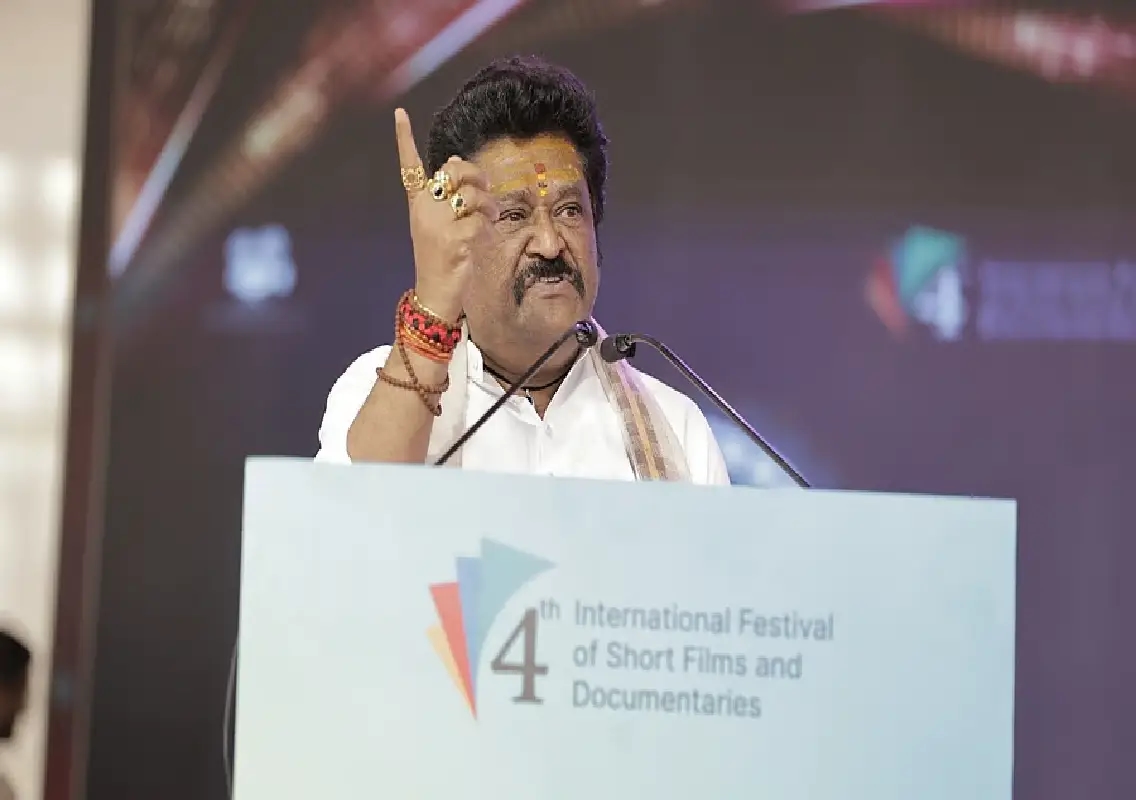


Mysuru: Rajya Sabha Member, actor and filmmaker Jaggesh said times have changed for the film industry, with Prime Minister Narendra Modi extending support to filmmaking through structured platforms under the Union Ministry of Information and Broadcasting.
Delivering the keynote address at the inaugural session of the three-day Fourth International Festival of Short Films and Documentaries ‘Paridrishya 2026’, hosted by the Mysuru Cinema Society at Maharaja College Grounds on Friday, Jaggesh reflected on his early struggles in cinema and the transformation of the industry over the decades.
Support through ICH and FFO
Jaggesh highlighted the role of the India Cine Hub (ICH) and Film Facilitation Office (FFO) in streamlining film production processes. He noted that these platforms have made filmmaking more accessible and organised for aspiring filmmakers.
“I am highly indebted to cinema for what I am today. I am fortunate to work under an able Prime Minister. My journey into cinema began in unexpected ways, including my handwriting skills in Kannada script,” he recalled, drawing applause from the audience.
He observed that institutional support, digital systems and policy reforms have reduced procedural hurdles that earlier made filmmaking a challenging pursuit.
Concerns over piracy and negative reviews
While acknowledging progress, Jaggesh expressed concern over the growing menace of piracy. “We invest crores of rupees and years of effort into making a film. Yet, many people watch pirated versions on their mobile phones. It deeply affects the industry,” he said.
He also criticised what he termed as “hearsay reviews” that damage films without fair evaluation. “We welcome criticism and constructive reviews. But negative opinions formed without watching the film are harmful to the industry,” he added.
Debate on certification and false narratives
Lyricist, music composer and director V Nagendra Prasad addressed concerns regarding film certification and alleged misinformation.
He refuted claims that the Indian government was preventing Palestinian films from being screened at Indian festivals. Referring to the role of the Central Board of Film Certification (CBFC), he clarified that no film can be screened in India without certification.
“If the government had blocked such films, how was ‘Palestine 36, Once Upon a Time in Gaza’ screened at the 17th Bengaluru International Film Festival?” he asked, emphasising that certification procedures must be followed uniformly.
Importance of film societies
National award-winning director P Sheshadri stressed the need to strengthen film societies to cultivate discerning audiences. He pointed out that Kerala once had over 1,000 film societies, a number now reduced to around 500, but credited them with nurturing appreciation for quality cinema.
“That culture helped Malayalam cinema maintain strong storytelling traditions,” he said, underscoring the role of community-based film appreciation movements.
Writer Jogi (Girish Rao Hatwar) said technological advancements have democratised filmmaking. “Short films and documentaries now have greater reach and impact. However, mainstream Kannada cinema has been influenced by external factors, often portraying violence as the only solution to societal problems,” he observed.
Global participation at Paridrishya 2026
The festival has received 3,140 entries from 114 countries, reflecting its growing international stature. Screenings are being held in temporary theatres named after Kannada cinema stalwarts Puttanna Kanagal and Dr Vishnuvardhan at the venue.
Masterclasses and workshops are scheduled for media enthusiasts, conducted by national and international experts. Awards in various categories will be presented during the valedictory ceremony on Sunday. An exhibition and food court have also been arranged as part of the event.
Actors Karunya Ram Gowda and other dignitaries, including society president Dr G R Chandrashekar, secretary Padmavathi S Bhat, Chetan, Jogi Manju and vice-president Shobith Rangappa, were present at the inauguration.
The discussions at the festival reflected both optimism about institutional support for cinema and concern over challenges such as piracy, certification debates and content quality, signalling a dynamic phase for Indian filmmaking.