







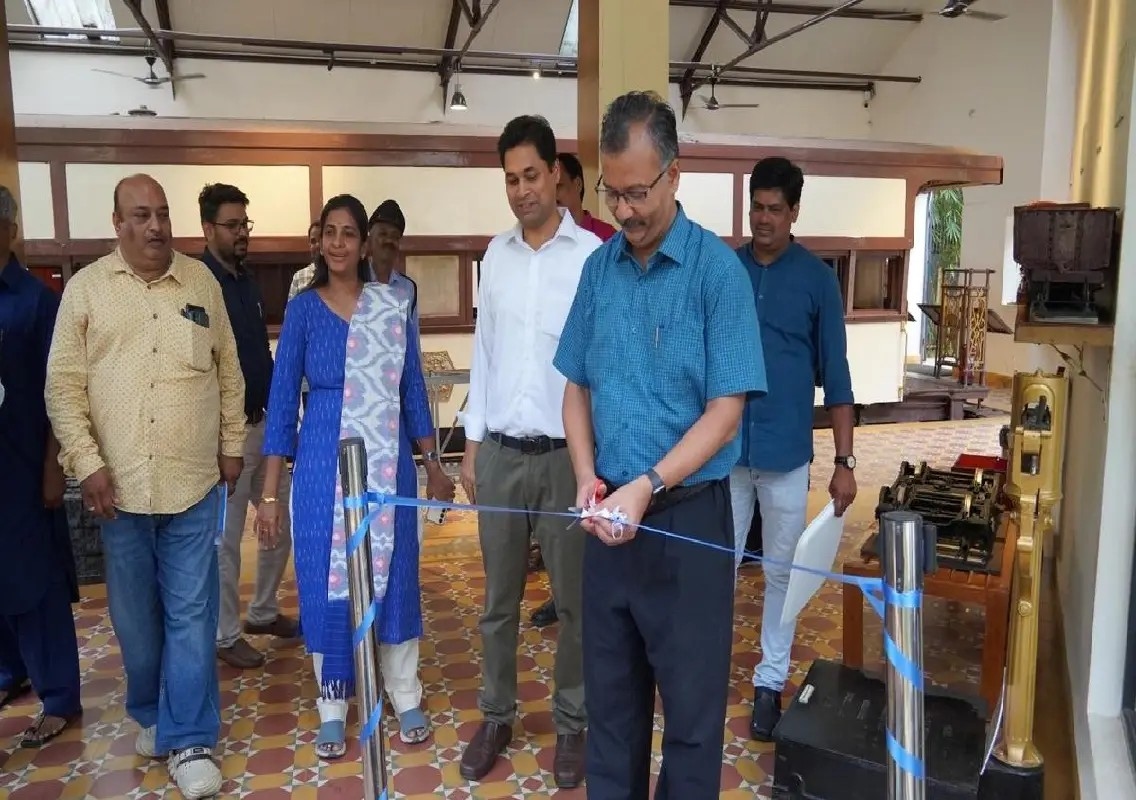


Mysuru: A rare and historically significant railway artifact dating back to the late 1880s has been restored and unveiled at the Mysuru Railway Museum, offering visitors a glimpse into the engineering heritage of India’s railway system. The restored exhibit, a mechanical platform weighing scale with a capacity of 2,000 kilograms, was formally dedicated to the public by Divisional Railway Manager Mudit Mittal.
The heritage asset, manufactured by the renowned British company Henry Pooley & Son of Liverpool, is among the few surviving examples of Victorian-era railway weighing equipment. Railway officials described the restoration as an important step in preserving the rich legacy of Indian Railways and showcasing the evolution of railway operations over the decades.
Heritage exhibit inaugurated at railway museum
The restored weighing machine was inaugurated by Mudit Mittal, Divisional Railway Manager of Mysuru Division, in the presence of branch officers and railway officials.
The unveiling marks the addition of another valuable exhibit to the Mysuru Railway Museum, which houses several historic artifacts reflecting the development of rail transport in India.
Officials said the restoration was undertaken to preserve a unique piece of railway history and provide visitors with an opportunity to understand how railway operations functioned during the colonial era.
Artifact dates back to the late 19th century
The mechanical platform weighing scale was manufactured in the late 1880s by Henry Pooley & Son, a company widely recognised for producing high-quality weighing equipment for railways, ports, factories and commercial establishments across the British Empire.
Originally acquired by the South Indian Railway, the weighing machine served an important role in railway operations for several decades. Following the merger of Mysore State Railway, South Indian Railway and Madras & Southern Mahratta Railway in 1951, the equipment became part of Southern Railway.
Its final operational location was Bangarpet Junction, which now falls under the jurisdiction of South Western Railway.
The restoration ensures that the artifact will continue to educate future generations about the technological advancements of the period.
Engineering excellence of the Victorian era
The weighing machine reflects the engineering precision and craftsmanship associated with the Victorian era. Constructed primarily from cast iron, the scale features a robust mechanical design that enabled it to accurately weigh loads of up to 2,000 kilograms.
The system relied on a sophisticated lever-and-beam mechanism, allowing railway personnel to measure the weight of passengers’ luggage, parcels and consignments before the introduction of electronic weighing technology.
Railway officials noted that such equipment played a crucial role in freight management and baggage handling at stations across the railway network.
The durability of the machine is evident from the fact that it survived more than a century of use before being preserved as a museum exhibit.
Link to India’s railway heritage
According to railway authorities, the restored scale serves as a tangible connection between the legacy of the South Indian Railway and the present-day South Western Railway.
The exhibit illustrates how railway administrations managed parcel and baggage traffic during an era when all weighing operations depended on mechanical systems and manual calculations.
By preserving such artifacts, Indian Railways aims to highlight the transformation of railway technology from mechanical instruments to modern digital systems.
Officials believe the exhibit will be of particular interest to railway enthusiasts, students, historians and tourists interested in industrial heritage.
Henry Pooley & Son’s global reputation
Henry Pooley & Son was among the most respected manufacturers of weighing equipment during the 19th and early 20th centuries. The company supplied precision scales and weighing systems to railways and industries across Britain and various parts of the British Empire.
Its products were known for their accuracy, durability and engineering quality, making them a preferred choice for railway operators during the period.
The presence of a Pooley weighing machine in India reflects the historical links between British industrial manufacturing and the expansion of railway infrastructure across the subcontinent.
Visitors advised to preserve exhibit
Railway authorities have encouraged visitors to view and photograph the restored artifact as part of their museum experience.
However, officials have requested members of the public not to climb onto the platform or touch the delicate mechanical components. Such precautions are necessary to preserve the integrity of the exhibit and protect it from accidental damage.
The museum hopes that the restored weighing scale will continue to serve as an educational and heritage attraction for years to come.
Conclusion
The restoration of the 1880s mechanical platform weighing scale at the Mysuru Railway Museum celebrates a remarkable chapter in railway history. As a symbol of Victorian engineering and early railway operations, the exhibit offers visitors an opportunity to appreciate the technological innovations that once formed the backbone of India’s railway network.