







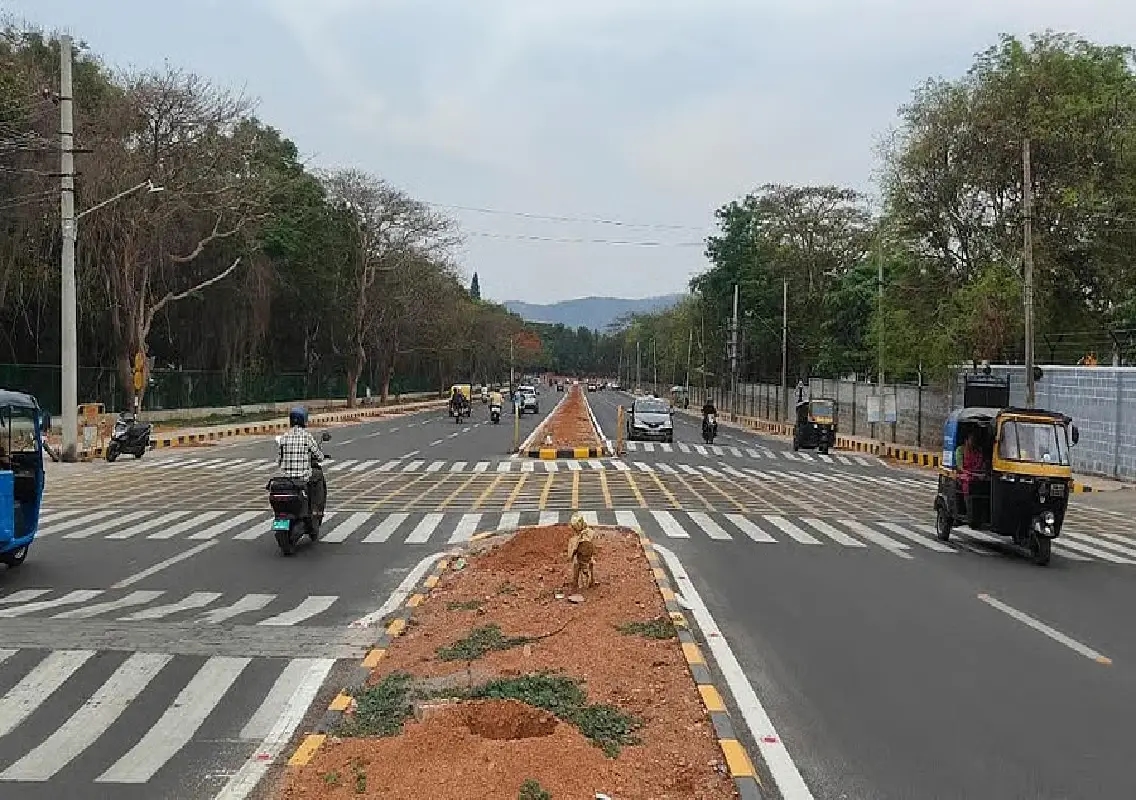


Mysuru: A year after nearly 40 fully grown Peltophorum trees were felled for the widening of Hyder Ali Road, the project has been completed, but concerns over environmental impact continue to linger among citizens and activists.
The road, stretching between the SP Office Circle and Kalikamba Temple, has been widened significantly by the Mysore City Corporation (MCC) as part of infrastructure development efforts aimed at easing traffic congestion.
Road expansion completed
According to MCC officials, the road width has been expanded from approximately 11 metres to 30 metres, including a 2.5-metre-wide median, over a stretch of 360 metres. The project was completed at a cost of Rs 3.8 crore.
MCC Superintendent Engineer Manjunath stated that the road will be formally inaugurated after the installation of ornamental poles fitted with LED lighting along the median.
The project was undertaken using funds from the SST grant of Tanveer Sait, MLA of Narasimharaja constituency.
Plans for green cover restoration
In an effort to compensate for the loss of trees, the civic body has prepared to plant 123 saplings along both sides of the road and on the median. The initiative aims to transform the stretch into a visually appealing “pink road.”
MCC Assistant Executive Engineer (Horticulture) P. K. Mohan Kumar said that Tabebuia rosea saplings will be planted for beautification. These trees, known for their pink blossoms, are expected to flower within three years and have vertical root systems that minimise damage to road infrastructure.
Additionally, around 1,000 bougainvillea plants will be grown along the median. The plantation plan includes 40 trees near the compound of the Karnataka Police Academy, 50 along the median, and 33 towards the SP Office road.
Environmental concerns persist
Despite these efforts, environmentalists have raised concerns about the loss of mature trees and the ecological impact of such projects.
Members of Parisara Balaga suggested that a diverse mix of native species such as Mimusops elengi, Aphanamixis polystachya, and Lagerstroemia speciosa should have been planted instead of focusing primarily on ornamental varieties.
They argue that such species support biodiversity and provide habitat for birds and other organisms.
Another concern raised relates to planting trees on medians. Experts suggest that shrubs may be more suitable to prevent headlight glare from oncoming vehicles, while also avoiding future pruning or removal due to interference with large vehicles.
Debate over tree felling and compensation
The felling of the 50-year-old trees in April 2025 had triggered widespread public outrage, with protests and candlelight vigils held across the city.
The tree cutting was permitted under the Karnataka Preservation of Trees Act, 1976, with authorities citing traffic improvement as the primary reason.
As part of compensatory measures, MCC paid Rs 7.5 lakh to the forest department to plant ten saplings for every tree cut, amounting to around 400 saplings.
Forest officials stated that these compensatory plantations have already been carried out in areas such as BEML and Saptharushi layouts, where thousands of saplings, including Mahogany, Neem, and Indian Beech, have been planted.
Parallel concerns over tree removal
Meanwhile, a similar issue has emerged on NH-275 Mysuru ring road, where the Public Works Department (National Highways) has sought permission to cut 48 neem trees to facilitate the construction of a flyover at Devalapura cross junction.
Public hearings on the matter have remained inconclusive, and the forest department has extended the deadline for submitting objections until April 10.
Conclusion
While the widening of Hyder Ali Road is expected to ease traffic and improve connectivity, the project has reignited the debate between development and environmental conservation. As Mysuru continues to expand, striking a balance between infrastructure growth and ecological preservation remains a pressing challenge for authorities and citizens alike.