







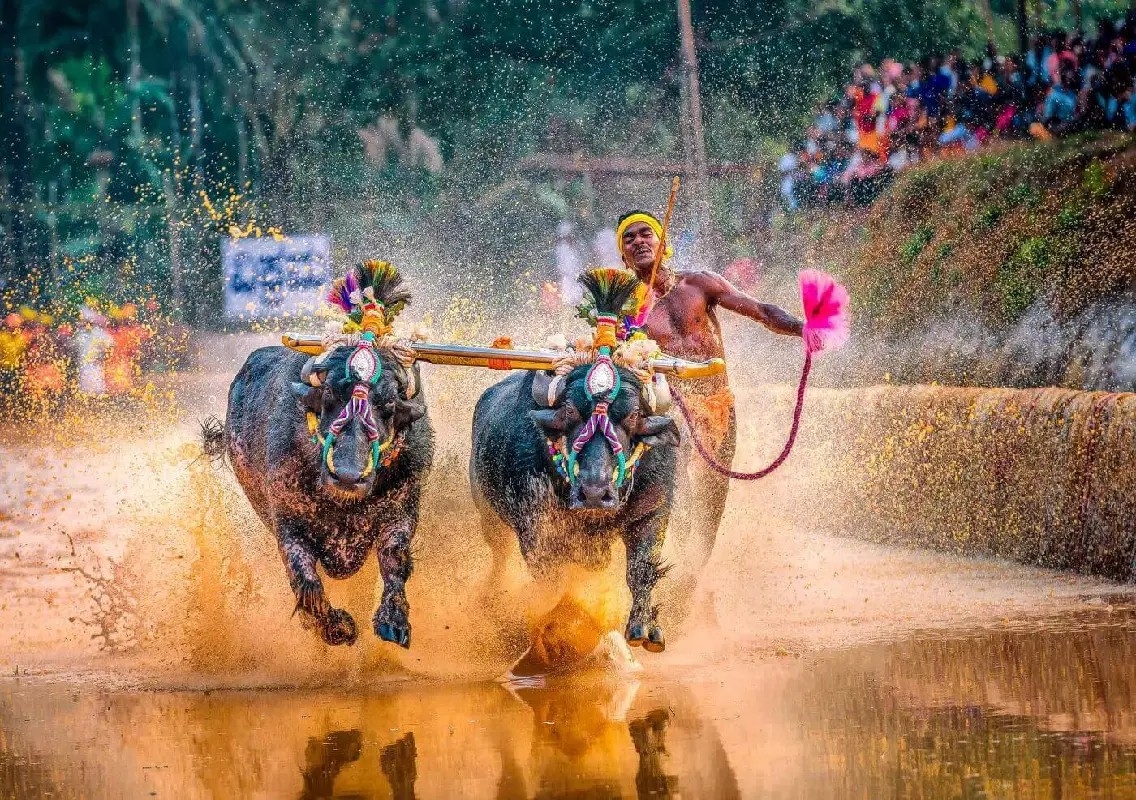


Mysuru: The inclusion of Kambala, Karnataka’s traditional buffalo race from the coastal districts, in this year’s Mysuru Dasara celebrations has triggered a wide-ranging debate over cultural identity, environmental sustainability, water use and the changing character of the state’s flagship festival.
The event is scheduled for October 18 and 19 and is being presented as an opportunity to take one of Karnataka’s best-known traditional sports to a larger audience. Supporters say Kambala must evolve with changing times and reach audiences beyond its traditional home in Dakshina Kannada and Udupi.
Critics, however, argue that Kambala cannot be separated from the landscape and agricultural traditions from which it emerged. They contend that moving the sport to an urban setting could dilute its cultural context while creating an artificial environment requiring substantial quantities of water.
The controversy has also intensified because of concerns over the environmental impact of the proposed venue and allegations of tree felling.
Government plans Kambala event during Dasara
The State Government has decided to organise Kambala as part of the Dasara festivities, with a sub-committee headed by the Zilla Panchayat CEO overseeing preparations.
A venue in the eastern part of the city has been identified, where a slush track of around 250 metres is being prepared. Arrangements are also being made for spectators, parking, buffaloes and their handlers.
Organisers have indicated strong interest from the Kambala fraternity. Registrations had crossed 125 pairs at one stage, while subsequent reports put the number at more than 180 pairs.
For supporters, the event would provide an opportunity to introduce Kambala to tourists visiting the city during Dasara, including visitors from other parts of India and abroad.
From agricultural fields to a competitive sport
Kambala has deep roots in the paddy-growing regions of coastal Karnataka. Traditionally, buffaloes were raced through slushy agricultural fields after the farming cycle, linking the practice to agriculture, fertility rituals and community celebrations.
Over the decades, the sport has undergone significant changes. The emergence of permanent tracks from the late 1960s and the fragmentation of large agricultural holdings gradually shifted Kambala away from its original field-based setting.
By the 1980s and 1990s, it had developed into a major spectator sport. Organised competitions, timing systems, cameras and photo-finish technology have subsequently transformed it into a highly competitive sporting event.
Today, the Kambala season generally runs from November to March, with numerous events held across the coastal belt.
Supporters see Mysuru as a new platform
Supporters of the Dasara event argue that taking Kambala outside its traditional region does not necessarily amount to abandoning its cultural roots.
Puttur MLA Ashok Kumar Rai, one of the principal proponents of the Mysuru event, has argued that Dasara itself has expanded considerably over the years.
The festival now includes attractions such as Yuva Dasara, laser shows, air shows, orchestral performances and other programmes that were not part of its traditional format.
In that context, supporters believe Kambala can become another attraction while introducing the coastal tradition to a wider audience.
Karnataka State Kambala Association president Belapu Deviprasad Shetty has also indicated that stakeholders are willing to participate.
Supporters further argue that traditional sports need new platforms as agricultural practices change. They point to the success of Kambala events outside the coastal region, including the major event held in Bengaluru in 2023, as evidence that the sport has developed an audience beyond its traditional geographical boundaries.
Critics question whether location matters to tradition
The central criticism is not necessarily against Kambala as a competitive sport, but against placing it within the Mysuru Dasara celebrations.
Kambala’s traditional identity is closely connected to the paddy fields, monsoon, agricultural calendar and social customs of coastal Karnataka. Its original setting was not merely a backdrop but an integral part of the practice.
Heritage expert Dr N S Rangaraju has argued that the folk sport evolved in Dakshina Kannada and should not be conducted as part of Mysuru Dasara.
Farmer leader Badagalapura Nagendra has similarly clarified that the opposition is to the inclusion of Kambala in the Dasara programme rather than to Kambala itself.
This has produced a fundamental question: Can a tradition be relocated without changing its cultural meaning?
Environmental concerns add another dimension
Environmental groups in Mysuru have raised concerns over the proposed site as well as the ecological implications of creating an artificial Kambala track.
Activists have alleged that trees were felled at the site. The Forest Department subsequently registered an FIR over the alleged felling of 36 trees.
Concerns have also been raised about a nearby lake and the ecological value of the area.
Members of Parisarakkagi Naavu and representatives of environmental, farmers’, Kannada and progressive organisations have decided to form an action committee opposing the event.
Their concerns extend beyond tree felling to the broader environmental footprint of recreating a traditional wetland-like sporting environment in an urban location.
Water requirement becomes major flashpoint
Perhaps the most contentious issue is the amount of water required to create and maintain the slush track.
Estimates have varied considerably. Activists and water-related experts have cited figures ranging from around 10 lakh litres to at least 25 lakh litres.
Prof U N Ravikumar, a water expert, has estimated the requirement at a minimum of 25 lakh litres.
The difference in estimates itself highlights the uncertainty surrounding the eventual water footprint of the event. Activists, meanwhile, have questioned whether such consumption can be justified when several parts of Karnataka continue to face concerns relating to rainfall, drinking water and agricultural requirements.
The issue becomes particularly sensitive because traditional Kambala developed in a region naturally shaped by heavy monsoon rainfall and water-rich agricultural landscapes. Recreating those conditions in an urban environment requires water to be brought in and managed artificially.
Monsoon conditions sharpen concerns
Environmental groups say the timing of the event has added to their concerns.
With rainfall patterns and water availability remaining important issues in the state, they believe government resources should be prioritised for drinking water, agriculture and water conservation rather than an additional festival attraction.
Supporters, on the other hand, argue that the water requirement needs to be assessed based on actual arrangements, including the source of water and whether it can be recycled or reused.
They say the event should not be described as wasteful without examining the final design and resource-management measures.
Animal welfare remains a separate debate
Kambala has also faced longstanding scrutiny over the treatment of buffaloes.
Supporters maintain that the animals participating in the sport receive extensive care. Buffalo owners often invest considerable amounts in feeding, training, grooming and veterinary treatment, and describe the animals as an important part of their families and sporting tradition.
Animal rights activists have a different assessment. They have alleged that buffaloes can be subjected to physical coercion and distress during races and have raised concerns over the use of ropes and other methods to make the animals run at high speeds.
The animal welfare debate has played a significant role in Kambala’s legal history.
Kambala’s long legal battle
The Supreme Court’s 2014 judgment in Animal Welfare Board of India v A Nagaraja became an important turning point in the legal debate over the use of animals in sporting and entertainment activities.
In 2016, the Karnataka High Court issued an interim order restricting Kambala while litigation involving animal rights groups was pending.
Following widespread protests, the Karnataka Government amended the Prevention of Cruelty to Animals law in 2017 to provide legal protection for Kambala and bullock-cart racing.
The amendment subsequently survived legal scrutiny.
In March 2026, the Supreme Court also rejected a challenge by People for the Ethical Treatment of Animals (PETA) India seeking to limit Kambala to Dakshina Kannada and Udupi, removing a significant legal hurdle to the sport being organised elsewhere in Karnataka.
Mysuru royal family opposes proposal
Yaduveer Krishnadatta Chamaraja Wadiyar, MP, has emerged as a prominent opponent of the proposal.
His objection is not directed at Kambala itself. Instead, he has argued that the sport represents the unique cultural identity of coastal Karnataka and is rooted in its soil, agricultural traditions and religious practices.
He has called for reconsideration of the proposal, maintaining that Kambala and Mysuru Dasara each have distinctive identities that should not be merged simply to create another festival attraction.
The larger question facing Dasara
The controversy has ultimately moved beyond a debate over one sporting event.
For Kambala supporters, Mysuru provides an important new platform at a time when traditional agricultural practices are changing. They argue that cultural traditions can survive only when they are allowed to adapt and reach new audiences.
For opponents, however, the setting matters. They believe Kambala’s connection with the coastal landscape is fundamental to its identity and that Mysuru Dasara need not absorb every popular cultural tradition.
The dispute also raises questions about the environmental cost of staging traditional events outside their natural context.
With preparations already underway and October 18 and 19 fixed for the proposed event, the government faces pressure from both sides. Protest groups have indicated that they may pursue demonstrations and legal action, while Kambala stakeholders remain keen to participate.
At the heart of the controversy are three questions: whether Kambala can expand beyond the coast without losing its cultural meaning, whether its artificial recreation in Mysuru can be environmentally sustainable, and whether the expanding Dasara festival should continue incorporating traditions with identities of their own.
For supporters, Kambala in Mysuru represents cultural expansion. For critics, it represents culture being taken out of context. The debate is therefore likely to continue well beyond the two days of racing.