







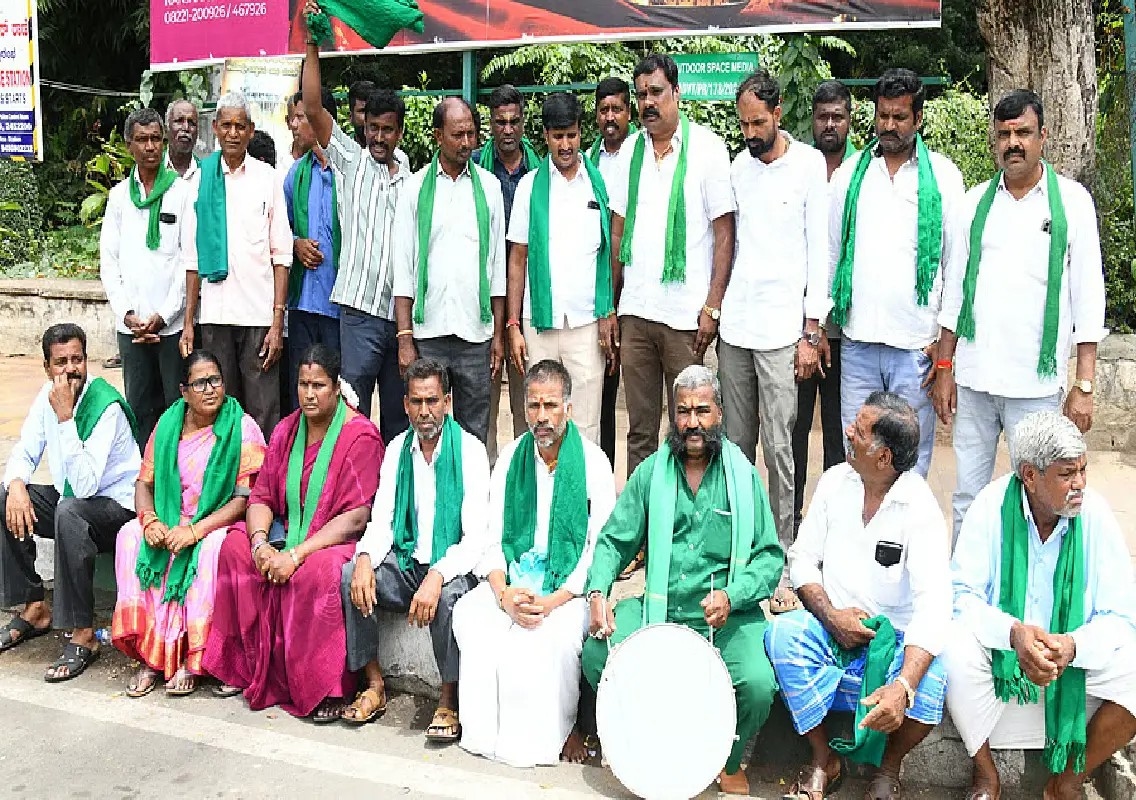


Mysuru: Protests by farmers’ organisations and pro-Kannada groups marked the Karnataka Bandh in Mysuru on Thursday, but normal life across the city remained largely unaffected. Public transport, businesses and vehicular movement continued as usual despite demonstrations at several locations.
The protests were primarily directed against the release of 12,000 cusecs of Cauvery River water to Tamil Nadu every day for 15 days, following directions issued by the Cauvery Water Regulation Committee (CWRC).
Public transport services continue
Mysuru City Police had strengthened security arrangements across the city as a precautionary measure in view of the bandh.
Despite the protests, KSRTC city and rural buses operated as usual. Vehicular movement on major roads was also not significantly affected.
Hotels, shops, cinema theatres and other business establishments remained open. The Mysuru Hotel Owners’ Association had earlier announced that its members would extend moral support to the agitation concerning Karnataka’s river, land and water issues, but would not shut their establishments.
Association president C Narayanagowda said closing hotels could inconvenience the general public, including tourists visiting Mysuru. Hotels therefore continued their regular operations during the bandh.
Protests over Cauvery water release
Farmers and pro-Kannada organisations took to the streets to oppose the decision to release 12,000 cusecs of Cauvery water to Tamil Nadu for 15 days.
The protesters argued that Karnataka’s farmers should not be made to bear the burden of water releases when the state itself faces concerns regarding water availability and irrigation requirements.
Several organisations demanded that the state government take a stronger position on the Cauvery issue and protect the interests of farmers dependent on the river and its reservoirs.
Kannada Vedike stages protest
Members of Mysuru Kannada Vedike staged a protest near Agrahara Circle.
The protesters alleged that Karnataka had been treated unfairly in matters concerning Cauvery water. They also questioned the silence of political leaders who had been actively protesting issues such as the proposed Bidadi township.
The protesters argued that political representatives should also raise their voices on issues directly affecting Karnataka’s farmers and water resources.
The demonstrations remained largely peaceful, with police personnel deployed at key locations to maintain law and order.
Broom movement near CADA office
Members of Mysuru Chaluvaligaarara Sangha organised a ‘broom movement’ in front of the CADA office.
The protesters used brooms as a symbolic form of protest and slapped brooms against photographs of some Tamil Nadu leaders.
They demanded that the government expedite the construction of the Mekedatu balancing reservoir downstream of the Cauvery basin.
The protesters said the project was important for Karnataka’s long-term water security and argued that the state should pursue measures to strengthen its water resources rather than repeatedly face disputes over releases.
Sugarcane growers stage whip protest
Members of the Karnataka Sugarcane Growers’ Association, led by Hallikerehundi Bhagyaraj, organised a ‘whip’ protest.
The protesters carried whips and empty pots during a march from Gun House Circle to the CADA office.
The empty pots were used to symbolise concerns over water availability, while the whips represented the farmers’ anger over the government’s handling of the Cauvery water issue.
The protesters also attempted to lay siege to the CADA office and demanded that water be released into canals for irrigation.
Police intervened to prevent the situation from escalating.
Protesters detained after attempting to stop buses
Members of Karnataka Sena Pade attempted to stop KSRTC buses during the protests.
Police intervened and detained the protesters to prevent disruption to public transport services.
The move was part of the security arrangements put in place by Mysuru City Police to ensure that the bandh did not affect essential services or create difficulties for commuters.
Despite the attempted disruption, KSRTC services continued operating normally across the city.
Protesters demand wider development
Pro-Kannada activist Tejesh Lokesh Gowda said the agitation was not limited to the Cauvery water dispute.
He said the organisations were also demanding the overall development of Karnataka and called for the implementation of projects such as Mekedatu, Kalasa-Banduri and Mahadayi.
The protesters also raised concerns about employment opportunities for Kannadigas and demanded that Kannada-medium schools should not be closed.
According to the protesters, these issues should be addressed alongside the immediate dispute over Cauvery water.
Farmers demand government support
Members of Karnataka Kaavalu Pade and Karnataka Rajya Raitha Sangha staged a protest by sleeping on the footpath near Hardinge Circle.
The protesters urged both the state and Union governments to support farmers and take effective measures to resolve their problems.
They said farmers should not be left without adequate government intervention when issues involving irrigation, water availability and agricultural livelihoods arise.
The symbolic sleeping protest was intended to highlight what the participants described as the government’s failure to adequately address farmers’ concerns.
Kannada organisations hold separate protests
Other pro-Kannada organisations also participated in the bandh.
Members of Kannada Sena Pade protested near Agrahara Circle, while members of Kannada Sene held a demonstration near the CADA office.
Although several groups participated in protests at different locations, the demonstrations did not significantly affect normal life in Mysuru.
Police maintained a visible presence at protest locations and monitored the situation throughout the day.
Normal life remains unaffected
Unlike bandh calls that result in widespread closures and disruption, Thursday’s Karnataka Bandh had limited impact on daily life in Mysuru.
KSRTC buses continued to operate, roads remained accessible and commercial establishments stayed open. Hotels and cinema theatres also functioned normally.
The decision by hotel owners to keep their establishments open was particularly aimed at preventing inconvenience to tourists and residents.
The protests nevertheless highlighted the continuing political and agricultural sensitivities surrounding the Cauvery water-sharing dispute.
Cauvery issue remains contentious
The release of Cauvery water to Tamil Nadu continues to be a politically sensitive issue in Karnataka, particularly among farmers in the Cauvery basin.
Protesters in Mysuru used the bandh to demand stronger action from the government and called for long-term solutions to Karnataka’s water requirements.
The demand for projects such as Mekedatu was also prominently raised, with protesters arguing that additional water storage infrastructure could help the state manage future water shortages.
For now, the bandh resulted in protests and symbolic demonstrations rather than widespread disruption, allowing normal activities in Mysuru to continue.