







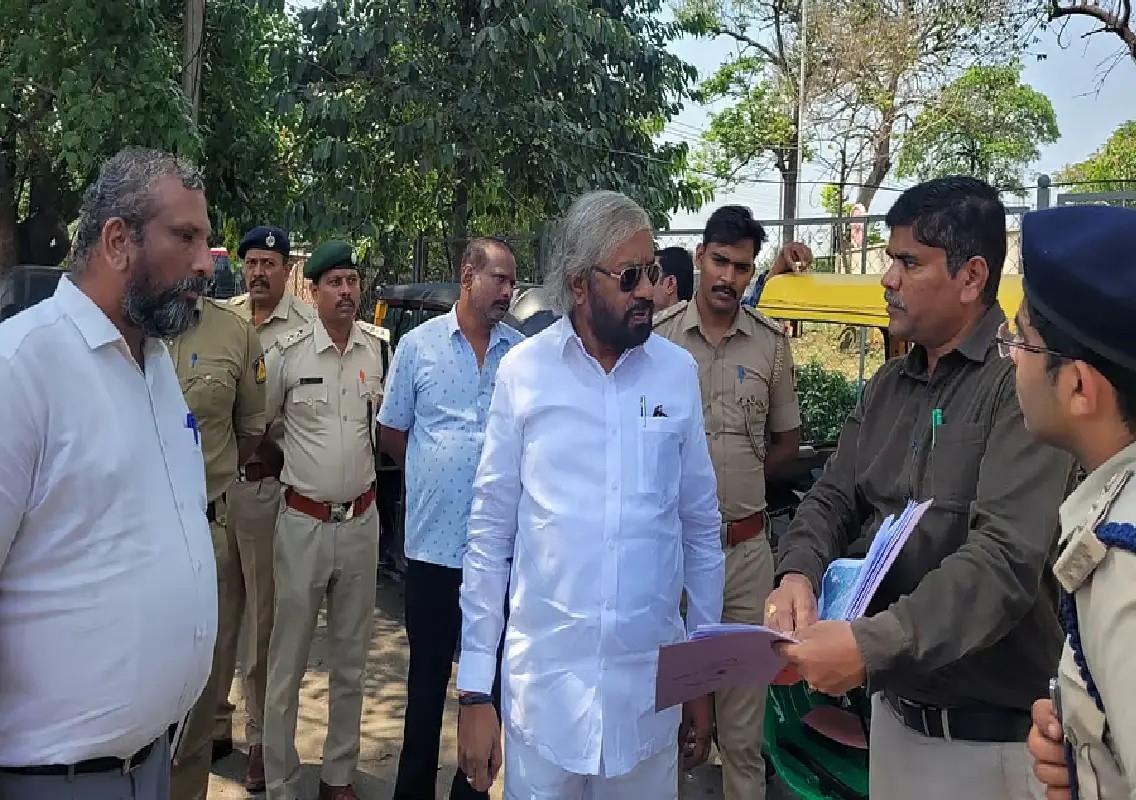


Mysuru: Karnataka Forest, Ecology and Environment Minister Eshwar B Khandre visited the Mysuru ring road junction where officials of the National Highways Authority of India (NHAI) have proposed the removal of around 350 trees for the construction of a flyover and underpass on the Bengaluru-Mysuru Expressway (NH-275).
The minister inspected the proposed project site along with senior forest department officials, including K Paramesha and Shankaregowda.
During the inspection, Khandre directed officials to examine the possibility of preserving as many trees as possible and explore translocation options for suitable species instead of cutting them down.
Trees marked for removal at multiple locations
According to officials, the NHAI has proposed clearing approximately 350 trees to facilitate additional infrastructure works at the ring road junction under the Bengaluru-Mysuru Expressway project.
The proposed works are being taken up at an estimated cost of Rs 63.67 crore and include the construction of a flyover and an underpass aimed at easing traffic congestion and improving connectivity.
Officials stated that the flyover project on NH-275 from the Mysuru side will have a total length of 1,008 metres, while the underpass planned for the Mysuru ring road will extend for about 750 metres.
Trees identified for removal are spread across multiple stretches, including:
- 19 trees on Fountain Circle Road near Siddique Nagar
- 256 trees at Bannimantapa Road park
- 52 trees on the Hunsur Road median
- 20 trees on the Nanjangud Road median
The proposed tree clearance has raised environmental concerns due to the large number of mature roadside and park trees likely to be affected.
Minister calls for conservation efforts
During the site visit, Khandre observed that several valuable tree species had been marked for removal. These include Indian Cork Tree, Indian Rosewood, Rain Tree, Indian Beech Tree, Muntingia calabura, Mahogany, Neem, and Mango trees.
The minister instructed forest officials to scientifically assess how many of these trees could be retained or safely translocated to other locations.
Special attention was given to Indian Rosewood trees, which officials believe may be suitable for transplantation if technically feasible.
Khandre stressed the importance of balancing infrastructure development with environmental conservation. He reportedly asked officials to minimise ecological damage while ensuring the smooth implementation of the highway expansion works.
Environmental concerns over highway expansion
The proposed removal of trees has sparked concern among environmentalists and local residents, especially because many of the identified trees are mature shade-giving species that contribute significantly to urban greenery in Mysuru.
Experts have pointed out that large roadside trees help regulate temperatures, improve air quality, reduce dust pollution, and support biodiversity within urban areas.
Environmental activists have also highlighted the need for compensatory afforestation and scientific transplantation methods wherever possible.
Officials from the forest department are expected to submit detailed reports regarding the condition and transplant feasibility of the marked trees before final approvals are granted.
Infrastructure works aimed at reducing congestion
The Bengaluru-Mysuru Expressway and associated junction improvement works are part of broader efforts to improve highway infrastructure and traffic movement in and around Mysuru city.
Authorities stated that the proposed flyover and underpass are intended to reduce congestion at the busy ring road junction, which experiences heavy vehicular movement connecting multiple highways and city routes.
The infrastructure project is expected to improve traffic flow for commuters travelling between Bengaluru and Mysuru while enhancing road safety at the junction.
However, civic groups have urged authorities to ensure that developmental works are carried out responsibly without causing irreversible environmental damage.
Officials to study alternatives
Following the minister’s visit, officials are likely to conduct further assessments regarding tree conservation, transplantation possibilities, and alternative engineering solutions that could reduce the number of trees required to be cut.
The Forest Department is also expected to coordinate with NHAI authorities before granting permissions related to tree removal.
The issue has once again brought attention to the challenge of balancing rapid urban infrastructure growth with environmental sustainability in expanding cities like Mysuru.