







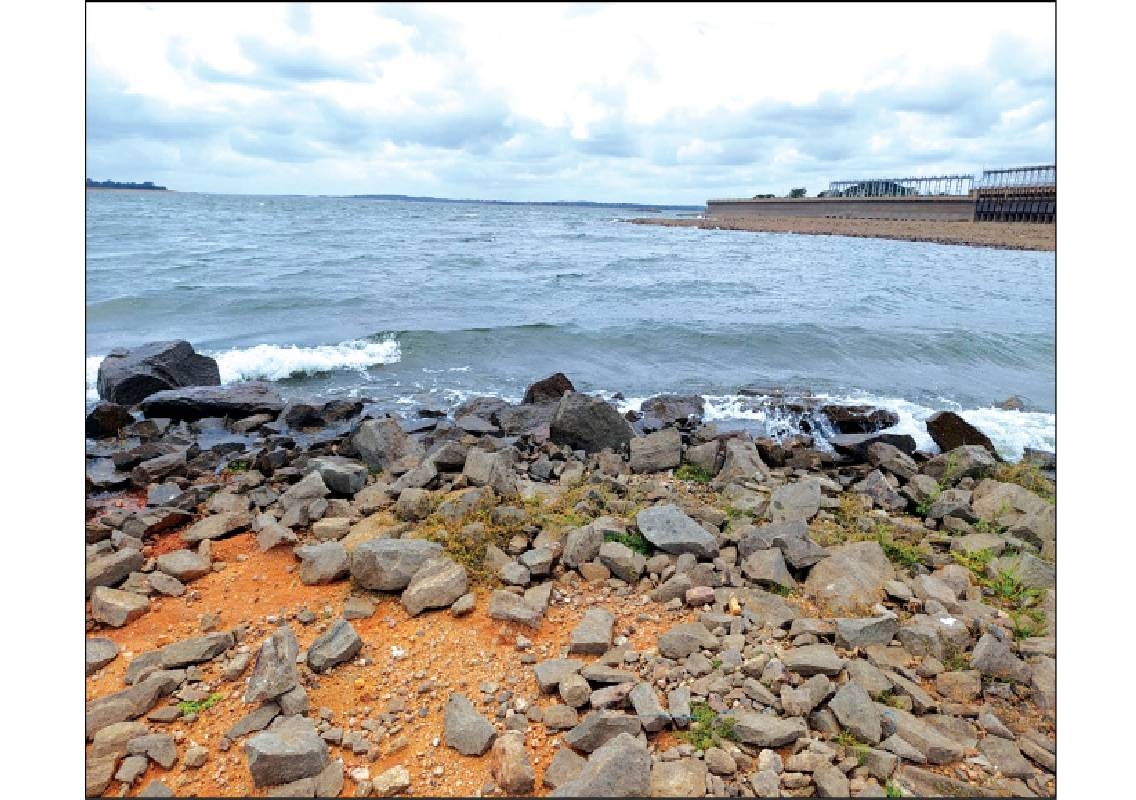


Mysuru: The water level at the Krishna Raja Sagar (KRS) Dam has continued to decline as the quantity of water being released to Tamil Nadu remains significantly higher than the inflow into the reservoir. The latest figures have raised concerns over the falling storage level at the reservoir, which is an important source of water for irrigation and drinking water needs in the region.
According to the latest reservoir data, KRS recorded a water level of 109.32 feet on September 4, against its full reservoir level of 124.8 feet. The reservoir had about 31,043 million cubic feet (MCft) of water in storage, while inflow stood at 3,864 cusecs and outflow at 8,544 cusecs.
The figures underline the widening gap between water entering the reservoir and water being released downstream.
KRS outflow remains higher than inflow
The Star of Mysore report noted that the KRS water level had fallen to 108.76 feet when the figures cited in the report were recorded. At that point, inflow was 3,028 cusecs, while the outflow towards Tamil Nadu was 9,253 cusecs, more than three times the inflow.
The continued release of water at a rate substantially higher than the incoming flow has resulted in a gradual decline in the reservoir level.
The latest official reservoir data available for September 4 also shows that the outflow continues to exceed inflow, although the recorded figures vary depending on the time of measurement. KRS had an inflow of 3,864 cusecs and an outflow of 8,544 cusecs in the latest data.
This means that the reservoir is currently losing stored water faster than it is receiving fresh inflows.
KRS was close to full capacity earlier
The decline is notable because the KRS reservoir had received substantial inflows during the monsoon season and had earlier moved towards higher storage levels.
The Star of Mysore report said the reservoir needed only about 14 feet to reach its full level, but continued releases have prevented it from maintaining the higher storage position.
The full reservoir level of KRS is 124.8 feet, with a total capacity of 49,452 MCft. As of September 4, storage was 31,043 MCft, according to reservoir data.
The current storage is also considerably lower than the corresponding figure from last year. The September 4 data shows last year’s KRS level at 124.02 feet, with storage of 48,363 MCft.
Kabini also sees changes in water levels
The situation is not limited to KRS. The Kabini reservoir has also recorded a decline in its water level.
According to the Star of Mysore report, Kabini stood at 2,269.73 feet, compared with its full reservoir level of 2,284 feet. Its inflow was reported at 3,526 cusecs, while the outflow to Tamil Nadu was around 3,000 cusecs.
Unlike KRS, however, the inflow into Kabini was slightly higher than the reported outflow at the time of those measurements.
The combined status of the major Cauvery reservoirs is closely watched because their releases contribute to downstream flows and have implications for water availability in both Karnataka and Tamil Nadu.
Water also being released from Hemavathi and Harangi
Other major reservoirs in the Cauvery basin are also releasing water.
The Star of Mysore report stated that 8,850 cusecs were being released from the Hemavathi reservoir in Hassan district, while 1,700 cusecs were being released from the Harangi reservoir in Kodagu.
These releases form part of the broader management of water in the Cauvery basin, where reservoir storage, inflows, downstream requirements and inter-State water-sharing considerations all play a role.
Why the KRS level matters
KRS is one of Karnataka’s key reservoirs and plays an important role in supporting irrigation and water supply in the Mysuru-Mandya region. Water released from the reservoir eventually flows downstream into Tamil Nadu.
The reservoir’s position therefore becomes particularly important when inflows begin to weaken after periods of strong monsoon rainfall.
Recent data shows the change clearly. On September 4, KRS had an inflow of 3,864 cusecs against an outflow of 8,544 cusecs.
If this pattern continues for an extended period, the reservoir’s stored water will continue to decline unless inflows increase.
The weakening of monsoon inflows has already been identified as a factor behind the changing reservoir balance. A recent report also noted that KRS outflow had risen to roughly three times the inflow as the monsoon weakened.
Cauvery water sharing remains a sensitive issue
Water releases from Karnataka’s reservoirs to Tamil Nadu have long been a politically and legally sensitive issue. KRS is one of the reservoirs whose releases are closely monitored as part of the wider Cauvery water-sharing framework.
The present decline in the KRS level comes at a time when the difference between inflow and outflow has widened. However, the reservoir figures alone do not establish whether individual releases comply with any particular water-sharing requirement; such assessments depend on the applicable regulatory directions, reservoir conditions and basin-wide calculations.
For Karnataka, the challenge is to balance downstream releases with the water requirements of farmers and residents dependent on the Cauvery system.
Reservoir management under focus
With the monsoon season progressing and inflows fluctuating, the KRS storage position is likely to remain under close observation.
The September 4 figures show that the reservoir is still holding more than 31,000 MCft of water, but its level is well below full capacity. At the same time, the outflow remains substantially higher than the incoming water.
The coming weeks will therefore be important for the reservoir. A revival in rainfall could improve inflows and slow the decline, while continued weak inflows could put further pressure on stored water.
For now, the key concern is the widening gap between what KRS receives and what it releases. With the water level around 109 feet and outflow exceeding inflow, the reservoir’s storage trend will remain an important indicator for the Cauvery basin in Karnataka.