







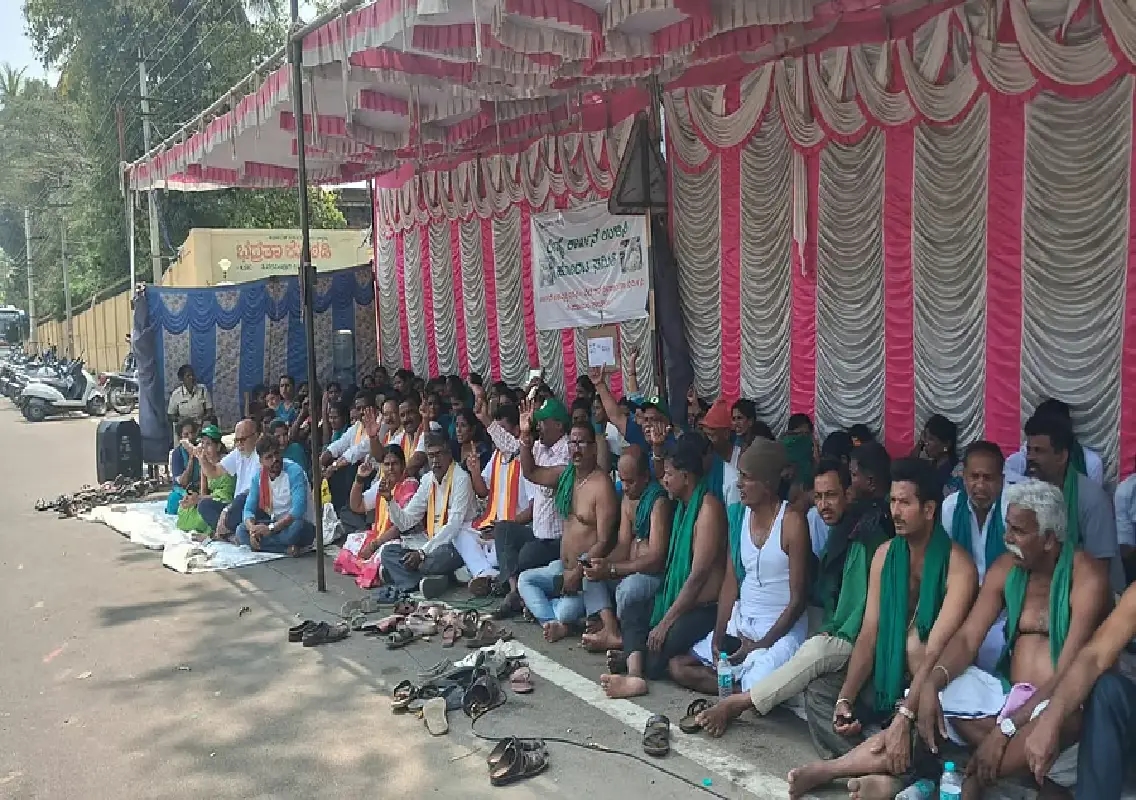


Mysuru: As many as 190 employees of the mother unit of the Karnataka Silk Industries Corporation (KSIC), including 97 women, have been staging a protest at the gate of the unit at T Narsipur, about 35 km from Mysuru, for the past 13 days.
Production at the raw silk yarn reeling and silk yarn degumming unit has come to a standstill since February 21, after 5 acres of the 12 acre and 32 guntas land was reportedly acquired for a proposed sports stadium. The protesting employees fear that the move could eventually lead to the closure of the unit, affecting their livelihoods and the future of the iconic Mysore Silk brand.
Production comes to a halt
During a visit to the factory premises, usually bustling sections of the unit were found deserted. The cocoon godown, where around 40,000 kg of cocoons dried with hot air and segregated are stored, remained locked. The coal dumping yard, water collection tank area, the cocoon boiling unit, four semi-automatic and two automatic reeling units used to brush and reel raw silk yarn were all non-functional.
The raw silk yarn produced at the T Narsipur unit is supplied to weaving units in Channapatna and Mysuru, where the famed Mysore Silk sarees are manufactured. While some employees at the Channapatna and Mysuru units have resumed work, saree production is currently dependent on stocked yarn. Finished sarees are being dispatched to 12 showrooms across the State, but employees warn that prolonged disruption at the mother unit could impact supply.
Livelihood concerns
Of the 190 employees participating in the protest, 176 are outsourced staff, including 91 women, and 14 are permanent employees, of whom six are women. Many of them have been associated with the unit for decades and say their families depend entirely on the income earned here.
Bhagya from Hosa Tirumalakoodlu said she has been working at the unit for 30 years after losing her husband. “After two months during the Covid-19 pandemic, this is the second time that the unit has remained closed for such a long period. We are worried about our future,” she said.
Yogeeshwari from Muddabeeranahundi said most of the women employees are the primary earners in their families. “Husbands of many women here are daily wage workers. The income we earn here is the only stable source of livelihood. If the land is taken away and the unit is shut, it will affect not only us but also the weaving units in Channapatna and Mysuru. The brand of Mysore Silk must be protected,” she said.
Support from activists and organisations
The agitation has drawn support from environmental groups and local organisations. Members of Parisara Balaga, including Parashurame Gowda, Ravi Bale, Gantaiah, Akbar Sindhuvalli, Anjana, Bhagya and Gayathri, have joined the protest, expressing concern over tree felling and the impact on the local ecosystem.
Organisations such as Jai Karnataka have also extended solidarity to the workers, calling on the State government to reconsider the land acquisition decision.
Call for ‘Mysore Silk City’
At the protest site, Prakash Linge Gowda suggested that instead of carving out land for a stadium, the government should focus on strengthening the silk industry.
“The State government should develop the existing filature and enhance production instead of snatching KSIC land and chopping trees. Chief Minister Siddaramaiah, being a Mysurean, should come up with a ‘Mysore Silk City’ by allotting 500 acres in Mysuru to promote the brand,” he said.
He proposed a comprehensive silk ecosystem where farmers could cultivate mulberry, generate cocoons, establish reeling units to produce raw silk yarn and set up weaving units to manufacture Mysore Silk sarees at one integrated location.
Future uncertain
Employees fear that if 5 acres are taken away for the stadium, the remaining infrastructure may become unviable for long-term operations. They are demanding written assurances from the government that the unit will not be shut down and that their jobs will be protected.
As the protest enters its second week, production remains stalled, raising concerns about supply chains and the sustainability of one of Karnataka’s most iconic textile brands. The workers have vowed to continue their agitation until the government addresses their demands and ensures the survival of the T Narsipur unit.