







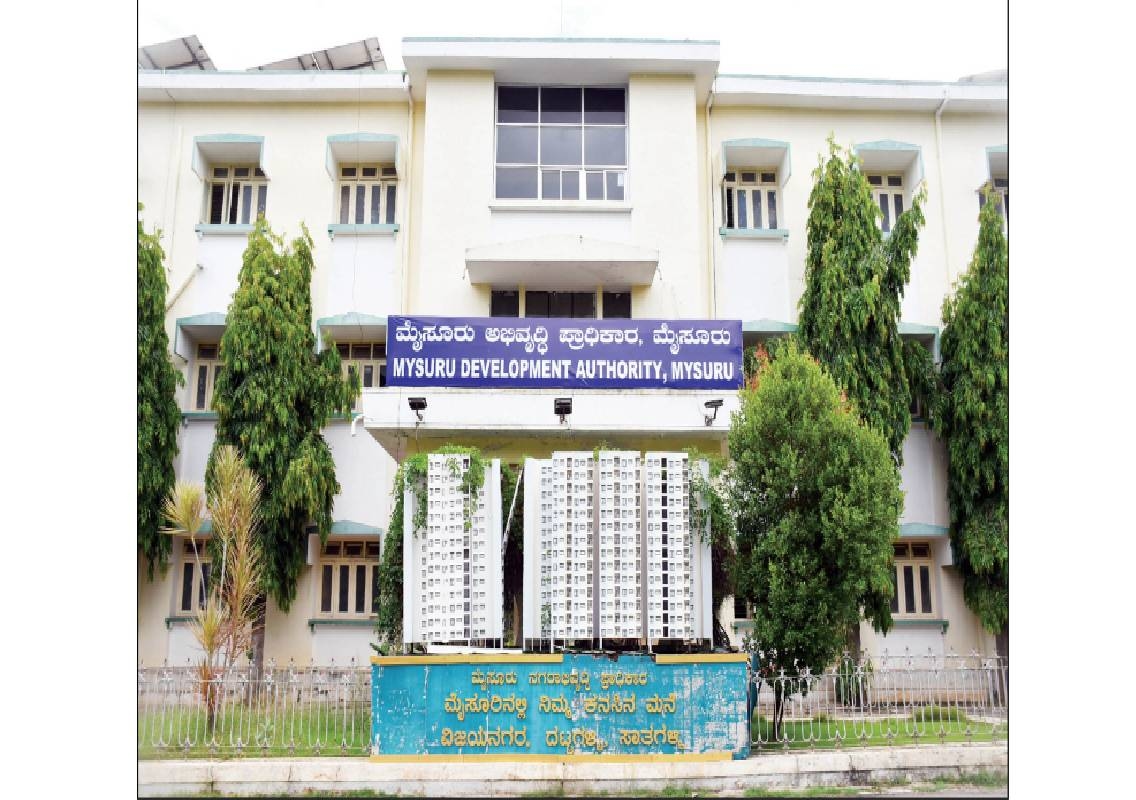


Mysuru: The Mysuru Development Authority (MDA) has begun administrative, legal and verification work to reclaim properties allotted under the controversial 50:50 scheme after the State Government ordered cancellation of the disputed alternative site allotments.
The Authority is now cross-checking its allotment records with the findings of the Justice P.N. Desai Judicial Commission to identify sites that were allotted in violation of rules. MDA officials are also seeking transaction details from Sub-Registrar offices to trace properties that may have been sold to third parties after the original allotments.
The move marks the beginning of a detailed process to recover MDA properties and protect them from further legal complications. According to MDA In-charge Commissioner B.R. Mahesh, cancellation orders will be issued in batches after the necessary records and ownership details are verified.
MDA starts verification of 50:50 allotments
The MDA has records of the original allotments and initial registrations made under the 50:50 scheme.
However, the Authority does not have complete information about subsequent transactions involving the properties. Some allottees may have sold or transferred their sites to other individuals, making it necessary for the MDA to trace the complete ownership history before taking further action.
Officials are therefore comparing the Authority’s allotment database with the findings of the Justice P.N. Desai Commission.
The verification process involves matching site numbers, allotment records and registration details to determine which transactions were compliant and which may have been made in violation of the rules.
Sub-Registrar records sought
To establish the complete chain of ownership, the MDA has written to Sub-Registrar offices seeking Encumbrance Certificates (ECs) and ownership transfer records relating to 50:50 scheme sites.
The documents are expected to help the Authority identify subsequent sales and transfers that do not appear in its own allotment records.
According to MDA Commissioner B.R. Mahesh, the Sub-Registrar offices have been given a three-day deadline to submit the required transaction details.
These records will be important in determining whether a site has changed hands after its original allotment and who currently holds ownership.
Cancellation orders to be issued in phases
The MDA is not expected to cancel all the disputed allotments at once.
Mahesh said the cancellation orders would be issued in batches, as the verification process is completed.
The phased approach is intended to ensure that individual site records and transaction histories are checked before cancellation orders are issued.
Officials will first establish the relevant details from the MDA database and Sub-Registrar records before proceeding with the cancellation of individual allotments.
This means the process could continue over a period of time rather than resulting in one blanket cancellation order covering every disputed property.
MDA prepares for civil court action
Alongside the administrative verification, the MDA is preparing to approach civil courts to protect properties that are reclaimed.
The Authority plans to file civil suits and pre-emptive caveat petitions in an effort to prevent private buyers or original allottees from obtaining ex parte stay orders against the cancellation process.
A caveat allows a party to request that a court not pass an order in a matter without first hearing that party.
The MDA’s move is intended to strengthen its legal position as it begins reclaiming properties covered by the Government’s cancellation directive.
Concern over properties sold to third parties
One of the major complications facing the MDA is the possibility that sites originally allotted under the 50:50 scheme may have subsequently been sold.
The Authority’s original records may show the first allottee, but they do not necessarily contain details of later transactions.
This is why the Sub-Registrar records have become an important part of the verification process.
By obtaining ECs and ownership transfer documents, the MDA can establish whether a site was sold, transferred or otherwise encumbered after its original allotment.
The information will also help officials determine the legal steps required for each individual property.
Developed properties pose additional challenge
The recovery process could become more complicated where allottees or subsequent buyers have already constructed houses or other buildings on the sites.
The MDA is seeking legal opinions on how such properties should be dealt with.
According to Mahesh, the Authority is examining the recovery process and working towards establishing clear procedures for reclaiming land where residential structures have already been constructed.
The issue is significant because simply identifying an allotment as illegal may not automatically resolve questions involving later buyers, construction and possession.
Government directive triggers action
The MDA’s latest move follows the State Government’s directive to cancel controversial alternative site allotments made under the 50:50 scheme.
The Government’s decision came after scrutiny of the allotment process and the findings of the Justice P.N. Desai Judicial Commission.
The MDA is now responsible for implementing the cancellation process at the property level.
This requires officials to establish which sites are affected, verify their current ownership and take appropriate legal measures to reclaim them.
Justice P.N. Desai Commission findings being examined
The Justice P.N. Desai Judicial Commission report has become a key reference point for the MDA’s verification exercise.
Officials are comparing the commission’s findings with the Authority’s own records.
This cross-verification is intended to ensure that the cancellation process is based on specific site and transaction information rather than relying solely on broad categories of allotments.
The exercise could also help identify discrepancies between official records and the actual status of individual properties.
Legal protection becomes a priority
The MDA’s decision to prepare civil suits and caveat petitions indicates that the Authority expects the cancellation process to face legal challenges.
Property allotments and subsequent sales can involve multiple parties, and disputes could arise over ownership, possession and construction.
By preparing its legal cases in advance, the MDA hopes to protect reclaimed properties and prevent the recovery process from being stalled by interim court orders.
The Authority is therefore pursuing administrative verification and legal preparation simultaneously.
Buyers and sellers under scrutiny
The verification process could involve not only original allottees but also people who purchased properties from them.
The MDA is examining subsequent transactions to determine how sites moved from the original allottee to later owners.
This could become particularly important where a buyer claims to have purchased a property without being aware of irregularities associated with the original allotment.
The legal position of such cases may vary depending on the circumstances, which is why the MDA is seeking legal opinions before proceeding with recovery.
No blanket cancellation process yet
The latest development does not mean that every 50:50 site will be cancelled immediately.
The MDA is first undertaking verification to identify properties covered by the Government’s order.
Cancellation orders will then be issued in batches once the relevant records have been examined.
This approach is intended to reduce errors and ensure that the Authority has sufficient documentation to support each cancellation.
Importance of Encumbrance Certificates
Encumbrance Certificates will play a particularly important role in the process.
An EC can provide information about registered transactions and encumbrances associated with a property.
By collecting ECs for the disputed sites, the MDA can gain a clearer picture of their transaction history.
This information can help officials determine whether a property has been sold or transferred after its original allotment and identify the current registered owner.
MDA seeks government clarification
The Authority has also sought technical clarification from the State Government regarding the guidelines for executing the cancellation process.
MDA officials are awaiting formal directions on certain aspects of implementation.
Such clarification is important because the process involves properties with different ownership histories and, in some cases, existing constructions.
The Government’s directions are expected to provide greater clarity on how officials should proceed in complicated cases.
Reclaiming public properties
The broader objective of the exercise is to reclaim MDA properties that were allegedly allotted illegally.
The Government’s cancellation order has placed responsibility on the Authority to identify the affected properties and take steps to recover them.
The process will involve administrative verification, registration checks and legal action where necessary.
The MDA’s current approach indicates that the recovery exercise is likely to be detailed and property-specific.
Possible legal disputes ahead
The MDA’s preparations for civil litigation suggest that disputes could emerge once cancellation orders begin reaching individual allottees and buyers.
Affected parties may challenge the cancellation or seek court protection.
The Authority is therefore preparing its legal strategy before issuing all cancellation orders.
Filing caveat petitions could help ensure that the MDA receives an opportunity to present its case before courts consider requests for interim relief.
Impact on property transactions
The developments could also affect people who have purchased or are considering purchasing properties connected to the 50:50 scheme.
The verification process is likely to bring greater scrutiny to the ownership history of such properties.
Buyers and sellers could face questions regarding the validity of earlier allotments and subsequent transfers.
The MDA’s efforts to obtain complete transaction records are therefore significant for establishing the legal status of individual sites.
Recovery process likely to take time
Given the number of properties involved and the need to examine individual records, the recovery exercise is unlikely to be completed immediately.
The MDA must first obtain information from Sub-Registrar offices, match it with its own records and the commission’s findings, and then issue cancellation orders.
Properties involving secondary sales or existing buildings may require additional legal examination.
The phased approach is therefore expected to continue as officials complete the verification of individual cases.
MDA focuses on documentation
Documentation will be central to the entire exercise.
Original allotment records, registration documents, ECs, ownership transfer details and the commission’s findings will all need to be examined.
The MDA’s objective is to create a clear record for each affected property before moving ahead with cancellation and recovery.
Such documentation could also become important if the decisions are challenged in court.
What happens next
The immediate priority for the MDA is to obtain the required records from the Sub-Registrar offices.
Officials will then continue cross-verifying the details and identify the properties that require cancellation.
The first batch of cancellation orders is expected to follow once the verification is completed.
At the same time, the Authority will continue preparing civil cases and caveat petitions to protect properties it seeks to reclaim.
Wider implications for Mysuru
The 50:50 site issue has become a major property and administrative controversy in Mysuru.
The Government’s decision to cancel disputed allotments and the MDA’s subsequent recovery exercise could have significant implications for land administration in the city.
The current legal verification process is therefore being closely watched by property owners, buyers and other stakeholders.
The manner in which the MDA handles the recovery process could also determine how similar property disputes are addressed in the future.
Conclusion
Mysuru: The Mysuru Development Authority has begun legal, administrative and verification work to recover properties allotted under the controversial 50:50 scheme following the State Government’s decision to cancel disputed alternative site allotments. Officials are cross-checking MDA records with the findings of the Justice P.N. Desai Judicial Commission.
The Authority has also sought Encumbrance Certificates and ownership transfer records from Sub-Registrar offices to trace properties that were subsequently sold to third parties. The offices have been given three days to provide the required records, according to MDA In-charge Commissioner B.R. Mahesh.
Cancellation orders will be issued in batches after the verification process is completed. Meanwhile, the MDA is preparing civil suits and caveat petitions to protect reclaimed properties from potential legal challenges.
The recovery exercise could become more complicated in cases where properties have already been sold or developed. The MDA is therefore seeking legal opinions and government clarification before proceeding with such cases. With the verification process now under way, the coming weeks are expected to bring further clarity on the properties affected by the 50:50 scheme cancellations.