


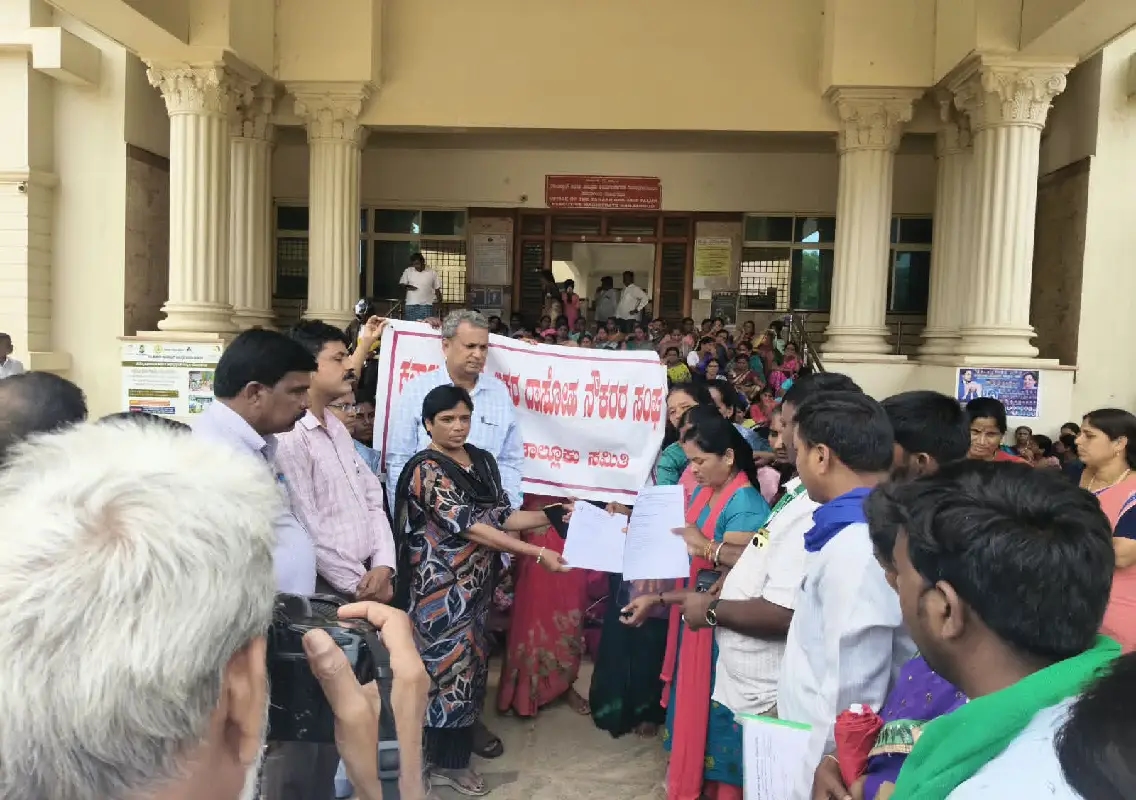


Nanjangud: Opposing the proposed implementation of the cluster kitchen system in schools, Akshara Dasoha (midday meal scheme) workers staged a protest in Nanjangud, holding ladles and rice and demanding that the government protect their jobs.
Kitchen staff from schools across Nanjangud taluk gathered in front of the Taluk Administrative Office under the leadership of the Karnataka State Akshara Dasoha Employees’ Association. Raising slogans against the proposed system, the protesters demanded that meals continue to be prepared within individual schools rather than being shifted to centralised cluster kitchens.
The protest received support from the Dalit Sangharsha Samiti, Raitha Sangha and Hasiru Sene. As part of the agitation, kitchen staff also halted the preparation of midday meals in schools for the day.
The demonstration was led by K. Manjula, taluk president of the Karnataka State Akshara Dasoha Employees’ Association. The protesters argued that the proposed arrangement could threaten the livelihoods of thousands of women who depend on cooking jobs under the government scheme.
Workers fear loss of livelihood under cluster kitchen system
Addressing the protesters, Manjula said that since the introduction of the Akshara Dasoha scheme, meals had been prepared within school premises and served to children. The proposed cluster kitchen arrangement, under which cooking responsibilities would be handed over to organisations and self-help groups, could deprive existing kitchen staff of their employment, she said.
She pointed out that thousands of economically disadvantaged women, including widows and divorced women, depended on the scheme for their livelihood.
According to her, many of these workers had continued preparing meals for schoolchildren despite receiving only a meagre honorarium. Introducing centralised kitchens without adequately addressing their employment concerns would place their families in further difficulty.
The association demanded that the government abandon the cluster kitchen proposal and ensure that the existing workers were not displaced.
Manjula said the present system of preparing food in schools could continue effectively if the government provided kitchen staff with the necessary training and support.
Association seeks greater responsibility for kitchen staff
The protesters maintained that teachers should be allowed to concentrate on providing quality education, while the responsibility for managing the midday meal programme should be entrusted to the cooking staff.
They suggested that the working hours of kitchen employees could be extended, wherever necessary, and that appropriate training should be provided to enable them to manage the scheme efficiently.
The association also urged the government to resolve practical difficulties associated with the implementation of the programme, including issues relating to the procurement of eggs.
The workers expressed concern that the cluster kitchen model could eventually lead to the involvement of private entities and other organisations in the management of school meals.
They argued that the existing school-based arrangement had enabled children to receive freshly prepared hot meals and that there was no justification for changing the system without considering the consequences for both students and workers.
The protesters insisted that the government should protect the employment of existing kitchen staff and address their demands before considering any restructuring of the scheme.
Dalit Sangharsha Samiti extends support
Gattavadi Mahesh, taluk convener of the Dalit Sangharsha Samiti, criticised the proposed cluster kitchen system, stating that it would push poor women who had worked under the Akshara Dasoha scheme for several years into unemployment.
He said the kitchen staff were already struggling to support their families with the limited honorarium they received. Removing their jobs through the proposed arrangement would further worsen their financial difficulties.
Mahesh maintained that the existing workers were effectively preparing and serving hot meals to children in schools. He questioned the need to hand over these responsibilities to private entities and other organisations when the present workforce was already carrying out the task.
He described the proposal as unjust to women who had depended on the scheme for years and warned that thousands of livelihoods could be affected if the government proceeded with the plan.
The Dalit Sangharsha Samiti demanded that the government immediately withdraw the cluster kitchen proposal, continue preparing meals within schools and provide job security to existing kitchen employees.
Mahesh assured the protesters that the Samiti would continue supporting their agitation if the government failed to respond to their demands.
Memorandum submitted to Chief Minister
At the conclusion of the demonstration, the protesters submitted a memorandum addressed to the Chief Minister through Grade 2 Tahsildar Kishore Kumar.
The memorandum called for the withdrawal of the proposed cluster kitchen system, protection of existing employment and the resolution of various issues faced by Akshara Dasoha workers.
The protesters warned that they would continue their agitation if the government did not take steps to safeguard the interests of kitchen staff.
Association and farmers’ representatives participate
Several office-bearers of the Karnataka State Akshara Dasoha Employees’ Association participated in the demonstration.
Those present included association vice-president Neelamma, secretary Mahadevamma and treasurer Netramma.
Satish Rao, district president of the Farmers’ Association and Hasiru Sene; Poornima, president of the Women’s Wing of the Chalavadi Mahasabha; and Byalaru Anand, taluk organising convener of the Dalit Sangharsha Samiti, also took part.
Other association members, including Suvarna, Roopa, Devamma, Geetha, Doddamani, Jayalakshmi, Savitha and Bhagya, joined the protest along with representatives of various farmers’ and Dalit organisations.
The demonstration highlighted the concerns of midday meal workers over the possible impact of centralised cooking arrangements on their employment. The workers called on the government to retain the school-based meal preparation system and ensure that the women who have been serving schoolchildren for years are not deprived of their livelihoods.