







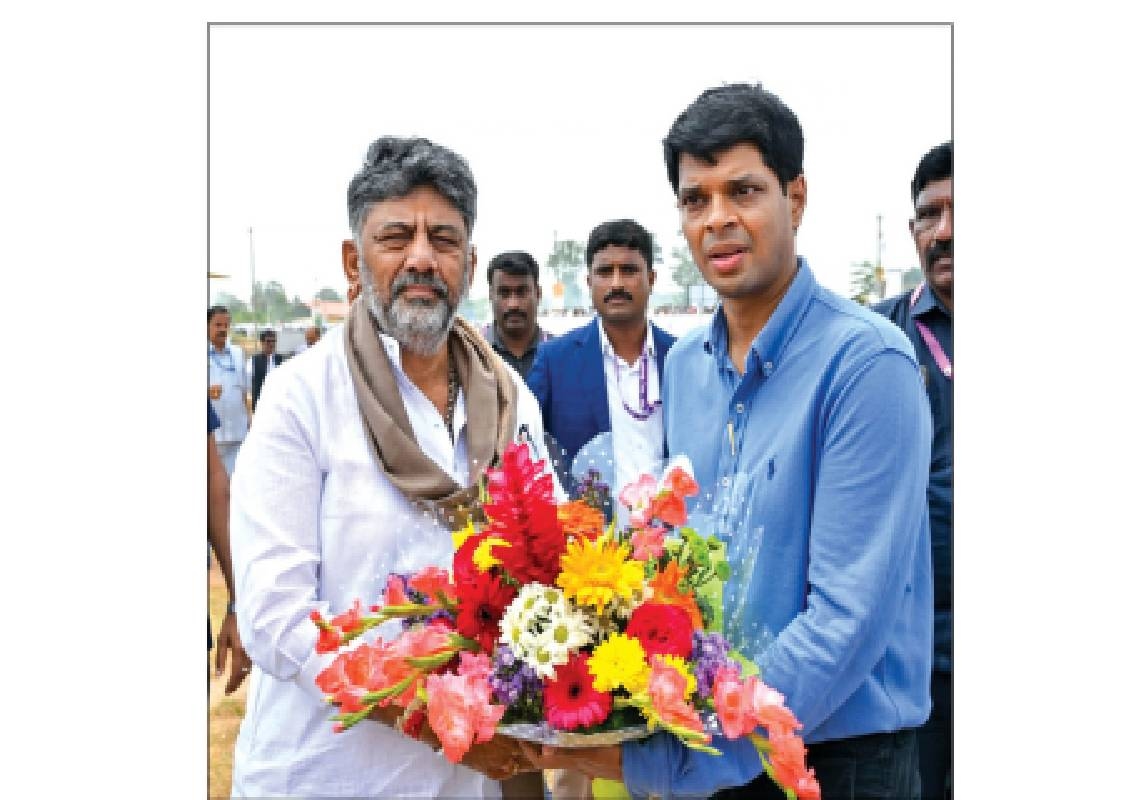


Mysuru: Chief Minister D.K. Shivakumar has defended the Karnataka Government’s decision to hold Mysuru Dasara on a grand scale despite the State facing a severe drought situation, saying the annual Nada Habba represents Karnataka’s art, culture and traditions.
Speaking to reporters at Periyapatna on October 3 after arriving to launch the Government’s ‘Prajaseva’ programme in Mysuru district, Shivakumar said Dasara could not remain unchanged and that introducing new cultural elements was part of the festival’s evolution.
His comments come at a time when Karnataka is facing a significant rainfall deficit. The State recorded a 35% shortfall in southwest monsoon rainfall between June 1 and September 30, 2026, with the rainfall deficit described as the worst in 55 years.
The Government has nevertheless decided to continue with an 11-day Dasara programme, with the festivities scheduled to begin on October 11 and the grand Jumboo Savari planned for October 21.
CM says Dasara represents Karnataka’s culture
Defending the decision to organise the festival on a large scale, Shivakumar said Dasara was not merely a series of entertainment programmes but the State’s Nada Habba.
He said the festival showcases Karnataka’s art, culture and traditions and that changes to the celebrations were inevitable with time.
The Government had earlier announced that the 2026 edition would continue for 11 days. The Chief Minister had also ruled out scaling down the festival because of the drought-like conditions, arguing that the grandeur of the celebrations should not be reduced merely to achieve relatively small cost savings.
The Government’s approach has been to combine traditional events with new programmes and cultural attractions, while retaining the major ceremonies associated with Mysuru Dasara.
Kambala becomes part of Mysuru Dasara
One of the newer additions to this year’s celebrations has been the proposal to conduct Kambala, the traditional buffalo race associated with coastal Karnataka, in Mysuru.
The inclusion of Kambala has faced opposition from some sections, particularly over whether the coastal sporting tradition should be brought into the Mysuru Dasara programme.
Responding to the issue, Shivakumar said cultural exchange between different regions of Karnataka was common and that Dasara, as a festival involving everyone, could provide representation to traditions from other parts of the State.
He said Kambala had therefore been allowed to be held in Mysuru as part of the broader cultural representation planned for the festival.
The proposed Dasara Kambala is scheduled for October 18 and 19, adding a coastal sporting tradition to the programme in the days leading up to Vijayadashami.
The decision reflects the Government’s stated intention to expand Dasara beyond its traditional Mysuru-centred events and showcase cultural practices from different parts of Karnataka.
Government plans participation from southern States
The Chief Minister also said the State Government plans to invite the Chief Ministers of southern States to attend Mysuru Dasara as guests.
According to Shivakumar, the respective States have also been asked to send tableaux representing their cultures for the Jumboo Savari.
The proposal is aimed at giving the festival a wider regional character while creating an opportunity to showcase cultural traditions beyond Karnataka.
He said Dasara-like celebrations are also held in neighbouring States and that details regarding participation by the southern States would be finalised in the coming days.
The proposal comes as the district administration has begun formally inviting dignitaries for the 2026 festivities. Mysuru District Minister Dr Yathindra Siddaramaiah has already invited Governor Thaawarchand Gehlot, Chief Minister Shivakumar and Deputy Chief Minister G. Parameshwara to the celebrations.
Dasara preparations continue despite drought
The Government’s decision to proceed with a grand festival has drawn attention because of the prevailing rainfall deficit and its impact on agriculture and water resources.
Karnataka’s southwest monsoon rainfall between June and September this year was significantly below normal. The 35% deficit recorded by the State has raised concerns about agricultural losses, drinking water availability and the broader economic impact of the poor monsoon.
The drought situation has therefore created a debate over whether public expenditure on large celebrations should be moderated.
The Chief Minister, however, has maintained that celebrating Dasara on a grand scale does not necessarily mean indiscriminate spending. In his earlier statements on the festival, he said grandeur should be understood as preserving traditions and introducing fresh ideas rather than simply increasing expenditure.
This distinction has become central to the Government’s defence of the celebrations.
11-day festival to culminate with Jumboo Savari
The 2026 Mysuru Dasara festivities are scheduled to begin on October 11 and continue for 11 days.
The Jumboo Savari, the main procession and traditional culmination of the festival, will be held on October 21.
The procession will feature the decorated Dasara elephants and the idol of Goddess Chamundeshwari carried in the Golden Howdah, continuing one of the most prominent traditions associated with Mysuru Dasara.
The Government had announced the 11-day format earlier this year and said the festival would include cultural programmes, sporting events and other attractions.
Preparations have been progressing across Mysuru, with the district administration, police and various Dasara committees working on arrangements for the expected influx of visitors.
The police administration has also reviewed security arrangements at major venues, including the Mysuru Palace and other locations where Dasara programmes will be held.
Debate over scale likely to continue
The Chief Minister’s latest comments are likely to keep the debate over the scale of Dasara in focus as the festival approaches.
Supporters of the grand celebrations point to the festival’s cultural importance and its ability to attract visitors and generate economic activity for tourism, hospitality, transport, retail and other sectors.
Critics, meanwhile, have questioned the appropriateness of large-scale expenditure when the State is dealing with rainfall shortages and drought-related concerns.
The Government has maintained that Dasara is an important cultural institution and that reducing its scale would not necessarily provide meaningful relief from the larger financial and agricultural challenges facing Karnataka.
The discussion therefore involves not only the cost of the festival but also the broader question of how cultural events should be organised during periods of economic or environmental stress.
Mysuru prepares for a major tourist season
Despite the debate, preparations for Dasara are continuing at full pace in Mysuru.
The festival traditionally attracts visitors from across Karnataka, other parts of India and overseas. The Government has previously pointed to increased tourist footfall and the impact of the Shakti scheme on travel as factors supporting continued investment in the festival.
The district administration has been extending invitations to political leaders, constitutional authorities, judges and other dignitaries.
Officials are also working on traffic management, security, public facilities and arrangements for the various programmes scheduled during the festival period.
With the opening ceremony less than a week away, attention will now shift to the execution of the programme and the Government’s promise to combine traditional grandeur with new cultural attractions.
Government maintains focus on cultural representation
The Chief Minister’s latest remarks also underline the Government’s broader vision for Dasara.
Rather than restricting the festival to established Mysuru traditions, the Government is attempting to use the event as a platform for cultural representation from different parts of Karnataka and potentially neighbouring southern States.
The proposed Kambala event and participation of State tableaux in the Jumboo Savari are examples of this approach.
At the same time, the core traditions of Mysuru Dasara are expected to remain central to the celebrations.
The challenge for the administration will be to balance the expansion of the festival with concerns over expenditure, public resources and the drought situation.
Conclusion
Mysuru Dasara 2026 will be held on a grand scale despite Karnataka’s severe rainfall deficit, with Chief Minister D.K. Shivakumar defending the decision by pointing to the festival’s importance as the State’s Nada Habba.
The 11-day celebrations will begin on October 11 and culminate with the Jumboo Savari on October 21. The Government is also introducing wider cultural representation through events such as Kambala and proposed participation from other southern States.
With Karnataka facing one of its worst southwest monsoon deficits in decades, the debate over the scale and expenditure of Dasara is likely to continue. The Government, however, has made clear that it intends to preserve the festival’s grandeur while presenting it as a celebration of Karnataka’s cultural traditions.