







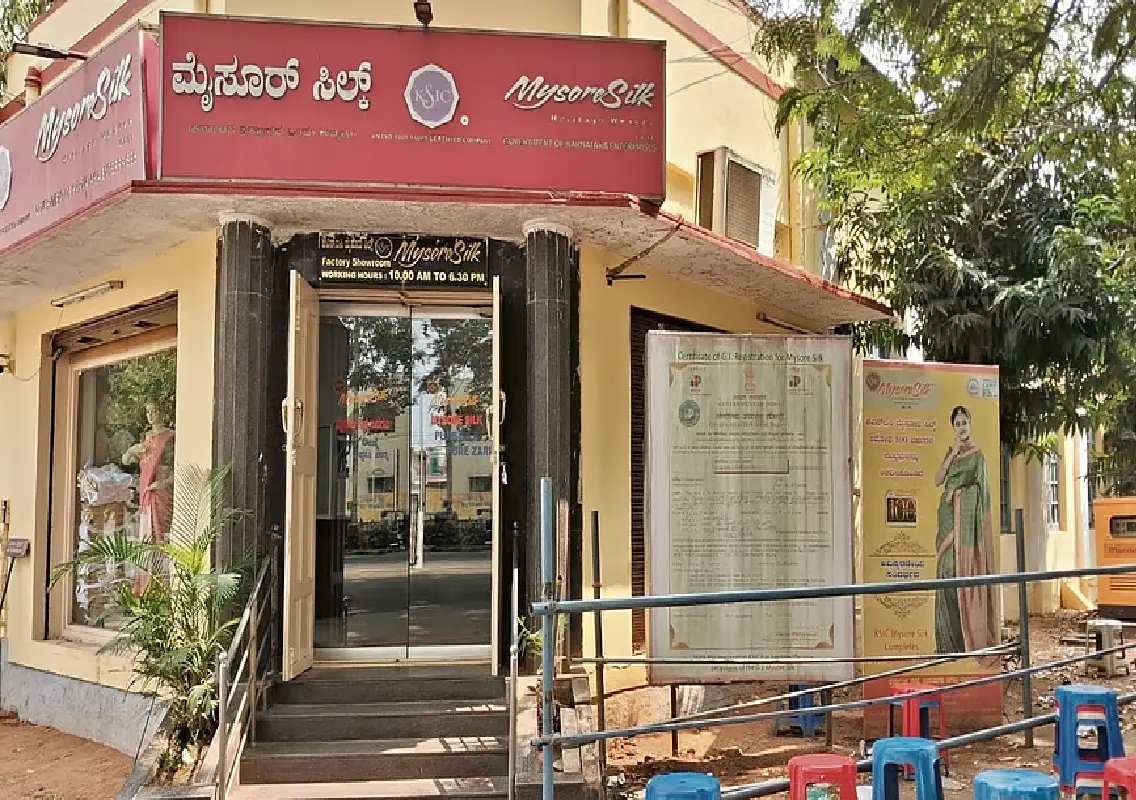


Mysuru: Karnataka Silk Industries Corporation (KSIC), the maker of the Geographical Indication (GI)-tagged Mysore Silk sarees, has witnessed its net profit (after tax) triple over the past five years, even as production has nearly doubled and demand continues to outstrip supply. However, employees are now protesting against a proposed stadium project, fearing it could impact one of the corporation’s key production units.
According to official figures, KSIC’s net profit rose from ₹31.64 crore in 2021-22 to ₹96 crore in 2024-25. During the same period, daily saree production increased from 280 to 400, with output rising from 1,500–1,700 metres to 2,200 metres per day.
Despite a 15% increase in prices over the past two years — attributed largely to rising gold and silver rates — demand remains strong. KSIC Managing Director Zehera Naseem said the corporation is currently facing demand for nearly 600 more sarees per day than it produces and is in the process of adding 20 more looms to bridge the gap.
Expansion of looms and production capacity
KSIC General Manager (Personnel and Operation) Uma said the corporation purchases about 2,000 kg of cocoons daily, mainly from Sidlaghatta, Ramanagara and Kollegal. The raw silk yarn reeling unit at T Narasipura in Mysuru district, spread over 12 acres, processes this into 250 to 300 kg of silk yarn per day.
The weaving unit in Channapatna, spread over 17 acres, originally had 30 looms. Twenty looms were added in 2024-25 and another 20 are being added this year. Meanwhile, the Mysuru weaving unit, spread over 19 acres, has expanded from 159 looms to 229, including mechanical jacquard units introduced for new zari designs.
Overall, the number of looms across the two weaving units has increased from 189 to 319 in five years, with 90 looms added during this period. The increase in production capacity has been supported by new colour combinations and innovative border designs developed by in-house and consultant fashion designers.
Officials said the zari thread used in Mysore Silk sarees contains 65% silver and 0.65% gold, contributing to the premium pricing. The purity of the zari is certified by the Silk Mark Organization of India, reinforcing the brand’s authenticity and quality.
Rising costs but higher demand
The cost of cocoon currently stands at around ₹700 per kg, and about 7 kg of cocoon is required to produce 1 kg of yarn. Operational costs have risen due to inflation, salary revisions under pay commission norms, and the steep increase in gold and silver prices.
Yet, the demand for Mysore Silk sarees has surged. According to KSIC officials, customers queue up outside the corporation’s 12 showrooms across the State as early as 5 am to secure tokens for purchase.
“Earlier, people used to buy Mysore Silk sarees mainly for special occasions and festivals. Now, with higher purchasing power, many are buying them regularly. It has become a matter of prestige to wear this authentic branded product,” a KSIC official said.
Employee protest over stadium proposal
Even as KSIC reports robust financial growth, employees have expressed concern over a proposal to utilise five acres of land belonging to the T Narasipura raw silk yarn reeling unit for construction of a ₹6 crore stadium by the Department of Youth Empowerment and Sports.
Employees fear that the move could eventually lead to the closure of the mother unit. They argue that the stadium cannot function next to the unit’s 5 tonnes per hour (tph) and 2 tph boilers and the dump yard for cinder ash generated by burning coal. The proposed land is also used for transporting 5 tonnes of coal daily and houses a pipeline drawing water from the river Cauvery to the facility.
With 1,200 sanctioned posts and 1,092 employees currently working across three units — of whom only 150 are permanent and the rest outsourced — staff have demanded that vacant posts be filled and production capacity expanded rather than curtailed.
Foreseeing potential disruption in raw material supply, employees stopped production at the T Narasipura unit on February 21 and at the Mysuru and Channapatna units on February 24. They are staging protests at the T Narasipura unit, and cocoon procurement has been halted for the past week.
Employees maintain that any closure of the reeling unit would halt yarn production, ultimately affecting weaving and threatening the future of the heritage brand.
As Mysore Silk continues to command strong market demand and rising profits, stakeholders now await the government’s response on safeguarding both the brand’s legacy and the livelihoods of over 1,000 workers associated with this iconic enterprise.