







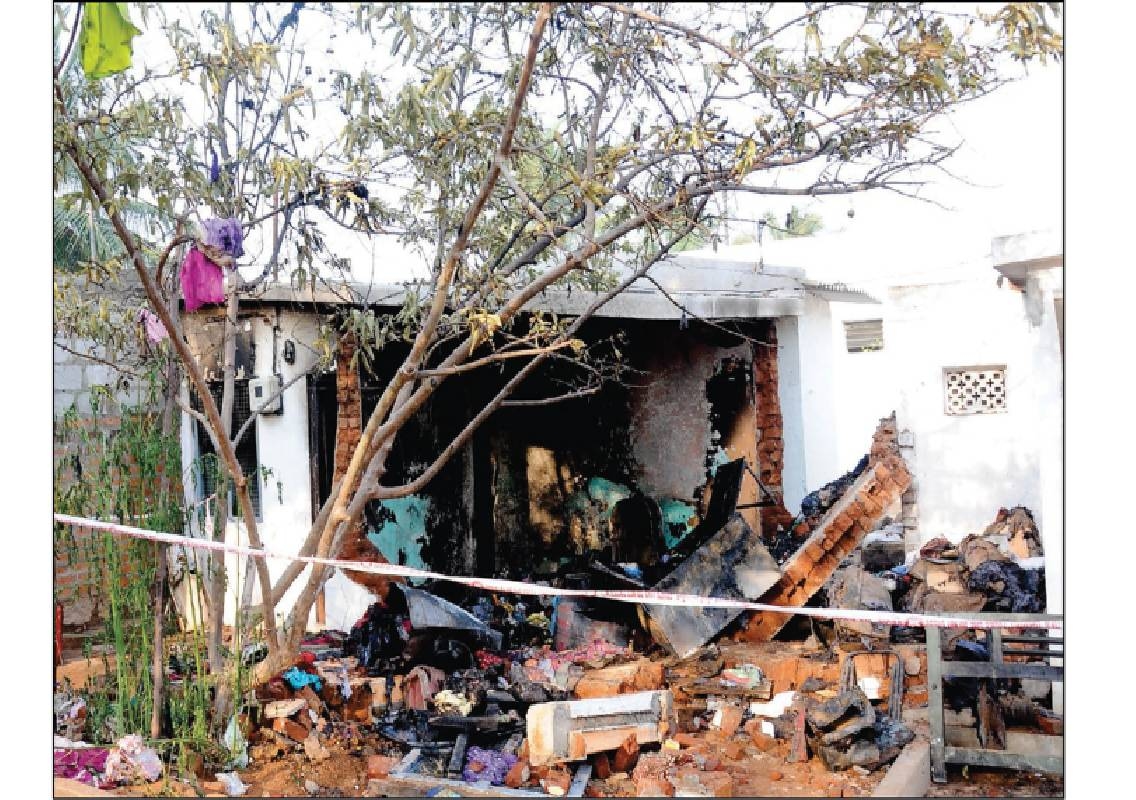


Mysuru: The Karnataka High Court has overturned the acquittal of a retired KSRTC bus driver and sentenced him to life imprisonment for his role in a 2013 house fire in Udayagiri, Mysuru, in which six members of a family died. The verdict came 13 years after the incident and followed a State appeal against the trial court’s acquittal.
A Division Bench comprising Justice H.P. Sandesh and Justice B. Pramod pronounced the judgment on August 29, 2026, in an appeal filed by the State Government challenging the April 28, 2018 order of the trial court. The High Court held that the lower court had failed to properly assess important evidence, including forensic evidence, and set aside the acquittal.
The accused, Abdul Sharief, was 50 at the time of the incident and is now 63. He was convicted under Sections 302, 307 and 436 of the Indian Penal Code (IPC). The court also directed him to surrender before the trial court and imposed a fine of Rs 25,000 for each count of murder.
Six family members died in 2013 fire
The incident occurred at around 3 am on April 12, 2013, at the residence of Mohammed Ameer Jan, 70, in Beedi Colony, Azeez Sait Nagar, within the limits of Udayagiri Police Station in Mysuru.
According to the prosecution case, eight people were sleeping inside the house when petrol was poured into the premises and ignited with a matchstick. The fire quickly engulfed the house.
Ameer Jan died in the blaze. His daughter Rizwana Banu, 38; her daughter Arbia Fathima, 8; her son Mohammed Arhan, 2; and another daughter, Parveen Taj, 27, also died. A fourth daughter, Reshma Anjum, 24, later succumbed to her injuries in hospital.
Three other occupants survived the incident but suffered burn injuries.
The prosecution alleged that Sharief had developed resentment towards Ameer Jan over money connected with medical treatment. The prosecution also relied on the account of an injured survivor who said she saw Sharief near the house before it caught fire.
Trial court had acquitted Sharief
Sharief was arrested in connection with the case and faced trial before the sessions court in Mysuru.
However, on April 28, 2018, the trial court acquitted him of offences under Sections 302, 307 and 436 of the IPC.
The State Government subsequently challenged the acquittal before the Karnataka High Court, arguing that the trial court had not properly appreciated the evidence presented during the proceedings.
The High Court examined the evidence afresh as part of the State’s appeal. The case was heard as Criminal Appeal No. 1310 of 2018.
High Court finds serious error in acquittal
The High Court found that the trial court had failed to properly evaluate the evidence and concluded that its reasoning amounted to a serious error.
Among the evidence considered by the Bench was the Forensic Science Laboratory report. The court also considered the statements of the injured survivor, other witnesses, medical evidence and material collected during the investigation.
The Bench specifically criticised the trial court’s focus on whether an explosion had occurred immediately or at a later stage.
According to the High Court, this question was not central to determining whether the accused had deliberately set the house on fire.
The Bench concluded that the trial court had erred in acquitting Sharief and described the lower court’s judgment as defective. It therefore set aside the acquittal and convicted him.
Forensic evidence played a role
The investigation involved the collection of several material objects from the scene and from the victims.
According to the High Court judgment, investigators collected clothing and other articles and sent them to forensic laboratories to determine whether petroleum or kerosene residues were present.
The court also considered the injuries suffered by Sharief. Medical examination following his arrest recorded burn injuries on his forehead and leg. His motorcycle was also recovered during the investigation.
The prosecution relied on this evidence along with witness testimony to establish its case.
The High Court ultimately concluded that the evidence was sufficient to reverse the trial court’s acquittal.
Court orders life imprisonment
After convicting Sharief under Sections 302, 307 and 436 of the IPC, the High Court sentenced him to life imprisonment.
The court also directed him to surrender before the trial court and imposed a fine of Rs 25,000 for each murder count.
The sentencing came more than 13 years after the deaths, bringing a major development in a case that had remained in litigation since 2013.
The judgment also demonstrates the appellate court’s power to interfere with an acquittal when it finds that the lower court has failed to properly evaluate the evidence.
A case that remained unresolved for years
The 2013 incident had resulted in the deaths of six members of one family and injuries to others. Yet the trial court’s 2018 acquittal meant that the criminal proceedings did not end with a conviction at that stage.
The State’s decision to challenge the acquittal kept the case before the higher judiciary.
The Karnataka High Court’s August 29 judgment has now reversed that outcome and found Sharief guilty of the offences charged.
The case also highlights the importance of forensic evidence and testimony from survivors in investigations involving fatal fires, particularly where the circumstances surrounding the origin of the fire become central to the prosecution.
Conclusion
The Karnataka High Court’s decision has brought a significant turn in the 13-year-old Udayagiri house-fire case in Mysuru. Abdul Sharief, who had been acquitted by the trial court in 2018, has now been convicted and sentenced to life imprisonment for the deaths of six family members.
The Bench found that the trial court had failed to properly appreciate the evidence, including forensic material, and overturned its acquittal.
The verdict marks the latest stage in a prolonged legal battle over one of Mysuru’s most serious family-fire cases, while the court’s detailed findings underline the importance of properly evaluating evidence before reaching a conclusion in a criminal trial.