







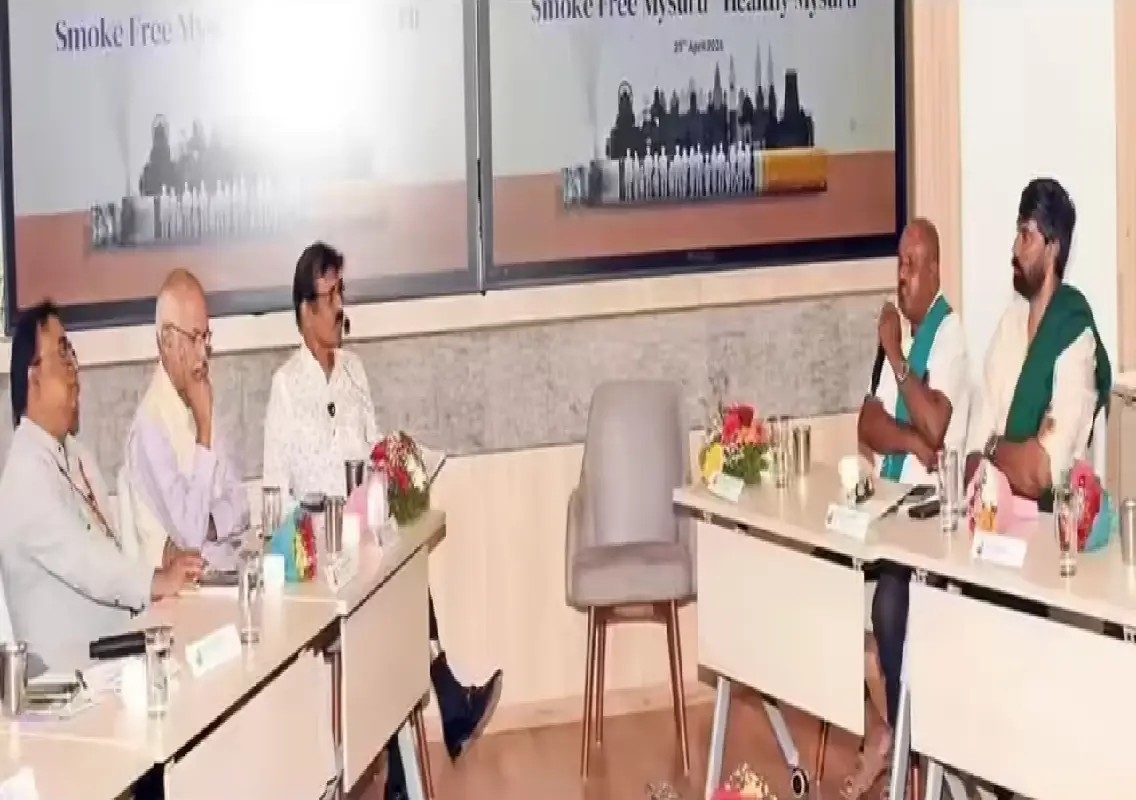


Mysuru: Setting an ambitious public health goal, oncologist Dr B S Ajaikumar has called for making Mysuru tobacco-free within the next 1,000 days. The proposal was put forward during a panel discussion titled ‘Smoke-Free Mysuru, Healthy Mysuru’, where experts stressed the urgent need for coordinated action to curb tobacco use.
Dr Ajaikumar, chairman of Bharath Hospital & Institute of Oncology, highlighted tobacco as one of the most serious public health threats. He noted that eliminating tobacco use could prevent nearly 40 per cent of health issues, underlining the scale of its impact on society.
Alarming health statistics highlighted
Citing national and global data, Dr Ajaikumar pointed out that tobacco is responsible for around 23 lakh deaths annually in India and over 80 lakh deaths worldwide. He also emphasised the strong link between tobacco consumption and cancer, stating that one in nine individuals develops cancer, often associated with tobacco use.
In addition, he raised concerns about second-hand smoke, which accounts for approximately 12 lakh deaths globally. In India, nearly one-third of adults are exposed to passive smoking, making it a significant yet often overlooked health hazard.
Call for stronger enforcement measures
The panel stressed that achieving a tobacco-free Mysuru would require strict enforcement of existing laws. Dr Ajaikumar suggested regular inspections, stringent penalties for violations, and the creation of accessible public complaint systems to ensure compliance.
He also proposed linking business licences to adherence to smoke-free norms. Such a move, he said, would make accountability an integral part of commercial operations and encourage establishments to actively support tobacco control measures.
Importance of education and urban planning
Beyond enforcement, the discussion highlighted the role of education in long-term behavioural change. Dr Ajaikumar emphasised introducing health education at the school level, noting that children can influence family habits and contribute to wider social change.
He also advocated a holistic approach to urban health planning, including the development of walkable streets, cycling infrastructure, and green public spaces. Continuous public awareness campaigns were identified as essential to reinforce anti-tobacco messaging.
Inspiration from national success stories
Panellists expressed optimism about achieving the goal, drawing parallels with India’s successful Polio eradication in India campaign. They suggested that with sustained effort, strong policy implementation, and community involvement, tobacco use could be significantly reduced or even eliminated.
The discussion saw participation from several notable figures, including V Prakash, farmer leaders Ramegowda and Manju Kiran, cancer survivors Mahadev and Nagaraj, district tobacco enforcement officer Dr S Gopinath, and deputy mayor Pushpavalli.
Conclusion
The vision of a tobacco-free Mysuru within 1,000 days presents both a challenge and an opportunity. With a combination of strict enforcement, community participation, and long-term health planning, experts believe the city can make significant progress towards reducing tobacco-related harm. The initiative, if successful, could serve as a model for other cities across India.