







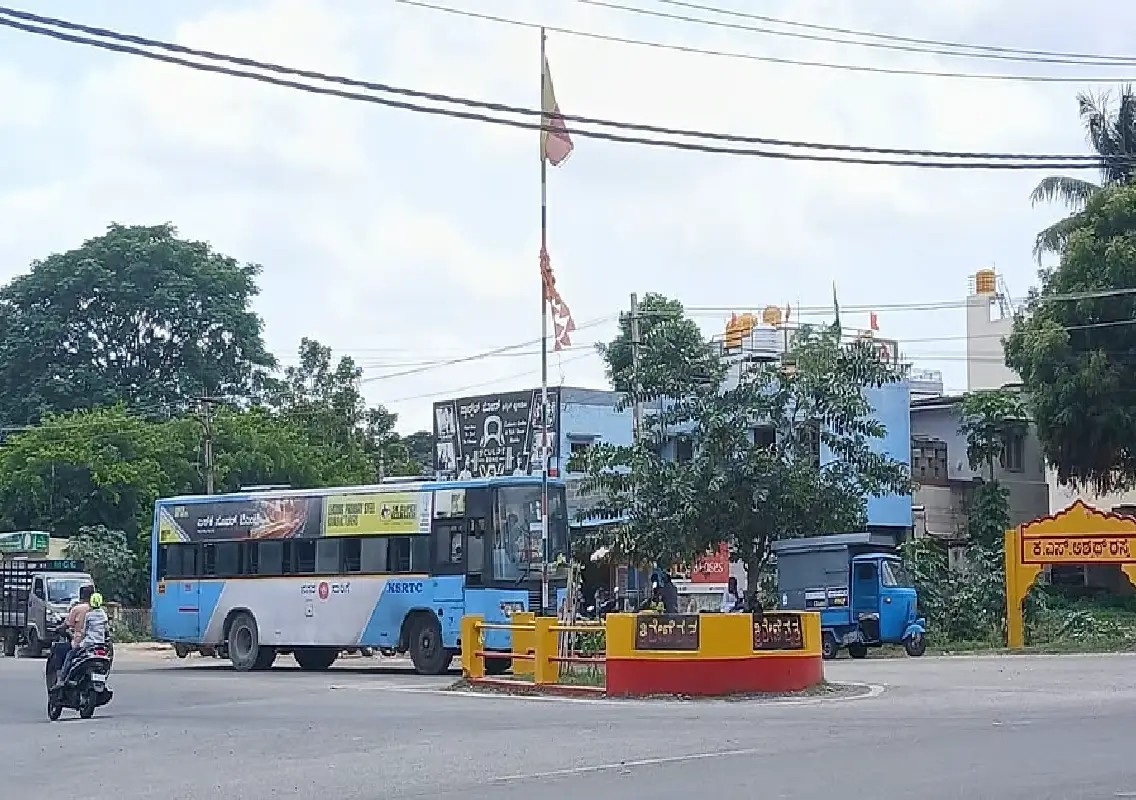


Mysuru: Daily commuters in Mysuru have voiced concerns over the planning and frequency of city bus services operated by the Karnataka State Road Transport Corporation (KSRTC), alleging that inadequate scheduling and poorly located bus stops are causing inconvenience, delays and a growing dependence on private vehicles.
Residents travelling between Kalyanagiri, Sathagalli Layout and the City Bus Stand say several operational issues have made public transport less reliable, despite the routes serving a large number of students, workers and senior citizens.
Commuters cite inconvenience on key routes
The KSRTC’s city bus routes 80 and 161 connect areas such as Kalyanagiri and Sathagalli Layout with the City Bus Stand through Dr Rajkumar Road and Triveni Circle.
The Kalyanagiri Water Tank bus stop on Dr Rajkumar Road, located near the State Bank of India branch, is served by the 80 series and only a few buses operating under the 161 series.
However, several buses in the 161 series halt at a different location near the junction of Visvesvaraya Technological University (VTU) Road and Dr Rajkumar Road, approximately 150 metres away from the Water Tank stop.
Commuters argue that this arrangement creates confusion, as many passengers waiting at the Water Tank stop often miss buses approaching from the VTU Road side.
Demand for merging bus stops
Regular passengers have suggested that the two bus stops be merged into a single location at the junction of VTU Road and Dr Rajkumar Road to improve accessibility and convenience.
Commuter Madan Gowda said governments should encourage greater use of public transport by making services more efficient and user-friendly.
He argued that relocating or merging the bus stops would allow passengers to board whichever bus arrives first, reducing waiting times and improving connectivity.
Several residents believe such a move would significantly enhance the efficiency of the transport network in the area.
Poor infrastructure adds to difficulties
Residents also highlighted shortcomings in supporting infrastructure, including the absence of adequate bus shelters at several locations.
A commuter identified as Devi said buses operating on the VTU Road route often stop near the Indira Gandhi auto stand instead of designated bus stops, creating confusion for passengers.
She pointed out that passengers frequently see buses pass by nearby locations without having convenient access to board them, resulting in missed services and longer waiting periods.
Other commuters noted that many bus stops across Mysuru still lack proper shelters, exposing passengers to harsh weather conditions while waiting for buses.
Irregular schedules frustrate passengers
One of the most common complaints relates to the irregular frequency of bus services.
Passengers claim buses often arrive in clusters, with two vehicles reaching a stop within minutes of each other, followed by long gaps of up to an hour or more.
This inconsistency has made it difficult for commuters to rely on public transport for time-sensitive travel.
Sudheer, the parent of an engineering student, said students often struggle to reach colleges and examination centres on time due to unpredictable bus schedules.
According to him, the uncertainty has forced many families to depend on private vehicles despite the additional financial burden.
Public transport users call for reforms
Local residents argue that improving bus frequency, route planning and passenger facilities would encourage greater use of public transportation.
Mallamma, a daily commuter, said investments in better infrastructure and planning would benefit thousands of passengers who depend on city buses every day.
She added that irregular services and inadequate facilities often discourage people from choosing public transport, leading them to opt for private vehicles or autorickshaws instead.
Fruit vendor Maneswamy, who works near Triveni Circle, noted that buses do not always stop adequately near existing shelters, forcing passengers to rush across the road to board arriving vehicles.
Need for sustainable urban mobility
Transport experts have often emphasised that efficient public transport systems are essential for reducing traffic congestion, fuel consumption and environmental pollution in growing urban centres.
Commuters in Mysuru believe that addressing operational issues such as route coordination, bus stop placement and service frequency could significantly improve passenger satisfaction and increase ridership.
Many residents have urged KSRTC and the Mysuru City Corporation to conduct a review of bus operations in the area and implement practical solutions based on commuter feedback.
Conclusion
As Mysuru continues to expand, commuters say a dependable and well-planned public transport system is vital for sustainable urban mobility. Residents are calling on KSRTC and civic authorities to improve bus frequency, streamline route planning and enhance passenger infrastructure to make public transport a more attractive and reliable option.