







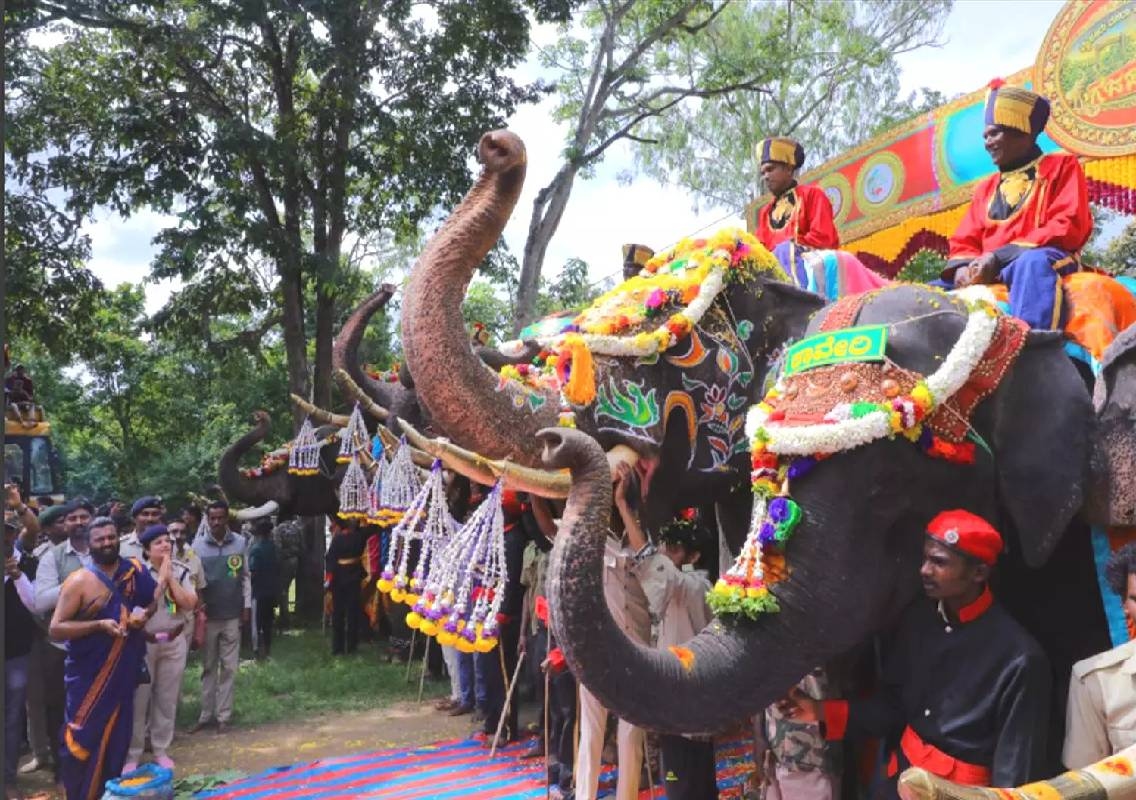


Mysuru: Preparations for the Mysuru Dasara 2026 celebrations officially began on Wednesday, August 26, with the traditional Gajapayana ceremony at Veeranahosahalli near the Nagarahole Tiger Reserve. The first batch of nine trained elephants was ceremonially sent towards Mysuru for the months-long preparation and training ahead of the grand Jumbo Savari.
The ceremony marks an important annual milestone in the preparations for Karnataka’s famous Dasara celebrations. The elephants will undergo specialised training, care and routine exercises before taking part in the Vijayadashami procession in October.
This year’s first batch comprises Dhananjaya, Gopi, Srirama, Srikanta, Prashantha, Kaveri, Mahendra, Lakshmi and Ekalavya, according to reports. The elephants have been brought from different elephant camps across the region and selected after health and fitness assessments.
Gajapayana marks the beginning of Dasara elephant preparations
The traditional Gajapayana ceremony was held at Veeranahosahalli in Hunsur taluk of Mysuru district, near the entrance of Nagarahole National Park. It is an important ritual associated with the preparation of the elephant squad for Mysuru Dasara.
Mysuru district in-charge Minister Dr S Yathindra Siddaramaiah formally flagged off the first batch after performing the customary rituals. The ceremony was held during an auspicious Tula Lagna in the morning.
The elephants were offered traditional food items, including jaggery, bananas and sugarcane, along with other delicacies as part of the ceremony.
The event was conducted amid traditional music and ceremonial arrangements, marking the formal start of preparations for the 2026 Dasara elephant contingent.
Nine elephants begin their journey towards Mysuru
The first batch consists of nine elephants selected from different camps.
According to the latest reports, Dhananjaya, Gopi, Srirama, Srikanta, Prashantha and Kaveri are from Dubare Elephant Camp. Mahendra and Lakshmi are from Balle Elephant Camp, while Ekalavya is from Mathigodu Elephant Camp.
The elephants will eventually be accommodated at the Mysuru Palace, where they will undergo extensive training for their roles during the Dasara festivities.
The first batch is scheduled to enter the Mysuru Palace premises on August 28, after completing the ceremonial journey from Veeranahosahalli.
Their arrival at the palace will mark the next major stage of preparations, as the elephants begin their regular training and acclimatisation exercises in an urban environment.
Abhimanyu’s retirement changes this year’s elephant squad
One of the notable changes in Mysuru Dasara 2026 is the retirement of veteran elephant Abhimanyu, who has been one of the most recognisable members of the Dasara elephant squad.
Abhimanyu, who is around 60 years old, has carried the Golden Howdah during the Jumbo Savari for six consecutive years, from 2020 to 2025. He has now retired from the prestigious responsibility.
His retirement means the Forest Department is preparing a new contender for the Golden Howdah duty.
Earlier reports indicated that Dhananjaya, Mahendra and Ekalavya were among the elephants being considered for the important role this year.
The selection of the elephant that will carry the Golden Howdah will be closely watched as preparations progress.
Twelve elephants finalised for this year’s Dasara
Although nine elephants participated in the Gajapayana ceremony on August 26, the overall elephant contingent for this year’s Dasara is larger.
Reports indicate that 12 elephants, including four female elephants, have been finalised for the 2026 festivities. The remaining elephants will join the contingent as preparations progress.
The Forest Department has been conducting health examinations and other assessments before finalising the animals for the festival.
The selection process is particularly important because the elephants have to cope with several weeks of training, public gatherings, ceremonial activities and the long Jumbo Savari procession.
Elephants undergo rigorous training before Jumbo Savari
Participating in Mysuru Dasara is not limited to the final procession.
The selected elephants undergo a carefully planned training programme that helps them become accustomed to crowds, traffic, loud sounds, ceremonial music and the surroundings of Mysuru city.
The animals also undertake regular practice walks to prepare for the Jumbo Savari route.
The training is necessary because the Vijayadashami procession attracts huge crowds, with thousands of people gathering along the route to watch the decorated elephants and cultural performances.
The elephants must remain calm and responsive despite the large crowds and noise.
Special care and diet for Dasara elephants
The health and stamina of the elephants are closely monitored during the preparation period.
Forest Department officials and veterinarians assess the animals before and during their training. Their diet can also be modified depending on individual requirements, including age, weight, health and workload.
Previous Dasara preparations have included detailed weight checks and special diet plans for the elephants. During the 2025 preparations, officials said the weight assessment helped determine the nutritional requirements and training needs of each elephant.
Similar health and fitness monitoring is expected to remain an important part of the 2026 preparations.
The elephants that participate in the final procession must be physically fit enough to complete the demanding route while carrying ceremonial equipment.
Mysuru Palace prepares to welcome the elephant squad
The arrival of the elephants at Mysuru Palace on August 28 will be another significant event in the preparations.
The Forest Department and Mysuru Palace Board have been making arrangements to accommodate the animals and their mahouts and kavadis.
Special facilities are required because the elephants will remain in the city for an extended period while undergoing training.
The animals will also need regular access to food, water, veterinary care and resting areas.
The palace premises become an important training base for the elephants in the weeks leading up to Dasara.
Golden Howdah remains the biggest attraction
The Golden Howdah is one of the most iconic symbols of Mysuru Dasara.
During the traditional Jumbo Savari, a specially trained elephant carries the Golden Howdah through the streets of Mysuru.
The elephant carrying the howdah becomes the centre of attention during the procession, making the selection and training of the lead elephant particularly important.
With Abhimanyu no longer performing the duty, the 2026 Dasara will mark a new chapter for the elephant contingent.
The Forest Department will assess the shortlisted elephants before deciding who is best suited to carry the Golden Howdah.
Abhimanyu receives a ceremonial farewell
Abhimanyu’s retirement has added an emotional element to this year’s Gajapayana.
The veteran elephant has been an important part of Mysuru Dasara in recent years and became closely associated with the Golden Howdah.
His six-year run as the lead howdah elephant made him one of the most familiar Dasara jumbos among visitors and residents.
Reports from the Gajapayana ceremony said Abhimanyu was given a respectful farewell as the new contingent began its journey.
His retirement also highlights the importance of ensuring that experienced elephants are not pushed beyond the age and physical limits considered appropriate for the demanding ceremonial role.
Dasara celebrations scheduled for October
The elephant preparations begin nearly two months before the main festivities because the animals require sufficient time to adapt to their new surroundings and undergo training.
The 2026 Mysuru Dasara celebrations are scheduled to take place in October, culminating in the traditional Vijayadashami procession.
The Jumbo Savari remains the central attraction of the final day’s celebrations.
The procession combines the ceremonial elephant squad with cultural performances, folk artistes, tableaux and other traditional elements, making it one of Karnataka’s most prominent annual cultural events.
The early arrival of the elephants therefore allows the Forest Department enough time to prepare the animals for the scale and complexity of the event.
Why the elephant selection is important
The Dasara elephants play a role that goes beyond the visual spectacle of the procession.
They are trained forest elephants that must adapt to a very different environment when they move from their camps to the city.
The transition requires careful supervision because Mysuru’s urban environment is filled with traffic, people, sounds and unfamiliar surroundings.
Training helps the animals gradually adjust to these conditions.
Officials also monitor their health and behaviour throughout the process to ensure that they remain fit for the final procession.
Traditional Gajapayana continues to connect forest and city
Gajapayana is also significant because it represents the traditional movement of the Dasara elephant squad from the forest camps towards Mysuru.
The ceremony connects the state’s forest and cultural traditions with the historic Dasara celebrations.
The elephants begin their journey from the forest region and eventually become the centrepiece of one of the country’s most prominent traditional processions.
The ritual has therefore become an integral part of Mysuru Dasara preparations.
For residents and visitors, the arrival of the elephants signals that the countdown to Dasara has officially begun.
Preparations intensify after elephant arrival
With the first batch of elephants now on its way to Mysuru, preparations for the festival are expected to accelerate.
The Forest Department will focus on training and maintaining the health of the elephant squad, while the palace authorities and district administration will continue preparations for accommodating the animals and conducting the various Dasara events.
The selection of the Golden Howdah elephant will be one of the major decisions in the coming weeks.
At the same time, Mysuru will gradually begin preparing for the large number of visitors expected during the festival.
Mysuru gears up for another grand Dasara
The arrival of the first nine elephants is an important sign that Mysuru Dasara 2026 is moving into its active preparation phase.
The elephants will spend the coming weeks training for their roles before the final procession.
With Abhimanyu’s retirement, the spotlight will also be on the next generation of Dasara elephants, particularly those being considered for the Golden Howdah.
The Forest Department’s emphasis on health checks, training and individual care will remain crucial to ensuring a safe and successful festival.
Conclusion
Mysuru: Nine elephants have begun their ceremonial journey towards Mysuru as part of Gajapayana, officially marking the start of preparations for the 2026 Mysuru Dasara festivities. The first batch was flagged off from Veeranahosahalli near Nagarahole on August 26 and is scheduled to enter the Mysuru Palace on August 28.
The first batch includes Dhananjaya, Gopi, Srirama, Srikanta, Prashantha, Kaveri, Mahendra, Lakshmi and Ekalavya. A total of 12 elephants, including four females, have been finalised for this year’s Dasara celebrations.
This year’s preparations are particularly significant following the retirement of veteran elephant Abhimanyu, who carried the Golden Howdah for six consecutive years. The Forest Department will now focus on training the new contingent and identifying the elephant best suited to take on the prestigious responsibility.
With the elephants beginning their journey to Mysuru, the countdown to the grand Jumbo Savari and Mysuru Dasara 2026 has officially begun.