







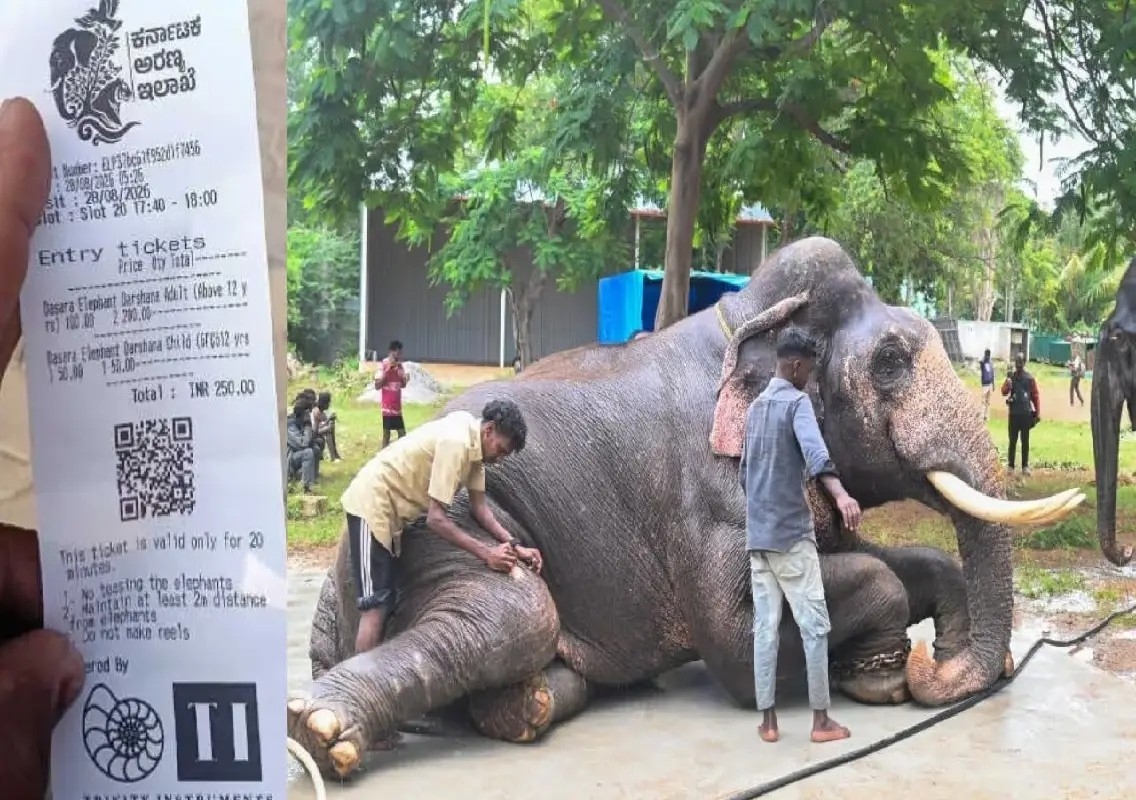


Mysuru: Tourists and locals visiting the Mysuru Palace grounds to see the famous Dasara elephants will now have to pay an entry fee under new rules introduced by the Forest Department.
The new system has been brought in to regulate crowds and improve the safety of both visitors and the elephants ahead of the Mysuru Dasara celebrations.
Under the revised rules, adults above 12 years will be charged Rs 100, while children below 12 years will have to pay Rs 50 to enter the designated viewing area.
The Forest Department has also imposed several restrictions on visitors, including a time limit for viewing the elephants and rules governing the distance that must be maintained from the animals.
Visitors allowed 20-minute viewing period
According to the new guidelines, visitors will be allowed to watch the Dasara elephants for a maximum of 20 minutes.
Visitors must maintain a minimum distance of two metres from the elephants. Alternatively, they must remain behind a barricade positioned 100 metres away from the animals.
The restrictions are intended to prevent people from getting too close to the elephants and reduce the possibility of situations that could cause stress or provoke the animals.
The department has also prohibited visitors from making social media reels around the elephants.
Close-up photography has been banned as well, while feeding the elephants is strictly prohibited.
Officials are expected to monitor compliance with the rules as visitors arrive to see the elephants during the Dasara preparations.
New SOP follows Dubare incident
The Forest Department has cited a new Standard Operating Procedure (SOP) as the reason for introducing the restrictions.
According to the department, the SOP was introduced following a recent incident at the Dubare Elephant Camp in Kodagu, where an elephant allegedly attacked a person.
The incident prompted authorities to review safety arrangements around captive elephants and introduce stricter protocols governing public interaction with the animals.
The new measures at the Mysuru Palace grounds are intended to ensure that visitors maintain a safe distance and do not engage in activities that could disturb the elephants.
The Forest Department is also seeking to manage the movement of visitors so that large crowds do not gather close to the animals.
Barricades installed at palace grounds
As part of the new safety arrangements, barricades have been installed near the Kote Anjaneya Swamy Temple and the Trineshwara Temple.
These barricades are intended to create a controlled viewing area and maintain separation between visitors and the elephants.
Ticket sales began on a trial basis last Friday.
The introduction of the ticketing system marks a change in the way visitors can access the area where the Dasara elephants are housed and trained.
Authorities are expected to assess the response to the trial arrangement before deciding on further measures for crowd management.
Visitors question entry fee
The decision to charge visitors to watch the Dasara elephants has attracted criticism from members of the public and tourists.
Some visitors have questioned the need for an entry fee, arguing that crowd-control measures could be introduced through barricades and regulated access without imposing a separate charge.
According to one visitor, restricting the number of people entering the viewing area and maintaining a safe distance could achieve the intended purpose without charging people to watch the elephants.
The criticism comes at a time when the Dasara elephants remain a major attraction for tourists and locals visiting the palace grounds during the festival season.
For many visitors, watching the elephants is an important part of the Dasara experience, making the new fee a matter of public interest.
Allegations of preferential access
Some eyewitnesses have also alleged that the new rules were not being applied uniformly.
They claimed that while members of the public were being stopped and asked to purchase tickets, relatives and friends of forest officials and police personnel were allegedly being allowed to enter without paying.
The eyewitnesses further alleged that some such individuals were permitted to get closer to the elephants than ordinary visitors.
These allegations have not been independently verified.
The claims have nevertheless raised questions among visitors about the transparency and uniformity of the new ticketing and access system.
Members of the public have called on the authorities to ensure that the rules are applied equally to everyone visiting the elephant viewing area.
Safety remains key concern
The Forest Department’s decision comes against the backdrop of the risks involved in allowing large numbers of people to approach elephants.
Dasara elephants are trained for various festival-related activities, but they remain powerful animals and can react unpredictably if startled, disturbed or surrounded by crowds.
Restrictions on feeding, close-up photography and social media reels are therefore aimed at reducing unnecessary interaction between visitors and the animals.
The two-metre minimum distance and 100-metre barricaded viewing arrangement are also designed to provide an additional safety buffer.
At the same time, the department faces the challenge of balancing visitor access with animal welfare and public safety.
Transparency sought in implementation
With ticket sales already beginning on a trial basis, visitors are seeking clarity on how the system will operate during the busy Dasara period.
Authorities may need to ensure that ticketing arrangements are clearly communicated and that all visitors are treated equally.
The allegations regarding preferential access, if substantiated, could undermine public confidence in the new system. Ensuring transparent enforcement will therefore be important as the number of visitors increases.
The Forest Department’s safety measures are aimed at preventing incidents involving elephants and visitors, particularly following the recent incident at Dubare Elephant Camp.
However, the criticism over the entry fee indicates that authorities will also have to address concerns regarding affordability, equal access and implementation.
As Mysuru prepares for Dasara, the new rules are expected to remain a key part of crowd management around the elephants. The effectiveness of the system will ultimately depend on consistent enforcement, adequate safety arrangements and transparent treatment of visitors.