







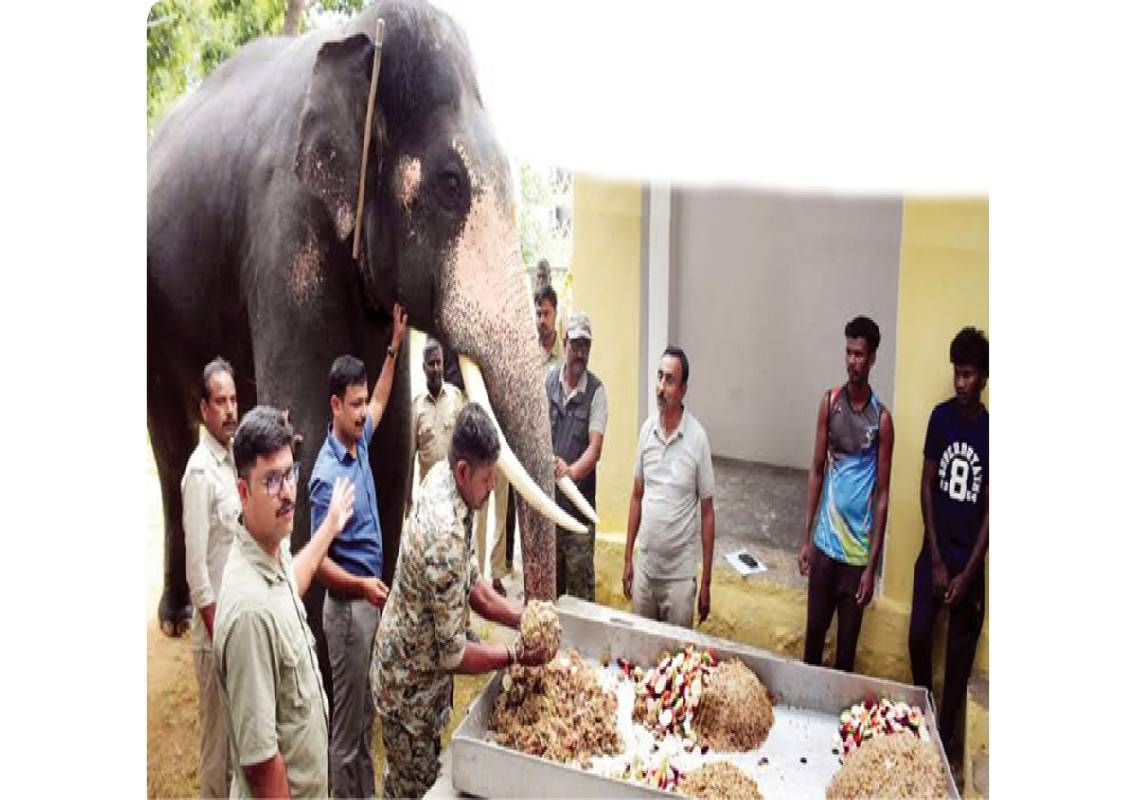


Mysuru: A controversy has emerged over the Forest Department’s decision to approve a single-bid tender worth around Rs 60 lakh for supplying food and fodder to the Dasara elephants during their stay at the Mysore Palace premises. The elephants are scheduled to stay at the Palace from August 28 to October 25 as part of preparations for Mysuru Dasara 2026.
The decision to proceed with a single bidder has raised questions over tender procedures, the rates fixed for fodder and whether the selected contractor meets all the required eligibility conditions. A former contractor has also alleged violations of the Karnataka Transparency in Public Procurements (KTPP) Act and tender conditions.
Rs 60 lakh tender for Dasara elephant food
The Forest Department has invited bids to supply food and fodder for the elephants that will be housed at the Mysore Palace during the Dasara season.
The tender covers large quantities of fodder as well as special food items and traditional dietary supplements required for the elephants during their stay.
The estimated value of the supplies for the period is around Rs 60 lakh.
The elephant team is expected to remain at the Palace for nearly two months, making uninterrupted availability of suitable fodder an important part of the festival preparations.
Why did the department approve a single bid?
The main controversy concerns the decision to award the contract despite receiving only one bid.
According to the report, standard tender procedure requires a tender receiving only one bid in the initial call to be cancelled and re-tendered.
However, Forest Department officials proceeded with the single bid, citing the limited time available before the elephants arrive at the Palace.
Deputy Conservator of Forests Dr I.B. Prabhu Gowda said the department had received official sanction to proceed with the single-bid tender because of pressing operational requirements and the short time available. With only five days remaining for arrangements, officials said a fresh tender process was not considered practical.
Former contractor alleges tender violations
The decision has been challenged by A.S. Babu, a former contractor who supplied food and fodder to elephants for several years.
Babu has submitted a complaint to the Chief Conservator of Forests and senior Forest Department officials in Bengaluru.
He has alleged that the tender process violated provisions of the KTPP Act and the conditions specified in the tender document.
According to his complaint, bidders were required to submit a supply confirmation certificate. Babu has alleged that the contractor who received the contract did not possess the required certificate.
He has therefore questioned why the bid was allowed to proceed to the financial stage instead of being rejected during technical evaluation.
Contractor says rates are too low
Another major issue is the rates fixed by the Forest Department for different types of fodder.
According to the report, the department has fixed a rate of Rs 6,000 per tonne for tree branches, while the Zoo Authority reportedly pays around Rs 12,000 per tonne for similar fodder.
The difference is even greater for dry grass.
The Forest Department has reportedly fixed the rate at Rs 7,000 per tonne, whereas the Zoo and elephant camps pay between Rs 22,000 and Rs 27,000 per tonne.
The significant difference has been cited as one reason why regular contractors have reportedly stayed away from the tender.
Why contractors may have stayed away
The low rates appear to have created another challenge for the department.
Sources said Babu, who has around 25 years of experience supplying food and fodder to elephants, did not participate in the latest tender because he expected officials to issue a second round with revised rates based on prevailing market prices.
The absence of multiple bidders has consequently left the department with only one offer to consider.
This has raised questions about whether the current rates are realistic enough to ensure uninterrupted supply throughout the elephants’ stay.
Fodder availability raises another concern
The tender specifies branches and leaves from trees including Banyan, Peepal and Basari.
However, obtaining these materials in the required quantities could present logistical difficulties.
Cutting branches from trees on government property or along roadsides is prohibited and can lead to legal action, according to the report.
Sourcing the required quantities from private land could also prove difficult.
This has led to questions about how the selected contractor will arrange the specified fodder while maintaining a consistent supply for the elephants.
Dasara elephants need uninterrupted nutrition
Food management is particularly important for elephants participating in Mysuru Dasara.
The animals undergo training and route familiarisation before the grand Jumbo Savari, while their daily routine also includes exercise and other preparations.
Adequate fodder and specialised food are therefore essential to maintain their health and fitness throughout their stay.
Any interruption in the supply chain could create additional challenges for the Forest Department during the festival period.
Department cites shortage of time
The Forest Department has defended its decision by pointing to the tight schedule.
Officials reportedly said that the tender process had already consumed considerable time and that there were only a few days left before the first group of elephants was scheduled to enter the Palace.
According to DCF Dr I.B. Prabhu Gowda, the department has been receiving single bids for several years.
Officials therefore proceeded with the current tender after obtaining the necessary approval rather than risking delays by starting another bidding process.
Questions over tender procedure remain
While the department has cited practical difficulties, the allegations made by the former contractor have brought the procurement process under scrutiny.
The key questions include whether the single-bid tender should have been reissued, whether the selected contractor satisfied all technical requirements and whether the fixed rates are sufficient to guarantee the required quantities of fodder.
The Forest Department will have to address these concerns while ensuring that preparations for Dasara continue without disruption.
Dasara elephant team set to arrive on August 28
The elephant team is scheduled to enter the Mysore Palace premises on August 28.
The animals will remain there until October 25 as part of their Dasara preparations and festival duties.
With the arrival date approaching, officials face the immediate task of ensuring that food and fodder arrangements are in place.
The tender controversy has therefore emerged at a particularly sensitive stage of the festival preparations.
Why the issue matters
The dispute is not only about a government contract.
It also concerns the welfare and daily requirements of the elephants that form one of the most recognisable features of Mysuru Dasara.
The animals require large and regular quantities of fodder, and any procurement issue could have a direct impact on the arrangements made for their stay.
At the same time, transparent procurement is important when public funds are involved, particularly for a contract estimated at around Rs 60 lakh.
Conclusion
The Forest Department’s decision to approve a single-bid, Rs 60 lakh tender for supplying food and fodder to Mysuru Dasara elephants has triggered questions over procurement procedures, contractor eligibility and the rates fixed for various types of fodder.
A former contractor has alleged violations of the KTPP Act and tender conditions, while officials have defended the decision by citing the shortage of time before the elephants arrive at the Mysore Palace.
With the Dasara elephant team scheduled to enter the Palace on August 28, the immediate priority will be ensuring a reliable supply of suitable fodder. At the same time, the allegations surrounding the tender process could require further scrutiny from senior authorities.