







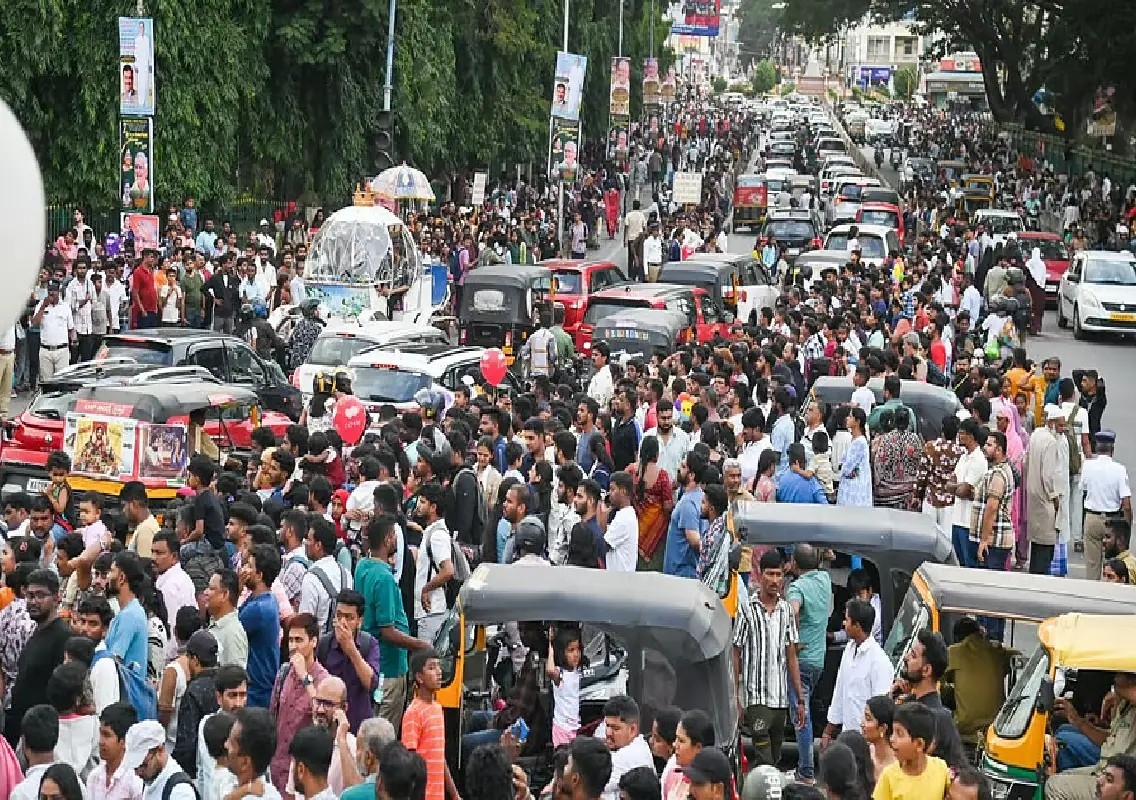


Mysuru: Dasara elephants continue to be one of the biggest attractions of Mysuru Dasara, drawing thousands of people who gather to watch the majestic pachyderms walk along city roads. With crowds growing steadily every year, concerned citizens have urged the authorities to strengthen crowd-management measures to prevent any untoward incident during the elephants’ daily training walks and the main Vijayadashami procession.
The sight of caparisoned elephants walking in discipline along the ‘Raja Marga’, the five-km route of the grand Dasara procession, is among the most anticipated spectacles of the festival. However, the growing popularity of the Dasara jumbos has also created challenges for the authorities tasked with managing crowds and ensuring the safety of both people and elephants.
Elephants undergo intensive training
The Dasara jumbos undergo more than 50 days of rigorous training before they participate in the Vijayadashami procession. As part of the training, the elephants are taken from Mysuru Palace, where they are housed, to Bannimantapa, the venue where the procession culminates.
The daily walks are intended to acclimatise the elephants to city conditions and prepare them to remain calm while moving through large crowds. The training is particularly important as thousands of people are expected to gather along the procession route on Vijayadashami.
The most important elephant in the procession is the one carrying the idol of Goddess Sri Chamundeshwari in the golden howdah. The golden howdah, weighing around 750 kg, is carried on Vijayadashami Day, making the elephant entrusted with the responsibility a key attraction of the festival.
Daily walks become a major attraction
Even before the main Dasara celebrations attract visitors from across the State and beyond, the elephants have already become a daily attraction in the city.
The jumbos are taken on their morning and evening walking schedules, with large numbers of local residents gathering along the route. Children, in particular, eagerly wait to watch the elephants pass through the city streets.
What was once a relatively low-profile training activity, witnessed by only a handful of people, has transformed into a major public attraction over the past few years.
The rise of social media has played a significant role in this change. Residents and visitors regularly record videos and photographs of the elephants and share them on social media platforms, generating greater interest in the daily walks.
Social media turns elephants into stars
The popularity of individual elephants has also contributed to the growing crowds.
Last year, Bheema became particularly popular among the public after videos of the elephant responding to people calling his name by raising his trunk circulated widely on social media. The elephant soon became a social media sensation, attracting people specifically hoping to see him.
Vasantha, a resident of Bengaluru, recalled bringing her granddaughter to Mysuru after the child became fascinated with Bheema through social media.
“I had to bring my granddaughter to Mysuru, as she was adamant about watching Bheema,” she said. She took the child to Sayyaji Rao Road near the Deaf and Dumb School and waited for the elephants.
When the line of jumbos appeared, the child began calling out “Bheema” without knowing which elephant was him. She was eventually delighted when a forest guard identified Bheema in the procession.
However, Bheema has not been included in this year’s Dasara elephant contingent as he is reportedly in musth, a natural physiological condition in male elephants that requires careful management.
Growing crowds pose a challenge
The increasing number of spectators has made crowd management more difficult for the authorities.
More than 10,000 people reportedly gathered to watch the elephants during their walk on Sunday. Many spectators stand close to the route to obtain a better view, while others record videos for social media.
The large gatherings can create difficulties for the personnel accompanying the elephants, particularly when people move towards the jumbos or obstruct the route.
Forest Department personnel, members of the Leopard Task Force and police personnel accompany the elephants during their walks. Their teams work to clear traffic and keep the designated route open as the jumbos proceed along Sayyaji Rao Road.
Despite repeated warnings, controlling the crowd can become challenging when large numbers of people gather at the same location.
Citizens seek standard operating procedure
Residents have called for a more organised system to regulate spectators during the daily elephant walks.
Nataraj, a city resident, said there was a need to establish a standard operating procedure for managing crowds along the route.
According to residents, the authorities could identify vulnerable stretches, create designated viewing areas and ensure that adequate personnel are stationed at locations where crowds are expected to be particularly large.
The demand comes at a time when the popularity of the Dasara elephants is increasing rapidly through social media. While the public’s enthusiasm adds to the festive atmosphere, authorities face the challenge of ensuring that spectators maintain a safe distance from the elephants.
Forest Department assures additional security
Forest Department officials have acknowledged the growing crowds and said additional personnel would be deployed if required.
The presence of trained personnel is particularly important because elephants can react unpredictably when exposed to sudden movements, loud noises or excessive crowd pressure. Maintaining adequate space around the animals is therefore essential for the safety of both the public and the elephants.
As the Dasara celebrations approach, the number of visitors is expected to increase further. The authorities will consequently have to balance public access with safety requirements during the elephants’ daily training walks.
The Dasara jumbos remain an inseparable part of Mysuru’s cultural identity and the annual festivities. With their popularity reaching new heights through social media, effective crowd management and greater public cooperation will be crucial to ensure that the spectacle remains safe and enjoyable for everyone.