







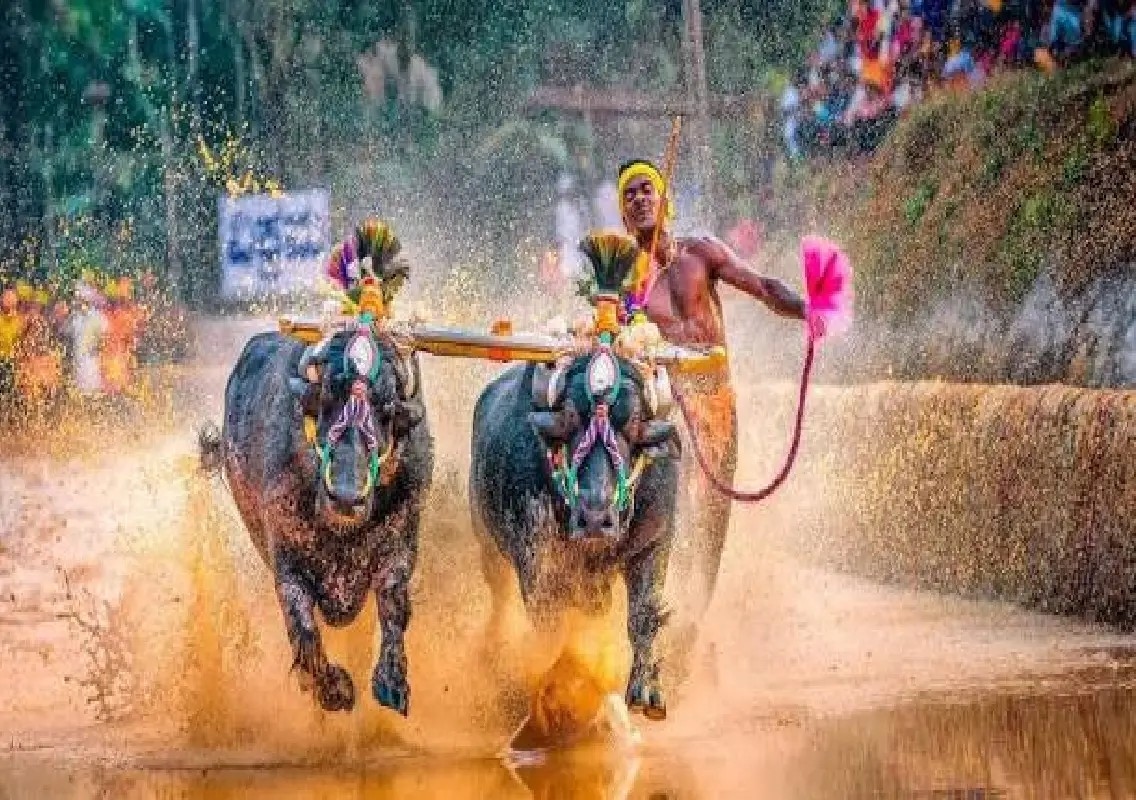


Mysuru: The Karnataka government’s proposal to include Kambala, the traditional buffalo race of coastal Karnataka, in this year’s Mysuru Dasara celebrations has sparked a debate, with supporters describing it as an opportunity to showcase the State’s cultural heritage while opponents question its relevance, environmental impact and cost amid drought-like conditions.
Preparations for the inaugural Mysuru Kambala are already under way, even as environmental groups, farmers’ organisations and several local stakeholders continue to oppose the move.
Government begins preparations
The State government has initiated preparations for the event, with a 17-acre site at Sathagalli in Mysuru identified as the proposed venue.
The organising committee, headed by Puttur MLA Ashok Kumar Rai, has begun planning the construction of a slush track, spectator galleries and other facilities required for the buffalo race.
The Kambala is expected to be held on October 18 and 19 as part of the Mysuru Dasara festivities.
Coastal stakeholders extend support
Stakeholders from coastal Karnataka have welcomed the proposal.
At a meeting held in Moodbidri on July 19, buffalo owners, jockeys, referees, helpers and organisers agreed to participate in the Mysuru event.
Karnataka State Kambala Association president Belapu Deviprasad Shetty said the participants had expressed their willingness to take part in the inaugural event.
Association general secretary N. Vijayakumar Kanginamane said Mysuru Dasara would provide an ideal platform to introduce Kambala to people unfamiliar with the traditional sport.
He noted that Kambala is among Karnataka’s oldest folk traditions and deserves wider recognition across the State and beyond.
Around 100 buffaloes expected
According to Muralidhara Rai, a member of the Mysuru Kambala Organising Committee, nearly 100 buffaloes are expected to participate.
Each buffalo pair is likely to be accompanied by 15 to 20 support staff, including handlers and assistants.
He argued that the inclusion of Kambala in Mysuru Dasara would expose domestic and international visitors to a unique cultural tradition from coastal Karnataka.
With Mysuru Dasara attracting lakhs of visitors every year, organisers believe the event could significantly boost tourism.
Muralidhara Rai pointed out that a Kambala event held in Bengaluru in 2023 reportedly attracted nearly 10 lakh spectators, demonstrating the sport’s popularity.
He also contended that the expenditure on organising the event would be outweighed by increased tourism and economic activity.
Experts distinguish traditional and competitive Kambala
Experts have noted that there are two broad forms of Kambala.
Devara Kambalas are ritualistic events closely linked to local traditions, temples and agricultural practices.
In contrast, most modern Kambala events have evolved into competitive sporting events with prize money and are generally conducted on specially prepared artificial slush tracks rather than traditional paddy fields.
For the 2026–27 Kambala season, about 27 events are scheduled across coastal Karnataka, with nearly 20 expected to be held on artificial tracks.
Supporters argue that the Mysuru event falls within this competitive sporting category and therefore does not alter the traditional religious significance of Devara Kambalas.
Opposition continues to grow
Despite the preparations, opposition to the proposal has intensified.
Mysuru MP Yaduveer Krishnadatta Chamaraja Wadiyar, several local organisations, environmental activists and farmers’ groups have urged the government to reconsider its decision.
Those opposing the move argue that Kambala is deeply rooted in the culture and traditions of coastal Karnataka and is not historically associated with Mysuru Dasara.
Critics have also questioned whether a region-specific cultural event should be incorporated into Mysuru’s centuries-old Dasara celebrations.
Concerns over drought and environmental impact
Another major point of contention is the use of water and public funds during a year marked by deficient monsoon and drought-like conditions in several parts of Karnataka.
Opponents argue that organising a slush-track buffalo race would require substantial quantities of water at a time when many districts are facing water scarcity.
Puttur MLA Ashok Kumar Rai has indicated that the event is expected to cost between Rs 5 crore and Rs 8 crore, with the State government likely to allocate a special budget for its organisation.
Environmental groups have questioned whether such expenditure is justified under the prevailing circumstances.
Allegations of tree felling
Members of the Joint Action Committee (JAC), formed to oppose the event, have also raised environmental concerns regarding the proposed venue.
Parashurame Gowda of Parisarakkagi Naavu, Mysuru, alleged that around 36 trees had been illegally felled and that additional trees had been identified for removal to prepare the site.
He noted that the Forest Department has already registered an FIR over the alleged illegal felling of trees.
The JAC has warned that it will continue its campaign against the project and has indicated that protests similar to the historic Appiko movement could be launched if further tree felling takes place.
Debate likely to continue
The proposed inclusion of Kambala has emerged as one of the most debated aspects of this year’s Mysuru Dasara celebrations.
Supporters view it as an opportunity to showcase Karnataka’s diverse cultural heritage before a global audience, while critics believe the event is environmentally unsustainable and inconsistent with Mysuru’s traditional Dasara identity.
With preparations progressing and opposition continuing, the debate over Mysuru Kambala is expected to remain a key issue in the lead-up to the State festival.