


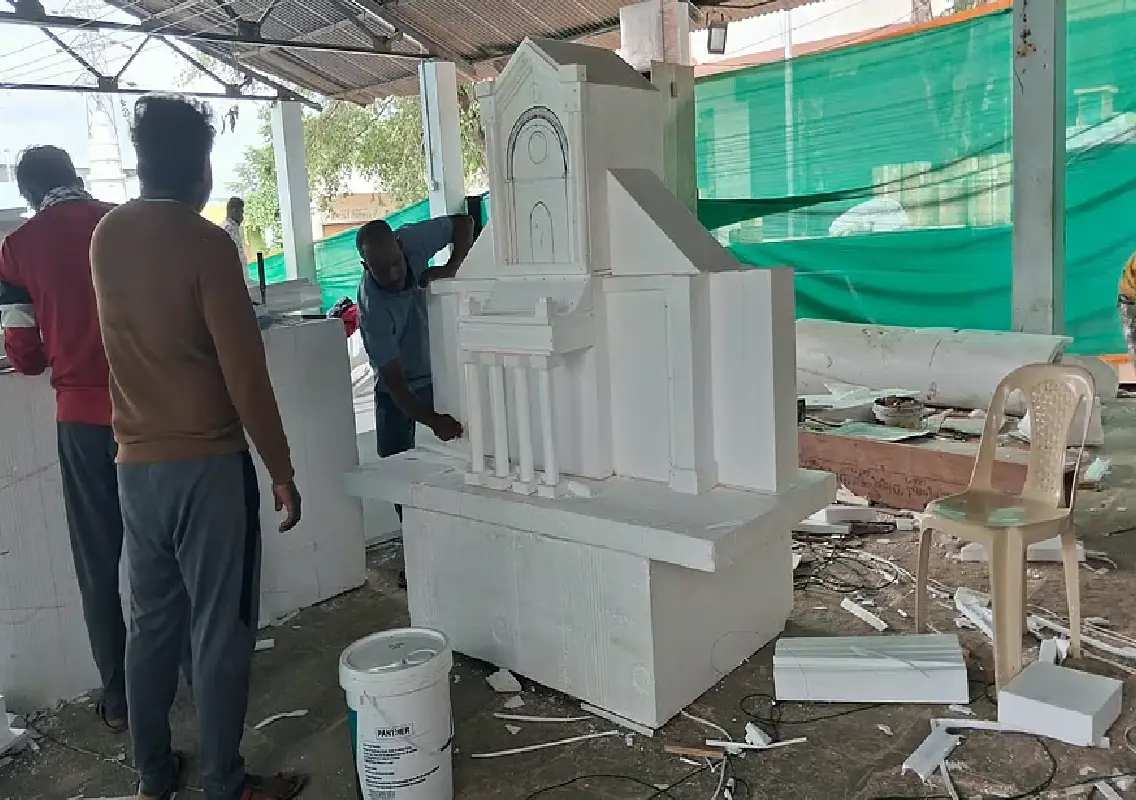


Mysuru: Artists preparing tableaux for the Mysuru Dasara Jamboo Savari procession have raised concerns over inadequate toilets, lack of bathing facilities, unsafe working conditions and the absence of proper accommodation at the APMC yard in Bandipalya, on the outskirts of the city.
With 53 tableaux scheduled to participate in the grand procession on October 21, the artists say more than 1,000 people are working under difficult conditions to complete the displays before the deadline. They have urged the district administration to provide basic amenities and safer working arrangements.
Over 1,000 artists struggle without basic amenities
Artists said only four toilet units were available for more than 1,000 people working on the tableaux, while there was no proper place to bathe or rest.
“At least 15 to 25 artists are burning the midnight oil, working day and night to get each tableau ready by October 20. But we do not even have a proper place to rest. We are sleeping amid dust, waste, paint and craft materials,” an artist said.
The workers said they were required to complete elaborate structures within a tight schedule, often working through the night. However, the designated work area reportedly lacked adequate facilities for those staying there throughout the preparation period.
Artists also expressed concern over the absence of proper shelters to protect the tableaux, equipment and materials from rain. Since they work and keep their supplies in open sheds, they said they faced difficulties in securing their belongings and ensuring their safety.
The tableaux are expected to be among the major attractions of the Jamboo Savari procession, which draws large crowds to Mysuru every year. Artists said the conditions under which the displays are being prepared do not reflect the importance attached to the festival.
No ambulance or fire tender at worksite
The artists also flagged the absence of emergency medical and firefighting facilities at the APMC yard.
One artist said there was no ambulance available to provide immediate medical assistance if a worker sustained an injury, fell ill or suffered health problems after inadequate rest and meals obtained from outside.
The lack of a fire tender was another major concern, particularly because the tableaux involve materials that can catch fire.
Artists said they use combustible materials such as thermocol, along with paints and thinners containing petroleum-based substances. They warned that an accidental fire could pose a serious risk to workers, structures and stored materials if emergency services were not readily available.
The workers claimed they had raised complaints and appealed to the authorities in previous years but continued to face similar difficulties.
“Despite appealing to the authorities and raising complaints every year, we are not provided even basic facilities by the district administration,” another artist alleged.
Officials and vendors differ over responsibility
An officer in charge of the Dasara tableaux said the administration provides financial assistance of at least Rs 25 lakh for each tableau and expects the vendors undertaking the work to arrange accommodation and facilities for their artists.
However, the officer said arrangements would be made for toilets.
A vendor involved in the tableau work said the artists could not easily be accommodated elsewhere because of the demanding preparation schedule and the need to complete the structures at the designated location.
“We received the work order just 15 days ago. Since artists are working day and night to get the tableaux ready within the deadline, they cannot be accommodated elsewhere,” the vendor said.
The vendor pointed out that tableaux could not simply be prepared at another location and shifted to the designated yard, given the nature and scale of the work.
The vendor urged the authorities to establish temporary shelters using German tents in an open ground and provide basic toilet facilities. Such arrangements, the vendor said, could offer artists a safer place to stay and work until the procession.
The vendor also suggested that the cost of accommodation could be deducted from the payment due for the tableau work, if necessary.
In addition to the concerns over working conditions, the vendor said artists were not even provided passes to watch the procession in which their creations feature.
Activist calls for a permanent ‘Kala Grama’
Activist Ravi Bale called on the district administration to recognise the contribution of artists and provide facilities that meet their basic needs.
He said the administration should ensure that people responsible for creating the tableaux and presenting folk performances during Dasara are not left to manage without adequate accommodation and sanitation.
Bale cited the expenditure on major festival events, arguing that the administration should also make arrangements for the welfare of artists. He referred to the reported Rs 50-crore Dasara expenditure and the Rs 10-crore allocation for Kambala, and called for a dedicated space for artists.
He proposed establishing a ‘Kala Grama’ in Mysuru, which could serve as a permanent facility for tableau artists and folk performers participating in the Dasara procession.
According to Bale, the proposed space could include accommodation and work facilities for artists during the festival. During the rest of the year, it could host art workshops, cultural programmes and exhibitions.
He also suggested establishing museums at the site to document and showcase traditional art forms and cultural practices.
The proposal, he said, would provide a lasting solution to recurring accommodation and infrastructure problems while strengthening Mysuru’s identity as Karnataka’s cultural capital.
Expert highlights toilet requirements
D C Nanjunda, Deputy Director of the Centre for the Study of Social Exclusion and Inclusive Policy at the University of Mysore, highlighted the toilet provisions cited under the Swachh Bharat Mission programme.
He said the norms stipulate one toilet seat for every 50 female users, one for every 100 male users and one urinal unit for every 20 to 25 male users.
The figures underline the concerns raised by the artists over the availability of sanitation facilities at the worksite, where more than 1,000 people are reportedly engaged in preparing the tableaux.
With preparations continuing ahead of the October 21 procession, the artists’ concerns have drawn attention to the working conditions behind one of Mysuru Dasara’s prominent attractions. Their demands include adequate toilets, bathing facilities, sheltered accommodation, medical assistance and fire safety arrangements.
The proposed ‘Kala Grama’ could offer a longer-term approach to the issue, while immediate measures at the Bandipalya yard would address the difficulties faced by artists working against the festival deadline.