







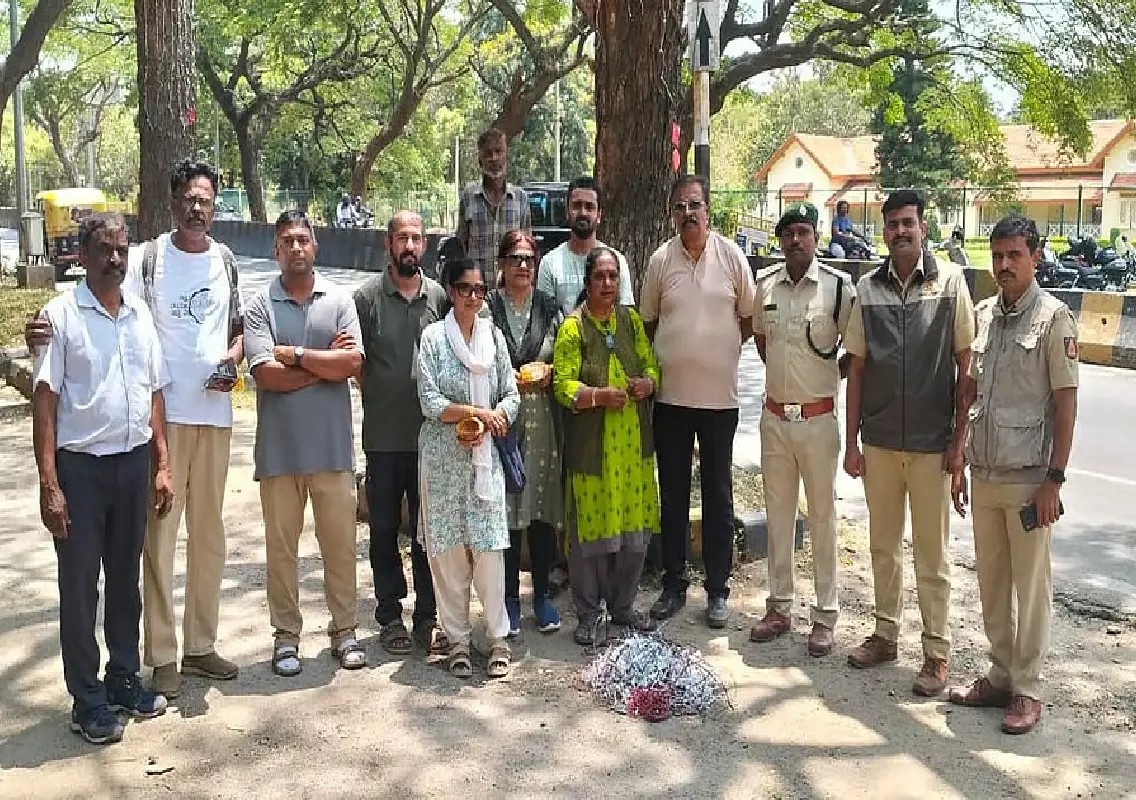


Mysuru: Environmentalists in Mysuru have launched a campaign to prevent trees from being used for Dasara illumination, after contractors working for Chamundeshwari Electricity Supply Corporation (CESC) reportedly fixed wires to trees at several locations in the city.
Members of various environmental organisations entered the field with tools and removed nails inserted into trees to secure illumination wires. They also applied a paste of turmeric and neem over the holes, saying the measure would help protect the affected trees.
The campaign comes despite efforts by the forest department and Mysuru City Corporation (MCC) to prevent the use of trees for festive lighting.
Wires removed from trees
Deputy Conservator of Forests (DCF) K Paramesha reportedly directed his team to act after wires were found wrapped around trees. CESC officials and contractors were summoned, following which the wires were removed and seized.
The action was taken with reference to the Karnataka Preservation of Trees Act, 1976, and guidelines issued by the National Green Tribunal (NGT).
Members of the Mysore Grahakara Parishat (MGP) had earlier submitted a representation to the authorities seeking measures to prevent trees from being used for Dasara illumination. The DCF and MCC Commissioner had also written to CESC regarding the issue.
Despite these directions, contractors reportedly wrapped wires around trees at a few locations on a trial basis. These included trees in front of the Maharaja College ground, six trees along Lalitha Mahal Road and seven trees on Chamaraja Double Road.
Environmentalists subsequently began removing the nails and wires from the affected trees.
Environmental groups join campaign
The campaign was led by members of the Mysore Grahakara Parishat and Parisarakkaagi Naavu, including Shylajesh, Banu Prashanth, Banu Mohan, Leela Shivakumar, Ganesh, Arun, Madhushree and Paramesh, among others.
Shylajesh said the campaign was intended to ensure that not even one tree is used for Dasara illumination.
He argued that Mysuru’s green character needs to be protected, particularly as the city is known for its heritage landscape and tree cover.
“On one hand, we are slowly losing the green charm of heritage city Mysuru,” Shylajesh said.
He also referred to trees planted during the period of Maharaja Nalwadi Krishnaraja Wadiyar and said environmental concerns should be considered while planning celebrations and infrastructure projects.
According to him, environmental groups have discussed the issue with other organisations in Mysuru and are prepared to continue the campaign if trees are used for illumination.
The group has suggested that CESC and the Dasara authorities use alternative structures such as poles for installing illumination wires.
CESC promises fewer trees and low-voltage LEDs
CESC officials said steps would be taken to ensure that trees are not nailed for illumination.
The electricity utility also said it had shifted towards low-voltage LED bulbs, which have reduced electricity consumption and heat generation compared with earlier lighting arrangements.
Officials said the plan this year would involve using fewer trees on fewer roads, while ensuring that nails are not driven into trees. They said wires would be wrapped around tree stems where required, rather than branches.
The assurances come amid growing concern among environmental groups over the use of trees as temporary supports for festive lighting.
Environmentalists, however, have maintained that even wrapping wires around tree trunks should be avoided where alternative arrangements are available.
Activists highlight impact on trees
Banu Mohan, Leela Shivakumar and Madhushree said their concern extended beyond the physical damage caused by nails.
They claimed that nuts and bolts had also been inserted into some trees and argued that trees should be treated as living organisms rather than convenient supports for temporary infrastructure.
The activists also linked the issue to the wider environmental concerns facing Mysuru, including rising temperatures and changing rainfall patterns.
“We are not against the Government or Dasara, but we only want our environment to be protected,” they said.
They suggested that illumination could instead be concentrated around suitable public spaces, including areas around the Palace, while avoiding the use of trees.
The activists also pointed to the potential for large-scale lighting installations to contribute to traffic congestion and pollution and urged residents to support efforts to protect the city’s green spaces.
Call for alternatives to tree-based illumination
The environmentalists have called for the use of poles and other purpose-built structures to support electrical wires and decorative lighting.
Such alternatives, they said, would allow Dasara illumination to continue without causing physical damage to trees.
The campaigners have also urged the authorities to involve environmental organisations and civic groups in discussions related to Dasara arrangements.
Pro-Kannada activist Paramesh said environmentalists and representatives of various organisations should be included in Dasara Committee meetings when decisions affecting the city’s heritage and environment are taken.
He questioned the practice of using trees for illumination at a time when environmental concerns are receiving greater attention.
He also raised concerns about other activities associated with celebrations that may affect trees and the environment.
Experts and activists seek stronger enforcement
The issue has brought together civic activists, environmental groups and government agencies, with the forest department already taking action against the use of trees for illumination.
The removal and seizure of wires reportedly placed on trees has sent a message to contractors that existing regulations will be enforced.
For the environmental groups, however, the immediate campaign is only the beginning. Shylajesh said members were prepared to return to the field if contractors again used trees for illumination.
The activists want Dasara lighting to be planned in a manner that preserves Mysuru’s green character while allowing the city’s major festival to retain its traditional visual appeal.
With Dasara preparations gathering pace, the coming days are likely to see increased installation of decorative lighting across the city. The challenge for authorities will be to ensure that the arrangements comply with tree-protection regulations and that contractors use designated structures rather than trees.
The campaigners have made it clear that their objection is to the use of trees for illumination and not to the Dasara celebrations themselves. They have urged authorities to adopt alternatives and ensure that festive arrangements do not come at the cost of Mysuru’s trees.