







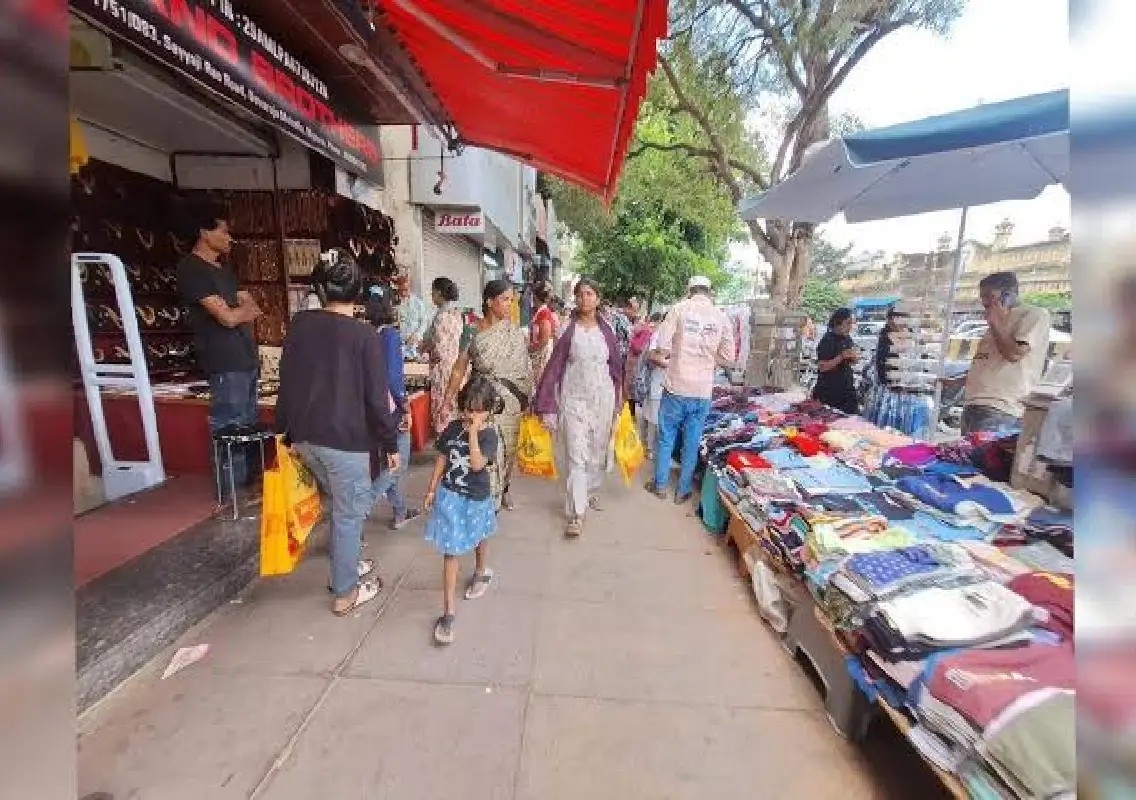


Mysuru: The Mysuru City Corporation’s (MCC) recent drive against footpath encroachments appears to have had only a temporary impact, with vendors reportedly returning to pedestrian spaces at several locations across the city.
The enforcement action had initially been welcomed by residents as an important step towards restoring footpaths for pedestrians. However, the return of vendors has raised concerns about the effectiveness and sustainability of the civic body’s action.
Vendors return to footpaths
Residents said the enforcement drive was largely concentrated in the central parts of the city, while several footpaths in other areas continue to remain encroached.
In the past few days, vendors have reportedly returned to footpaths at multiple locations, including parts of the Central Business District (CBD), shortly after the eviction drive.
Residents claim that the encroachments are particularly problematic around Devaraja Market, where traffic congestion is already a major concern. Vendors are allegedly occupying both footpaths and portions of the road, leaving limited space for pedestrians and vehicles.
“It is tough even to enter Devaraja Market,” said Sarojini M, a resident of Agrahara.
She said the entire area had been affected by encroachments and urged the MCC to take sustained action.
Devaraja Market area faces congestion
Residents have called for the clearance of encroachments around Devaraja Market, Chamaraja Double Road and the road connecting the Suburban Bus Stand.
According to them, removing obstructions from these stretches could significantly improve both vehicular traffic and pedestrian movement in the CBD.
Civic activist Raghu Gowda alleged that some vendors were operating without fear of enforcement action.
The concerns come amid broader complaints about the availability of pedestrian infrastructure in Mysuru. Footpaths are intended to provide safe walking space, but their occupation by vendors and other commercial activities often forces pedestrians to walk on busy roads.
Street vendors’ association offers another perspective
However, Bhaskar Shrinivasa Raje Urs, vice-president (South) of the National Association of Street Vendors of India (NASVI), presented a different perspective.
He said vendors who have been issued identity cards and registered with the MCC are following the prescribed guidelines.
According to him, the problem is largely associated with vendors from other states who allegedly occupy footpaths illegally.
He also urged the authorities to make dedicated arrangements for street vendors during Dasara so that they do not face difficulties during the festival period.
He referred to the difficulties faced by vendors during events such as the Open Street Festival and called for better planning and designated spaces.
Residents seek action beyond CBD
The concerns are not limited to the central business areas.
Dattagalli resident Ravi Kirthi Gowda said footpath encroachments were widespread in urban pockets across Mysuru, but enforcement remained limited.
“If you visit the urban pockets around the city, there is no end to this menace. Footpaths have been encroached upon extensively, but there is hardly any action,” he said.
Residents have called for the MCC to adopt a sustained approach rather than conducting occasional eviction drives. They say regular monitoring and enforcement would be necessary to prevent vendors and other establishments from returning to cleared footpaths.
At the same time, the street vendors’ association has sought designated vending areas and proper arrangements during major events. Such measures could help balance the livelihood concerns of vendors with the need to keep pedestrian spaces clear.
The renewed encroachments have therefore brought the focus back on the need for a long-term solution, combining consistent enforcement with proper vending zones and better urban planning.