







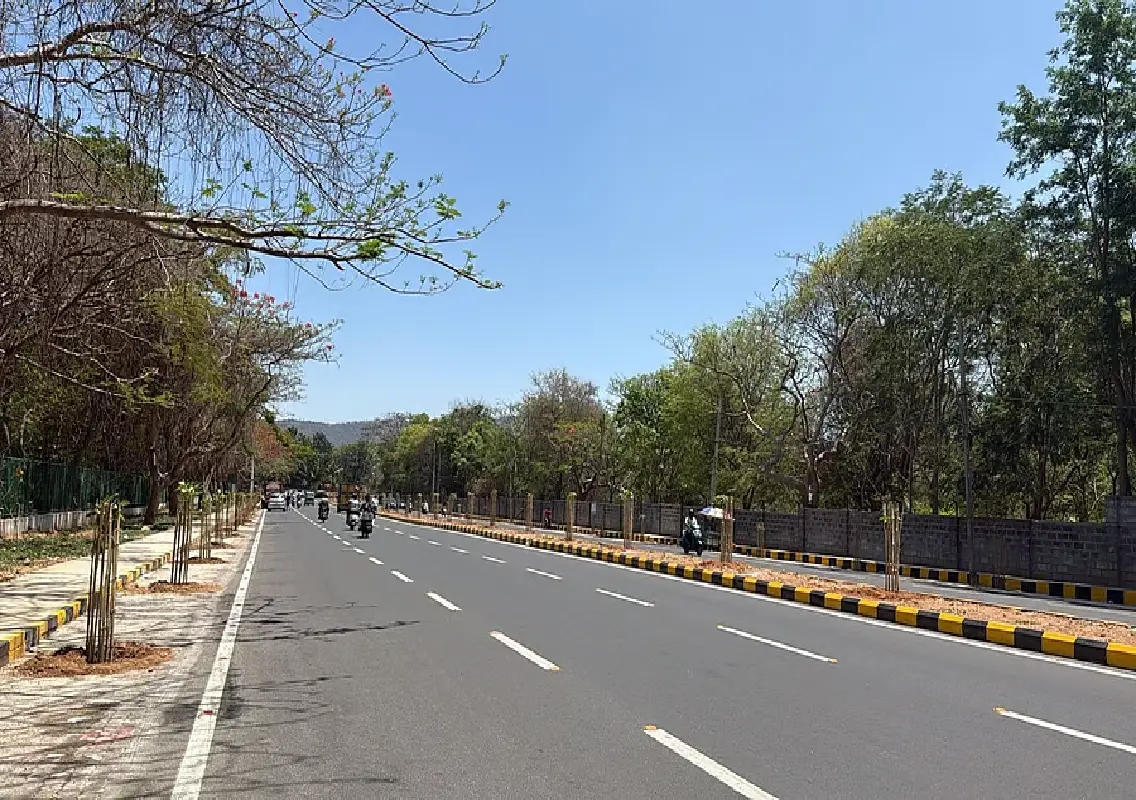


Mysuru: Exactly a year after 40 fully grown Peltophorum trees were felled for road widening, Mysuru City Corporation (MCC) has planted 122 Tabebuia Rosea saplings along the widened Hyder Ali Road. The plantation drive, carried out on April 9, aims to restore greenery and enhance the aesthetic appeal of the stretch.
The trees had been cut on April 13, 2025, during the widening of Hyder Ali Road from SP Office Circle to Sri Kalikamba Temple, sparking widespread public criticism at the time.
Saplings planted across key stretches
According to MCC officials, the 122 saplings have been planted strategically across the road. Of these, 40 saplings are along the compound wall of the Karnataka Police Academy, 50 on the road median, and 32 towards the SP Office side.
In addition, authorities plan to plant around 1,000 Bougainvillea seedlings along the median once electrification work is completed.
P K Mohan Kumar said the initiative was undertaken to beautify the road as per the directions of MCC Commissioner Shaikh Tanveer Asif.
Aim to create a ‘pink road’
Officials stated that the saplings, already about six to seven feet tall, are expected to grow and bloom into pink flowers within three to four years. Once matured, the stretch is envisioned as a “pink road,” adding to Mysuru’s visual appeal.
To ensure proper maintenance, the MCC has arranged water tankers to regularly irrigate the saplings, especially during the summer months. Tree guards for protection have been provided by Raghu Lal Medicals.
Road widening project details
Manjunath explained that the road widening project expanded the stretch from 11 metres to 30 metres, including a 2.5-metre-wide median, over a length of 360 metres. The project was completed at a cost of Rs 3.8 crore.
The road will be formally inaugurated after the installation of ornamental poles with LED lighting along the median.
The project was undertaken using SST grant funds from Narasimharaja constituency MLA Tanveer Sait.
Tree felling had triggered protests
The earlier felling of 40 mature trees had drawn significant backlash from environmentalists and the public. The Forest Department had granted permission under the Karnataka Preservation of Trees Act, 1976, citing the need to ease traffic congestion.
As part of compensatory measures, the MCC paid Rs 7.5 lakh to the Forest Department, adhering to the 1:10 rule — planting 10 trees for every tree cut.
However, activists argued that the ecological value of mature trees could not be replaced by saplings. Protests, including candlelight vigils, were organised by environmental groups.
Prominent voices such as Parashuramegowda and Bhamy V Shenoy had strongly opposed the move, highlighting the loss of habitat for birds and other species.
Balancing development and environment
The plantation of 122 saplings marks an attempt by civic authorities to address public concerns and restore greenery along the upgraded road. However, debates continue over the balance between infrastructure development and environmental conservation.
Conclusion
While the newly planted Tabebuia Rosea saplings promise to transform Hyder Ali Road into a vibrant, flower-lined avenue in the coming years, the episode underscores the challenges urban authorities face in reconciling development needs with ecological preservation.