







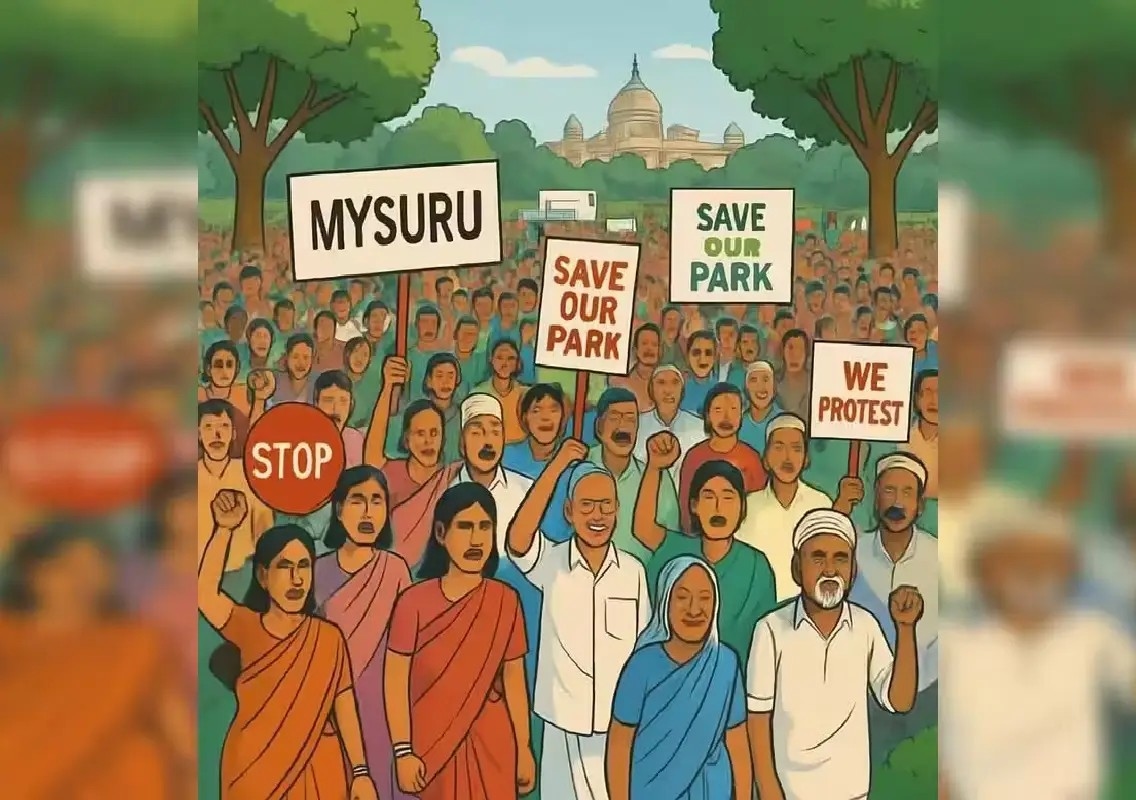


Mysuru: Hundreds of residents staged a protest at Cheluvamba Park on Saturday opposing the proposed amendment to the Government Parks (Preservation) Act, 1975, which would allow up to 5% of park and garden land to be used for public infrastructure and utility projects.
The protest was led by Krishnaraja MLA T S Srivatsa, MLC R Raghu, former MP Pratap Simmha, Mysuru Grahakara Vedike founding working president Bhamy V Shenoy, working president S K Dinesh and others.
The protesters demanded that the state government withdraw the proposed amendment, arguing that public parks and gardens need stronger protection rather than provisions that could permit portions of such spaces to be used for infrastructure projects.
Protesters demand withdrawal of proposed amendment
Residents gathered at Cheluvamba Park carrying out a demonstration against the proposed changes to the parks preservation law.
The protesters said allowing even a limited portion of park and garden land to be utilised for public infrastructure and utility projects could create scope for the gradual reduction of green spaces in urban areas.
They urged the state government to reconsider the proposal and withdraw the amendment.
Later, a group of young protesters took out a silent march around the park. Through the demonstration, they appealed to the government to protect existing parks and ensure that public green spaces remain available for future generations.
The protesters also appealed to the Governor not to give his assent to the Bill.
Leaders question government’s intention
Addressing the gathering, protesters criticised the state government and questioned the intention behind the proposed amendment.
They specifically questioned Chief Minister D K Shivakumar, asking whether the government viewed itself as the custodian or proprietor of the state.
“Are you the custodian or the proprietor of this state? You are not behaving like a custodian. You are behaving like a proprietor,” the agitators said.
They argued that public land and green spaces belong to the people and that the government has a responsibility to preserve them.
The protesters maintained that development and infrastructure requirements should not come at the cost of existing public parks and gardens.
Bengaluru lakes cited as warning
During the protest, the agitators referred to the condition of Bengaluru’s lakes to underline their concerns about the proposed amendment.
They said Bengaluru once had more than 1,000 lakes, many of which have subsequently been affected by encroachments.
They also alleged that raja kaluves, or stormwater drains, have been encroached upon in several parts of the city.
“Raja Kaluves have also been encroached upon. Now, you are targeting parks,” they alleged.
The protesters said the experience of lakes and stormwater drains should serve as a warning against allowing further use of protected public spaces for other purposes.
Young residents join silent march
The participation of young residents added momentum to the demonstration. Following the main protest, the young agitators conducted a silent march around Cheluvamba Park.
The march highlighted concerns about the long-term availability of green spaces in cities and the importance of preserving parks as public assets.
Residents argued that urban parks play an important role in providing open spaces for recreation, walking and community activities, apart from contributing to the city’s environmental health.
They called for greater public consultation before any amendment affecting protected park and garden land is implemented.
Demand for protection of green spaces
The proposed amendment has triggered concern among sections of residents who fear that provisions allowing a portion of park land to be used for infrastructure could eventually put additional pressure on urban green spaces.
The protesters at Cheluvamba Park maintained that public infrastructure can be planned without compromising established parks and gardens.
They urged elected representatives and authorities to consider alternative locations wherever infrastructure and utility projects are proposed.
The protest concluded with renewed appeals to the state government to withdraw the proposed amendment and to the Governor to withhold assent to the Bill.
The agitation reflects growing concern among residents over the balance between urban development and preservation of public green spaces. Protesters said parks should be treated as community assets and protected accordingly.