







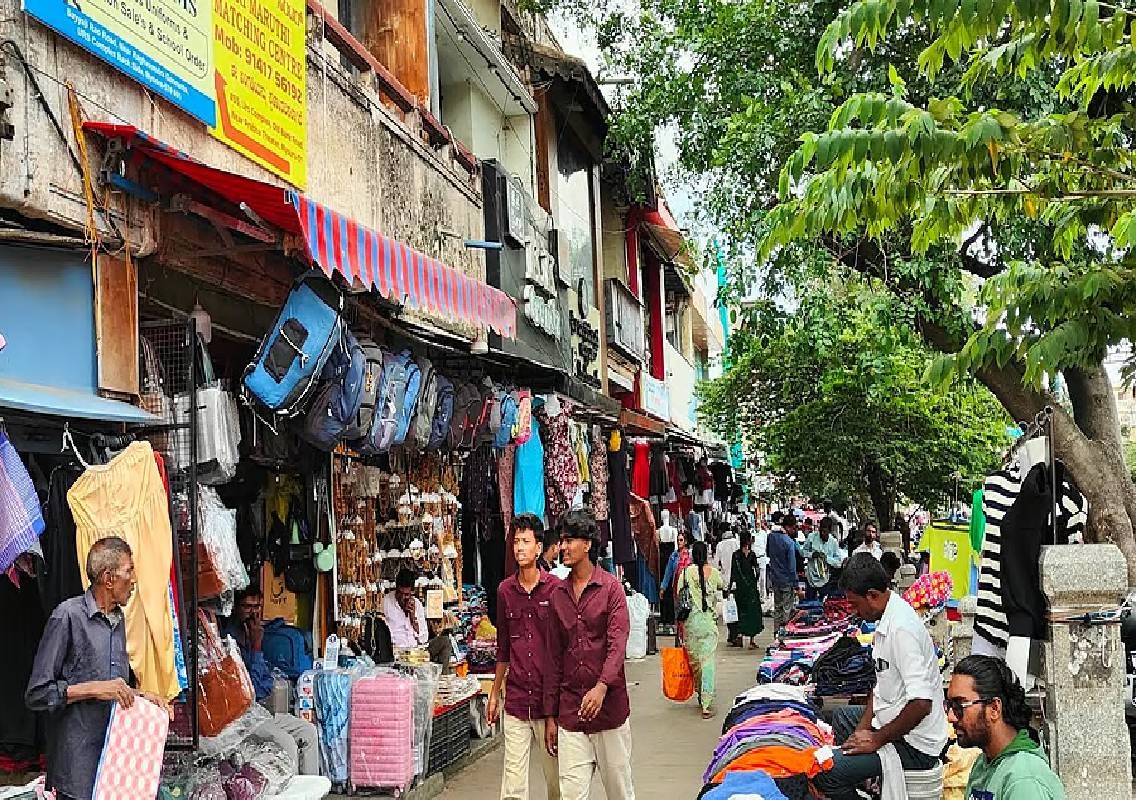


Mysuru: Street vendors who were evicted from key parts of the city have returned to business, bringing the long-running conflict between pedestrian safety, civic enforcement and vendors’ livelihoods back into focus. Vendors have been seen returning to stretches around K.R. Circle and Sayyaji Rao Road despite repeated eviction drives by the Mysuru City Corporation (MCC).
Vendors return after repeated eviction drives
The latest developments highlight the difficulty faced by civic authorities in keeping footpaths and busy roads clear when alternative vending arrangements are not effectively implemented.
MCC has been conducting drives to remove what it considers footpath encroachments. One such operation in the central business district cleared vendors from parts of the Jumboo Savari route. However, reports indicate that several vendors returned soon after the action.
The return of vendors has once again affected pedestrian movement in the area. With stalls and carts occupying portions of footpaths, pedestrians may be forced to use the road in some stretches, creating concerns about both convenience and safety.
Why do vendors keep returning?
For many street vendors, the roadside stall is their primary source of income. Removing them from a familiar location without providing a practical alternative can make it difficult for them to continue earning a livelihood.
The issue is therefore not simply one of removing encroachments. It involves balancing the right of pedestrians to use public footpaths with the livelihood concerns of people dependent on street vending.
The repeated cycle — eviction, temporary clearance and return — suggests that enforcement alone may not provide a lasting solution.
Alternative vending spaces remain important
One possible way out of the recurring conflict is to provide designated vending zones where vendors can operate without obstructing pedestrian movement.
The Street Vendors (Protection of Livelihood and Regulation of Street Vending) Act, 2014 provides a framework for regulating street vending while protecting vendors’ livelihoods. A Karnataka High Court order in August 2026 also dealt with the relocation of street vendors to identified vending zones, underlining the importance of a regulated approach rather than simply removing vendors from their existing locations.
In Mysuru, authorities have also moved towards mapping and identifying street vendors. A recent civic tender called for a comprehensive survey and digital census of vendors, including GPS/GIS mapping and preparation of a vending-zone plan under the Karnataka Street Vendors Scheme, 2020.
Pedestrian safety remains a concern
While vendors have livelihood concerns, residents and pedestrians have repeatedly raised concerns about footpath encroachments.
The central business district, including parts of the Dasara procession route, sees heavy pedestrian movement. When stalls occupy footpaths, pedestrians can be forced onto carriageways, particularly where roads are already crowded.
Earlier reports noted that vendors had returned to the Jumboo Savari route between K.R. Circle and Sayyaji Rao Road even after multiple eviction attempts. The situation has led to questions about the MCC’s ability to maintain cleared stretches once enforcement teams leave.
The issue is also not limited to street vendors. Shopkeepers placing advertisement boards and other material on footpaths can contribute to the obstruction, making enforcement more complicated.
A solution beyond repeated evictions
The recurring problem suggests that the city may need a long-term strategy rather than periodic clearance drives.
A properly conducted survey can help authorities establish the number of vendors, identify eligible vendors and determine suitable vending locations. Designated vending zones can then allow vendors to continue their businesses while keeping important pedestrian corridors free.
The Directorate of Municipal Administration’s recent tender for Mysuru specifically sought a digitised survey, geo-tagging and preparation of a GIS-based vending-zone plan. Such data could help the civic administration understand where vendors operate and plan relocation or regulation more systematically.
At the same time, enforcement will remain necessary in areas where vending is prohibited or where public safety is compromised. But consistent enforcement would need to be accompanied by clearly communicated alternatives for eligible vendors.
The larger challenge for Mysuru
The return of vendors after eviction reflects a larger urban governance challenge faced by Mysuru and several other cities. Public spaces have to accommodate pedestrians, businesses, vendors, traffic and other competing needs.
For vendors, returning to a busy commercial location may be essential for access to customers. For the civic administration, allowing businesses to occupy footpaths can undermine efforts to create safer and more accessible public spaces.
Finding a balance between these competing interests will require coordination between the MCC, street-vendor representatives and other authorities.
Conclusion
The repeated return of street vendors after eviction shows that clearing footpaths without addressing the underlying livelihood issue may offer only a temporary solution. Mysuru’s proposed vendor survey and vending-zone planning could provide a more sustainable approach, allowing authorities to protect pedestrian spaces while ensuring that eligible vendors have regulated places to earn their livelihood.