







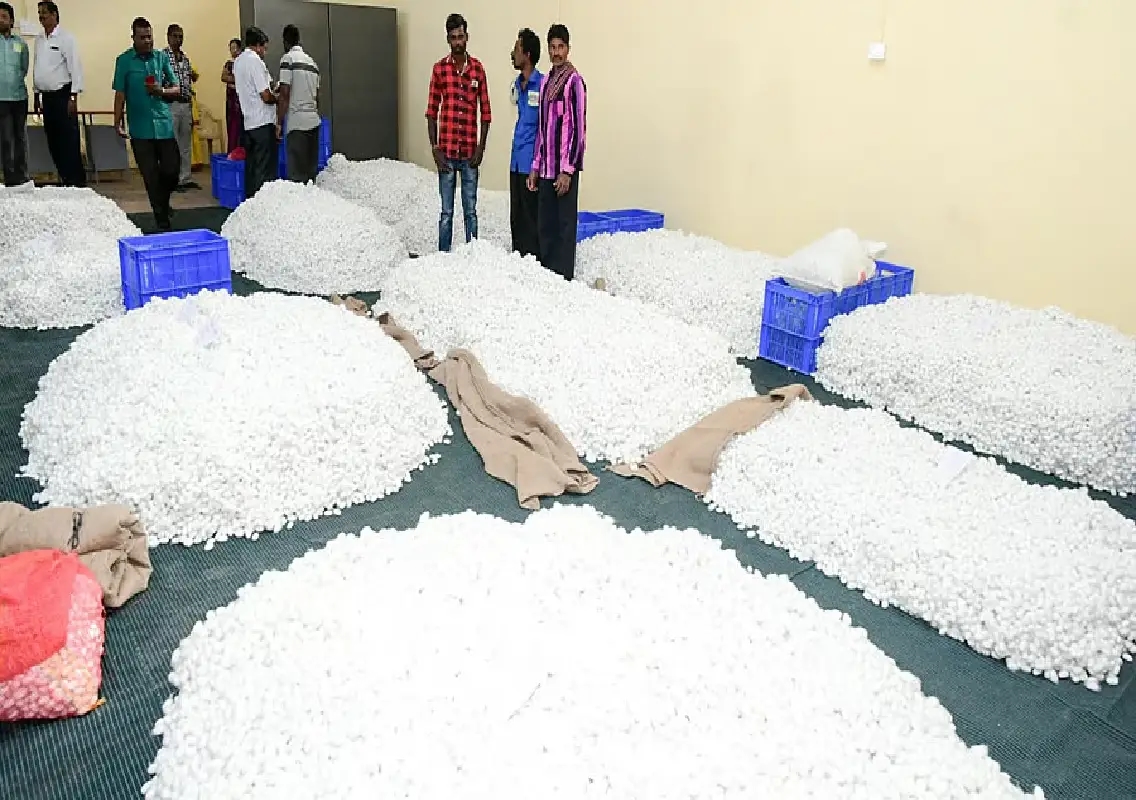


Mysuru: Mysuru is set to get a new hi-tech silk cocoon market, with the Karnataka government approving the project and sanctioning Rs 20 crore in the recent Cabinet meeting. The proposed facility, aimed at strengthening the sericulture economy in the region, will be developed on a two-acre site identified near Hosahundi, behind Bandipalya.
Officials from the Department of Sericulture said preliminary processes have begun and construction is expected to start in the coming months once the Detailed Project Report (DPR) receives final approval. The new integrated market complex is expected to significantly enhance auction capacity, farmer convenience, and digital transparency in cocoon trading.
Existing market facing space constraints
At present, the government cocoon market functions from a rented building inside the Agricultural Produce Marketing Committee (APMC) yard at Bandipalya. Established in 2019, the market supports sericulturists by enabling open auction of silk cocoons, including both bivoltine and multivoltine varieties.
However, the current facility operates largely as an open hall and faces severe space constraints. Farmers from Mysuru, Mandya, and Chamarajanagar districts bring their produce here for auction, often leading to congestion during peak arrival days.
Reelers — buyers who process cocoons into silk yarn — also gather at the same location for bidding, resulting in overcrowding and operational difficulty. Department officials say the limited infrastructure restricts both handling efficiency and daily trading volume.
Government approval and land identified
The proposal for a modern cocoon market received formal approval from the Karnataka government during a recent Cabinet meeting, with Rs 20 crore sanctioned for the project.
Sericulture department nodal officer for Mysuru and Chamarajanagar districts, Rachappa, who also serves as Joint Director, said the department has already identified two acres of land near Hosahundi, behind Bandipalya, for the facility.
He said the Sericulture Minister K. Venkatesh has shown active interest in pushing the project forward. The DPR has been submitted to the government and is currently awaiting technical and administrative clearance.
Once approved, tendering and ground works are expected to begin within a few months.
Budget announcement and NABARD linkage
The new cocoon market project was earlier announced by Chief Minister Siddaramaiah in the state budget, with a plan to establish the facility in association with NABARD support mechanisms.
Following the announcement, the Department of Sericulture prepared and submitted a formal proposal. A high-level meeting chaired by the Sericulture Minister reviewed the plan, after which land allocation was finalised for the construction.
Officials said the new market is designed not just as a trading hall but as a full-service cocoon commerce centre with modern amenities.
Hi-tech facilities planned
According to Sericulture Joint Director B.R. Prathibha, the proposed hi-tech cocoon market will include multiple dedicated facilities to improve efficiency and user comfort.
Key features planned include:
- A large, covered auction and storage hall for cocoon lots
- Segregated rest rooms for women farmers and reelers
- Canteen and basic food facilities
- Security room and controlled entry points
- Dedicated police outpost
- Structured unloading and lot display zones
- Digital auction infrastructure
The new complex will be designed to handle higher volumes with better logistics flow and hygiene standards compared to the present setup.
Higher trading capacity expected
Currently, the Bandipalya cocoon market handles around 2,000 to 3,000 kg of cocoons per day. On average, 25 to 50 farmers and reelers participate in the daily auction process.
Most reelers visiting the Mysuru market come from Kollegal, Malavalli, and Mandya silk clusters. Officials note that stronger buyer participation usually leads to better price discovery for farmers.
With the new hi-tech market, the department expects daily trading capacity to rise to around 10 to 12 tonnes of cocoons — nearly four times the present handling volume.
The cocoon market already operates with e-bidding, e-transaction, and e-payment systems, ensuring transparent price discovery without manual interference. After auctions conclude — usually by noon — farmers receive payments directly in their bank accounts within a few hours through digital transfer.
Boost to local sericulture sector
Sericulture remains an important rural livelihood sector in the district. More than 2,500 people are directly involved in sericulture activities in Mysuru district alone. Mulberry cultivation — essential for silkworm rearing — is spread across roughly 3,000 to 4,000 hectares in the region.
Officials believe that a modern, high-capacity cocoon market will improve farmer earnings, reduce post-harvest stress, and attract more organised buyers.
Conclusion
With Rs 20 crore sanctioned and land identified, the proposed hi-tech cocoon market near Bandipalya is expected to become a major infrastructure boost for the silk economy of southern Karnataka. Once operational, it will expand trading capacity, improve farmer facilities, and strengthen transparent digital auction systems — positioning Mysuru as a more efficient cocoon trading hub.