







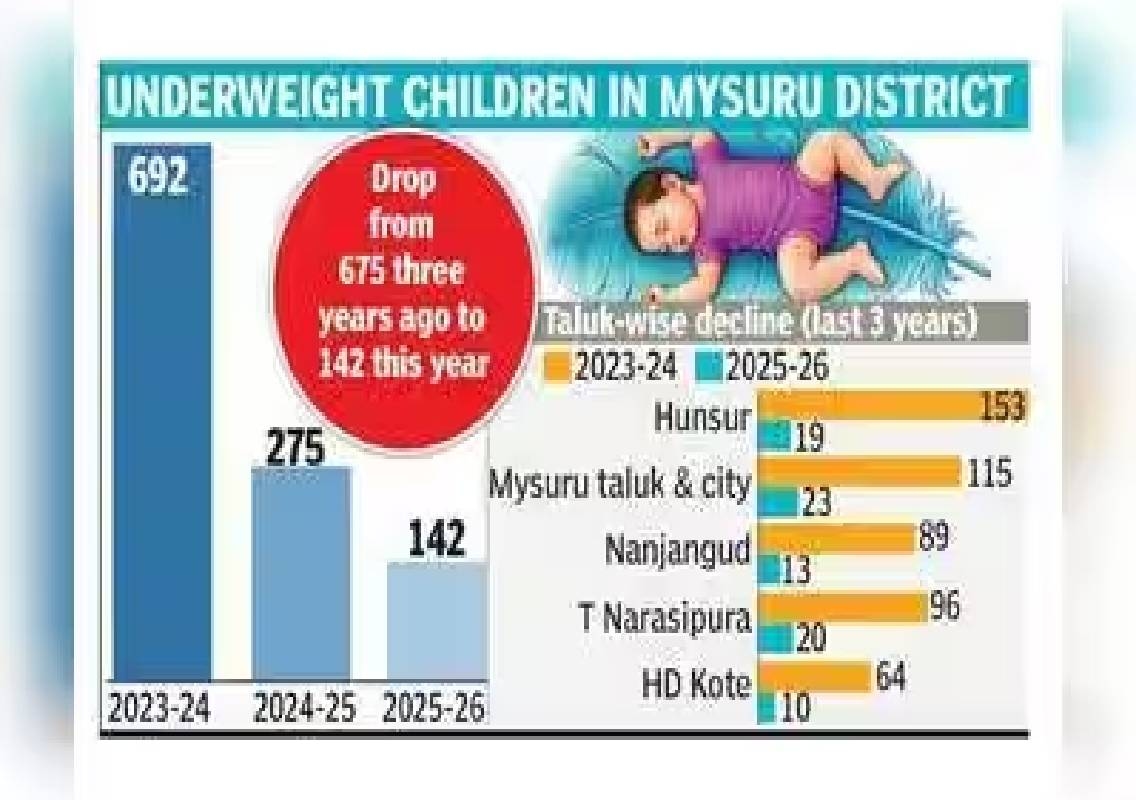


Mysuru: The number of underweight children in Mysuru district has fallen sharply to 142 in 2025-26, down from 692 in 2023-24, according to data from the Women and Child Welfare Department. The figures indicate a substantial decline in the number of children requiring special nutritional support across the district.
The number of underweight children stood at 275 in 2024-25 before falling further to 142 in 2025-26. The decline has been recorded across several taluks, including Hunsur, Nanjangud, T Narasipura and H D Kote.
According to the report, children aged between six months and six years who have low weight associated with inadequate nutrition intake and frequent childhood infections are classified as underweight or low-weight children.
Underweight children decline from 692 to 142
The year-wise figures show a consistent reduction in the number of underweight children in Mysuru district.
In 2023-24, the district recorded 692 underweight children. The number declined to 275 in 2024-25 and subsequently to 142 in 2025-26.
The latest figure represents a reduction of about 79% from the 2023-24 level.
The decline has been particularly visible in areas that had reported higher numbers of underweight children three years ago. Hunsur, which had 153 such children in 2023-24, recorded 19 in 2025-26. In Mysuru taluk and city, the number declined from 115 to 23 during the same period.
Nanjangud recorded a decline from 89 to 13, while T Narasipura saw the number fall from 96 to 20. H D Kote recorded a reduction from 64 to 10.
Hunsur records major decline
Hunsur recorded one of the largest reductions in the district, with the number of underweight children falling from 153 in 2023-24 to 19 in 2025-26.
The decline was also significant in other taluks where the number of children requiring nutritional intervention had previously been relatively high.
The current figures show 23 underweight children in Mysuru city, 23 in Nanjangud, 20 in T Narasipura and 19 in Hunsur.
K R Nagar has 13 underweight children, while H D Kote, Mysuru rural and Periyapatna have 10 each.
The figures are based on reports maintained by the Women and Child Welfare Department.
Maternal care and nutrition programmes contribute to improvement
Experts have attributed the decline to several factors, including improved maternal care, stronger health infrastructure and increased awareness about infant nutrition.
Greater awareness of exclusive breastfeeding during the first six months has also been cited as an important factor.
Nutrition kits containing items such as milk powder, eggs and nutrient-rich chakki and laddu are being provided to children requiring additional nutritional support. Vitamin A supplements and iron and zinc tablets are also part of the nutritional interventions.
Experts also pointed to measures aimed at preventing childhood diseases and sudden weight loss, along with better access to safe drinking water.
Improved antenatal care and maternal and child nutrition programmes have also been identified as contributing factors behind the reduction.
Government schemes support child nutrition
The effective implementation of government schemes has also played a role in addressing underweight and stunting among children, according to the report.
Programmes including Poshan Abhiyan, the midday meal scheme and Integrated Child Development Services (ICDS) have contributed to nutritional support and monitoring of children.
These programmes operate through a network of services aimed at supporting children, mothers and pregnant women, particularly those who require additional nutritional assistance.
The Women and Child Welfare Department is responsible for monitoring and caring for underweight children and coordinating rehabilitation and nutritional interventions.
Seven children undergoing rehabilitation
At present, seven underweight children are being rehabilitated at the Nutritional Rehabilitation Centre at Cheluvamba Centre in Mysuru.
The department has reserved 20 beds for underweight children at the Cheluvamba Centre and another five beds at the district hospital, providing dedicated capacity for children who require specialised nutritional care.
The rehabilitation facilities are intended to support children who require closer monitoring and additional nutritional intervention.
The continued availability of such facilities remains important even as the overall number of underweight children declines, particularly for children from vulnerable communities.
₹76 crore allocated annually for nutrition and maternal care
Women and Child Welfare Department deputy director Nagaraju told the Times of India that the department receives approximately ₹76 crore annually from the Union government for nutrition and maternal care.
The funds are used to provide nutritional supplements to children and pregnant women associated with Anganwadi centres throughout the year. Special financial support is also available for nutrition care for underweight children under various state and Union government schemes.
According to Nagaraju, effective implementation of government schemes, nutritional care, maternal awareness and access to safe drinking water have contributed to the reduction in the number of underweight children.
Experts stress continued monitoring
Despite the sharp reduction, experts have stressed the need for continued attention to children who remain underweight.
Retired government medical officer Sudha Doreswamy told the Times of India that underweight in childhood can be associated with developmental and long-term health consequences. She stressed the need for continued government attention to protect and rehabilitate affected children.
The remaining cases therefore continue to require nutritional monitoring, timely medical intervention and support for families.
The district’s latest figures show that the reduction has been substantial, but the presence of underweight children across multiple taluks means that nutrition programmes and maternal and child healthcare services will remain important.
Mysuru continues focus on child nutrition
The decline from 692 underweight children in 2023-24 to 142 in 2025-26 marks a significant change in the district’s recorded nutritional indicators.
The reduction has been accompanied by interventions covering maternal care, breastfeeding awareness, nutrition supplements, disease prevention, safe drinking water and rehabilitation facilities.
While the latest data points to considerable progress, continued monitoring will be necessary to ensure that children who remain underweight receive timely nutritional and medical support and that improvements are sustained across Mysuru district.